LA Sanitation’s Green Business Program empowers businesses and City departments to grow a more sustainable future.
City departments and outside businesses:
It’s time to go green.
Do you wish your City department or office, or outside venue or business were greener and more environmentally sustainable … but you don’t know where to start? And you worry about your bottom line?
The Bureau of Sanitation and Environment’s Green Business Program was set up exactly for you.
The City of Los Angeles’s Green Business Program recognizes businesses, nonprofit organizations, departments, venues and offices that meet environmental standards established by the California Green Business Network (CAGBN). Businesses enroll in this free program to save money on utilities and be part of the solution to the climate crisis. Businesses are given access to free consulting, referrals to City rebate programs, networking opportunities, and marketing perks.
It’s not just for businesses, either – City departments, Council offices, venues and facilities can get certified. Take advantage!
Program Benefits
Here are some of the benefits of working with the Green Business Program to get certified:
- Provides information about potential rebates, reducing utility costs, and other financial saving opportunities.
- Provides a certificate signed by Sanitation’s Director and General Manager.
- Offers free environmental consulting to help reduce your business’s environmental impact while demonstrating your commitment to employee health and well-being.
- Includes a listing on the CA Green Business Directory plus opportunities to be featured on Sanitation social media.
- Organizes events to network with other like-minded businesses.

Biggest Event
On Sept. 23, more than 100 people attended the Green Business Program’s first-ever Green Business Expo networking mixer, its biggest event to date. The event was held at the California Endowment.
In partnership with the California Green Business Network, Sanitation provided businesses with the tools necessary for water and electricity sustainability. This expo was the program’s next step in doing more for those who are certified green businesses and served as a kickoff for getting the word out to more businesses. With more than 300 businesses currently green businesses-certified, the Green Business Program plays a role in the greater plan for sustainability across the state of California.
Photos from the Sept. 23 business expo, as well as the Green Business Program’s welcome event in 2024, are in this story.

The Green Index: Meet the Green Business Program’s newest and most powerful tool.
LA Sanitation’s Green Business Directory helps businesses and the general public connect with businesses and City departments that have proudly gone through the certification process. The directory includes restaurants, retail stores, professional ser vices and large venues, all of which are proactive in their efforts towards environmental sustainability.
The directory is available to the public. It can be used to connect eco-conscious customers and shoppers with certified green busi nesses here in the City. Another benefit is that it also creates a resource for green businesses to do business with other green businesses. It expands their network and reinforces their business framework. The index creates an ecosystem of like-minded busi nesses that are committed to that environmental sustainability.
It’s simple: Anyone can access the directory and either search for a specific business in the search bar or search from a business sector list that includes many categories. It’s local for the City of Los Angeles at the moment, but it’s built to be expandable.
The index also provides potential an opportunity to make a choice with their dollars of where they want to go to. It’s a great tool for visitors to reach people who are eco-conscious and pull them in to have a great LA experience.


THE ALIVE! INTERVIEW
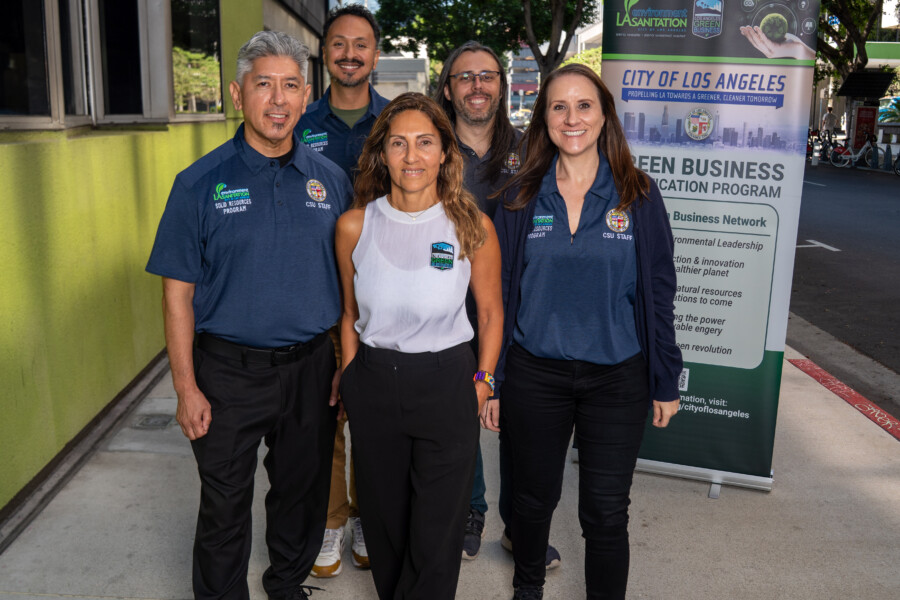
On Oct. 8. Club CEO Robert Larios and Alive! editor John Burnes interviewed five members of LA Sanitation’s Green Business Program about their recent successes. They are Manuel Montano, Management Analyst, eight years of City service; David Issa, Administrative Clerk, six years; Nuna Tersibashian, Environmental Supervisor II and manager of the Compliance and Sustainability Unit, 20 years; Jordan Wooten, Environmental Specialist II, six years, Club Member; and Colette Monell, Environmental Supervisor I, nine years. The interview took place via Zoom.
Alive!: Thanks everyone for joining us to talk about your very exciting Green Business Program. First, tell us the path you took to your current position.
Nuna Tersibashian: Sure. My career began after I completed my master’s degree in environmental geology. With a background in geology, I was eager to find a path that combined my interest in both geology and environmental protection. That led me to my first job in the private sector, where I worked for a couple of years before joining the City. My first role with the City was developing policy for the citywide Brownfields Program—focusing on potentially contaminated sites affected by pollutants. I really enjoyed that work and the opportunity to help shape how the City approached these environmental challenges. Then, around 2008, during the financial crisis, the Environmental Affairs Dept. I was part of was eliminated. Fortunately, our Sanitation Director decided to take on the City’s environmental programs. I transitioned to the Bureau of Sanitation, bringing the Brownfields Program with me, while a colleague brought over the Green Business Program. Over time, those two programs grew under one unit, and eventually I took on the role of managing it. I’ve been with the Bureau of Sanitation ever since—and it’s been incredibly rewarding to see how our work continues to promote a cleaner, greener and more sustainable City.
Jordan Wooten: Prior to the City, I’d worked in the private sector. I think a lot of people did. I worked in hazardous materials, packing and transportation for a company called Clean Harbors. From there, I made connections and got into the City. My first division was in Livability Services. I was there for about three years as an Environmental Compliance Inspector. In 2022, I came to the Brownfields Program as an Environmental Specialist II, and I still help support that as my main role. In late 2023, we began to help support the Green Business Program when we had some vacancies.
Colette Monell: After more than 10 years in private environmental consulting, I joined the City in 2017 as an Environmental Specialist II for the Brownfields Program. I was later promoted to Environmental Supervisor I and began assisting the Green Business Program in the fall of 2023.
Manuel Montano: I’ve moved around quite a few times. I started my City career with Recreation and Parks at Griffith Observatory. From there, I moved on to Sanitation as a Sanitation Communications Information Rep. From there, I was promoted and moved on to the LADOT section where they issue driver’s licenses for buses, taxis and ambulances. After a while, I transferred over to the Dept. of Cannabis Regulation as a Public Relations Specialist. Now I’m back full circle with Sanitation as a Management Analyst, exclusively on the Green Business Program. Right before the City, I was a small business owner in Eagle Rock. I owned a pizzeria. And before that, I had many years in marketing, advertising, public relations and events marketing.
David Issa: I started in retail visual merchandising for 14 years, but witnessing the environmental toll of the fashion industry motivated a complete career pivot. I pursued a master’s in public administration with the goal of serving the public sector and supporting communities. After working with the LA Housing Authority, I joined the team here six years ago as an Admin Clerk in the Brownfields Program. My role has since broadened to include significant work in Green Business. The most rewarding part is seeing the incremental yet increasingly bigger impact we’re achieving across the City.
Networking Event
Tell us about the Green Business networking event a few weeks ago. How did it go?
Manuel: It was Sept. 23rd at the California Endowment. We brought together Certified Green Businesses and other community members. We had a good turnout with about 100 guests. We also had a good-sized recognition event in 2024. As the program continues to build and mature, we plan on hosting additional events. One of the goals of the event was to bring businesses together to introduce three new items: the online directory, new online tools, and a new $1,000 Intuit grant available to certified green businesses. Now if you’re a certified Green Business in Los Angeles, you can go to the Los Angeles Green Business online directory and search on the page for other certified members specific to the City to do business with. The public can do this, too, by the way. The event was a networking expo and resource fair. We wanted the certified members to get to know each other and start communicating to conduct business and drive trade amongst each other. That’s one of the benefits and keys to becoming a green certified business – taking advantage of the networks available to you. And on their own, they could possibly provide rebates or incentives for purchase to each other, whatever they want to. It was good to get them in one room, to communicate and interact with them, and introduce our new tools and resources. It was a successful event.
Colette: It was a great networking event. There was a big turnout, and it was great to see all the businesses talk among themselves and learn about some of their operations, and share ideas with one another.
Manuel: Oftentimes we communicate via email with a lot of our Green Business constituents. But it was helpful to see the faces, hear the voices, and interact with them in person. It was great to feel the energy and excitement in that room. These are the Los Angeles Green Business leaders of today and tomorrow. They’re shaping the Green Business Program in LA.
Were the attendances already certified?
Manuel: The majority were certified green businesses. However, we did open it up so they could invite another colleague or another business owner who they thought would benefit from learning more about the program and what it takes to become certified. Some of them were new to the program or being introduced to it, but the majority were certified. Those who weren’t, we’re getting them on the road to certification.
Nuna: It turned out to be even more exciting than we expected because of the great turnout and the positive feedback we received. Business owners were really engaged, and even staff from other City departments reached out afterward. We had invited several departments to share how their programs could support Green Business certification, and many of their representatives told us how impressed they were. Some even said, “How did we not know about this program? We’ve been with the City for years, and this is such a great opportunity to learn about what’s happening right here.” It was really rewarding to see that level of enthusiasm—not just from the businesses, but from within the City as well.
Manuel: LA CityView Channel 35 News attended the event and covered it. They produced a segment that helps tell our story.
Certification
In general terms, describe the Green Business Program – what it is all about, and how it is going about its mission?
Manuel: The Green Business Program is a free, no-cost program available to the businesses in LA, and we encourage them to join. We provide assistance, resources and onsite consulting to encourage them to adopt eco-friendly practices in their daily operation. The intent is to help them reduce energy and water use, to reduce and or divert waste going to landfills, and to be a good Green Business partner to consumers, customers, clients, and to the community outside their front door.
Our program provides the infrastructure and support to become certified. For example, if we didn’t exist and you were a business in Los Angeles that wanted to go green and you needed support, well, where would you go? With this program, you come to us, and the LA Green Business Program provides the resources, support and structure. We walk you from A to Z every step of the way. We also provide onsite consulting. It’s a program about the future, Robert. Going green is the future. Green businesses oftentimes lead that push towards the future, and that’s what the program is about. When I’m onsite meeting with business owners, I thank them, first of all, for coming to the Green Business Program. I tell them that it’s no longer a question of if busi nesses will go green, but when. The time is now.
It seems to me that businesses are where the rubber meets the road. Businesses have to make it work in the real world. Sustainability has to work there instead of being just a pipe dream.
Manuel: Absolutely. And it can. A lot of what we do is onsite, doing the walkthroughs and providing education, methods and rationale to go green. We make recommendations as to the small changes that can make big differences. Over time, all these small changes get stacked to make a huge difference. But in the beginning, it means small, incremental changes like installing low-flow water fixtures, and faucet aerators. We point them in the right direction to help their business, like to the $1,000 Intuit electrification grant that they can utilize or apply to help offset some of these costs. We encourage them to use non-toxic cleaners, because once that gets rinsed off, eventually it goes into the sewer sys tem. We want that to be non-toxic. We educate them about diverting and sorting their waste into black bins, green organic bins, and blue recycle bins. All this education and communication is continuous.
These are just some examples, but it’s a full sup port program. We don’t abandon them ever.
Is all of that part of the certification process?
Manuel: Yes. The City has many different types of businesses, so we have different categories for different sectors. It’s a matter of a checklist – measures that each business category has to meet to get certified. As they complete the entire list, they arrive at the certified Green Business level. Some of the examples I just provided are things that we look for. Oftentimes when businesses come to us, they’ve already started their application; they’re already moving in the green direction and already making those changes. When we come in and provide the support and consulting, we walk them through some additional small changes that make a big difference. We point them out.
How many businesses in the City of LA are certified?
Manuel: Right now, we’re at about 325 actively certified businesses. The certification is valid for four years. But over the life of the program, a lot more than that have been certified.
For some, their certification has expired.
Manuel: Right.
Jordan: Like Manuel said, businesses that want to be certified are already moving in that direction. Once our outside consultant conducts the walkthrough to gauge where they are in terms of meeting the certification standards, it’s usually not a huge breadth of changes that they need to make. For the most part, it’s minor changes in their business practices that they need to implement. Once they’re ready to be certified, we have an online checklist they must meet. The checklist was established by the state of California, the California Green Business Network. We utilize their framework. There are different measures within each checklist – sub-measures related to energy savings, pollution prevention, solid waste, wastewater, and others. Once they meet all of these measures, we’ll review their checklist and their required supporting documentation; like documents or images of their LED lighting, for example. Once their checklist is ready to be reviewed, we’ll go over all the supporting documentation to verify they meet the specific standard they are applied to. If everything is in order, we’ll issue the certification. Our team will send out a welcome letter from our division, along with a certification signed by the Mayor. The business will get window decals to put on their business to advertise “We’re a California Green Business”. They’ll also be added to our local Los Angeles Green Business directory as well as on the Statewide green business directory.
Nuna: As Manuel mentioned, the certification lasts for four years. After that, businesses need to get recertified to remain part of the certified com munity. We’re currently piloting a new approach to make that process smoother. Instead of starting from scratch, we’re reaching out to businesses a few months before their certification expires. We review their measures and, if they’re still in compliance, we simply reissue their certification. This helps save time and keeps businesses engaged without going through the full application process again. We’re also encouraging certified businesses to refer others that aren’t yet certified—so they can bring someone new into the program. It’s a great way to grow the community and expand the impact of the Green Business Program.
That’s a great idea.
Manuel: This is a voluntary program. We want to make that clear.
Right. And this started under Mayor Villaraigosa 15 years ago. Is that correct?
Nuna: Yes
What City departments do you intersect with? Do you team up to offer services to businesses?
Manuel: Absolutely. We communicate with the LADWP consistently to uncover any rebates, incentives, or any programs that we can make available to the Green Business members or candidates. Internally, we partner with Sanitation’s organics and plastics divisions. That’s more for education purposes.
Colette: Both LADWP and the City’s Economic Workforce and Development Dept. attended the Sept. 23rd Networking Expo as resource vendors. They took the opportunity to share the incentives that they offer to local businesses. Additionally, as Manuel mentioned, there is an Intuit electrification grant available through the California Green Business Network.
Nuna: We’re also working to certify other City departments, not just private businesses. For example, we’ve already certified several City Council offices, and we’re planning to expand that effort to more departments across the City. It’s a great way to lead by example and show that sustainability starts within our own organization.
Dreams and Ambitions
What are the program’s dreams? What do you want to achieve in a year or five or 10 years?
Nuna: My dream is to see the entire City become greener and more sustainable. I want every neighborhood, business, and department to take part in creating a cleaner, healthier envi ronment. It’s not just about individual programs— it’s about building a culture of sustainability that everyone feels proud to be part of.
Manuel: Exactly. We want to continue expand ing the program. Step one is outreach, engage ment, education, and simply raising awareness. We want to continue doing that, and continue to align with the mayor’s Zero Waste goals. We want to build and grow the Green Business community. Eventually, we want to create Green Business zones or corridors, especially along those pedestrian-friendly, walkable, main-street type of streets with multiple storefronts. We want to try and get there. That’s a little bit more long term, but we envision that. We envision where there will be a lot of these business improvement districts. All of them will go green and be certified. But in the short term, we want to continue to roll this program out and continue to grow. We want to touch as many businesses as possible. We have flyers in English, Spanish, Chinese, Korean and Armenian. We want to reach as many of the different segments of the LA business population as possible. We have a great team. We work with good consultants, so the internal pieces are all there. It’s a matter of execution.
Nuna: We also want to welcome the Olympics with a greener face—showcasing sustainable venues, restaurants and hotels. It’s a great oppor tunity to highlight the City’s commitment to sustainability on a global stage. Of course, we’ll need the right resources and collaboration to make it happen, but that’s one of our key goals moving forward.
Yes, let’s stop and talk about the City’s big events on the near horizon. How are you preparing?
Manuel: We have some supersized events coming. The NBA All-Star Game in February 2026 is the first of them. We’re communicating to the Green Business Program membership that they clearly want to display their window sticker, that they are a certified Green Business. They should display it somewhere prominently at their entrance with high visibility. When we get these large influxes of visitors from the United States and from around the globe, specifically for the World Cup, Olympics and the Paralympics, the eyes of the world will be focused on LA. We’re going to get many shoppers, visitors and consumers from around the world who are eco conscious and eco-friendly. Maybe a lot of these visitors have already adopted these eco-friendly behaviors. It’s going to be important to them to shop at green businesses. So that’s something we’re anticipating, and we’ll be communicating that consistently through our Green Business Program and highlighting our online directory.
LA wants to be seen as the leader in so many ways, and this is a primary opportunity to be that.
Manuel: Absolutely. We’re a world-class City, which is why we have these five supersized events coming here. It’s a good time for certified green business members to increase their vis ibility about the Green Business Program. They need to make sure they’re creating plans now to execute as these events roll in.
Jordan: Getting some of the larger venues certified in anticipation of the Olympics is a shorter term objective. There’s going to be a global eye on Los Angeles, and we should be able to say that most of these venues are Green Business certified. We just certified the Coliseum, which was pretty big.
Congratulations!
Jordan: Yes. We’ve certified the Convention Center. too, but we have more to do.
Colette: To raise awareness and boost certifications for the Green Business Program, especially in anticipation of major events like the Olympics, we have started hosting networking expos and recognition events to get the word out about the program.
David: It’s about awareness. If we had everyone shouting on the rooftops talking about the Green Business Program, we would have so much more interest. Consumers are really picking and choos ing where they want to spend their money, and businesses are really looking to decrease their overhead. Any kind of service or program that’s available to them that creates more of a symbiotic ecosystem is really important.
Overall, what’s a main challenge to what you want to do?
Manuel: The budget battle still exists. Right now, we run lean. I wish we had more resources. But the program is alive, it’s not going away. It aligns with the mayoral environmental goals. This is making a commitment. We make a commitment to this program
Online Directory
You mentioned the brand-new online directory. How is it powerful?
David: We unveiled it at the networking event as a sort-of crown jewel. It’s a Green Business online directory that includes all of our different sectors. There are restaurants, retail stores, professional services and large venues, all of which are proac tive in their efforts towards environmental sus tainability. Visit greenbizla.com to access details on the LA Green Business Program and our new online directory. Alive! Feature The directory is available to the public. It can be used to connect eco-conscious customers and shoppers with certified green businesses here in the City. Another benefit is that it also creates a resource for green businesses to cultivate relationships with other green busi nesses. It expands their network and reinforces their business framework, creating an ecosystem of like-minded businesses that are committed to environmental sustainability. It’s very simple to use; anyone can access the directory and either search for a specific business in the search bar or search from a business sector list that includes many categories. Even though it’s local to the City of Los Angeles, it can expand to visitors, both domestic and international. A lot of people are making the self-push to go green. When you provide a tool like this for people who may want to visit Los Angeles, it gives them an opportunity to make a choice with their dollars about where they want to spend their money. It’s a great tool for visitors to find businesses that are eco-conscious and pull them in to have a great LA experience.
So it’s both business-to-business and business-to-consumer.
David: Yes.
Nuna: It’s a GIS-based database, which means it’s map-based and highly visual. You can open it and easily see the distribution of all the certified green businesses across the City.
David: Each business has its own profile.
Manuel: Everything the City of Los Angeles does is big. We’re a big city; we have scale. We’re the largest program in the state of California. In 2024, 22 percent of all certified businesses originated in Los Angeles. It made sense. It was a natural progression and growth to create our own online directory, so we did it. It is a tool for businesses and shoppers who want to spend their hard earned dollars at eco-conscious, eco-friendly businesses. That’s a growing trend.
Caring About Sustainability
How do you get people and companies to care about sustainability?
Manuel: That’s a great question, Robert.
Colette: Business engagement with the Green Business Program varies. We have proactive businesses that research the program independently and contact us, ready to sign up. Other businesses require outreach from our team to overcome initial reluctance. In many of these cases, the business is already implementing sustainable measures, and we simply guide them through the formal certification process. One of the challenges, as we’ve said, is getting the word out about the program so that more people are aware of it. Some businesses are really passionate about it, and they spread the word themselves, which is great.
David: A lot of businesses come to us already knowing their information. They’re being proactive. Another tool is speaking a business’s language. It comes down to the bottom line. When you’re able to speak to a business where surviving is a priority above sustain ability, that matters. Cost savings is important. If you can reduce their water usage, their energy; if there are rebates through different partners; these are all resources that businesses can use to secure the longevity of their program. We can tie that into sustainability and then let them use that as marketing as well, and it just gives them another tool.
We’ve talked about changing the minds of businesses to think about sustainability. How did you change your careers to focus on green initiatives?
David: Like I mentioned before, I was working in retail, and I was seeing the impact it was having on the environment. I realized, if I was going to be working for the rest of my life, I wanted my work to have a positive impact. One way that you do that is through the nonprofit, non-governmental or public sectors. I started exploring those oppor tunities, and it brought me here. So even though I didn’t see myself in this position initially, I’m grateful that I’m here.
Manuel: It was an awakening, when I just started looking and tracking my daily habits and all the waste I was producing. I was producing a lot of trash. That was one thing that was top of mind. But when this opportunity came about and I came to the team, I started conducting more research and educating myself more about the environmental sustainability sector and the discipline. I just became more aware. Did I see myself working in sustainability 10 years ago? No, but I’m glad I’m here now because it’s the future. We have to start every day. We have to be deliberate in how we choose to live on this earth and minimize our impact. Think green, live green.
Nuna: When I came to this country from Armenia in the early ’90s, I already had a bachelor’s degree in geology. But when I started tak ing classes here, I realized there was so much I didn’t know—especially about environmental science. I took an environmental law class at Cal State Northridge and found myself really curious about it. At first, I thought maybe I’d go into envi ronmental law, but I realized it wasn’t quite the right fit for me. That curiosity led me to pursue a master’s degree, combining environmental law with geol ogy, and learning how we can protect the Earth through science. That combination ultimately shaped my career and the path I’m on today.
Jordan: While earning my degree in biology, I learned a lot about ecology and environmental science. By chance I ended up in hazardous waste and disposal. From there, I got to see a lot of different types of waste and how it’s managed, which very often is not ecologically friendly – usu ally disposed of by incineration or into hazardous waste landfills. It was a long, meandering path of how I got here but it’s pretty fulfilling to see from where I came from and how I can play a small role in helping to reduce waste and pollution.
Colette: My path in sustainability started in college, leading me to the environmental sec tor where I gained exposure to compliance and sustainability in both private and public organiza tions. I started working for the City of LA with the Brownfields Program, and then expanded into supporting the Green Business Program, which focuses on sustainability efforts from a business’s perspective.
What will success look like for the program?
Nuna: One hundred percent Green Business throughout LA: Expansion, getting more and more businesses to sign up, having more recognition, having more events, increasing our engagement with businesses, building a community.
Manuel: Continued growth and expansion of the program where we see the certified green business numbers continue to go up. That’s a good indicator of success when we see greater program awareness and visibility.
A Passion for Growth and Change
What do you love about what you do?
Nuna: What I love most about what I do is how every new responsibility opens up another opportunity to learn—both about the work and about myself. When I first started, I was hands on in the field, focused on understanding the best techniques and how things worked on the ground. As I took on more responsibility and began managing larger programs and projects, I discovered how much I enjoy seeing the bigger picture—how all the moving parts come together to create results. I find it incredibly rewarding to watch those results take shape, and I love that there’s always something new to learn or explore. What makes it especially meaningful is seeing the City grow in a more sustainable and green direction. It’s incredibly rewarding to know that the work we do contributes to a healthier, more resilient community. And beyond that, I love that there’s always something new to learn, new challenges to solve, and new ways to make a positive impact.
Jordan: There is a ton of work we do in the background that no one really sees. Seeing the fruits of our labor in the form of businesses being certified is extremely gratifying. Colette: It is rewarding to see businesses make sustainable choices and improve their practices. Once they become Green Business certified, seeing their enthusiasm is truly rewarding because it shows we’ve had a positive impact. They begin spreading the word about the program, promoting sustainability, and encouraging others to make better choices for the environment.
Manuel: I really love visiting the owners at their place of business, getting to know them, talking to them, getting to understand their motivations and their challenges. These are the Green Business leaders of Los Angeles, and small business owners employ many people. I like getting to know them and hearing their stories.
David: First and foremost, both my professional and personal values align. I can support small businesses that support the things that are important to me, so it keeps giving back. I like seeing new business sectors joining the Green Business Program, celebrating businesses that are the first of their kind within a business sector. It may seem small but it has a big impact.
Nuna: I want to acknowledge the incredible work and commitment of my team. None of these programs would succeed without their dedication, expertise and support. Their passion for sustainability and for making a real impact in the City is truly inspiring, and I’m grateful to be able to work alongside them every day.
Excellent. Thanks, everybody, for talking to us, and for all that you’re doing for Los Angeles. We honor you and we celebrate you.
Manuel: Thank you.
Nuna: Thank you, John and Robert. Nice to meet you
Mixer 2025
On Sept. 23, more than 100 people attended the Green Business Program’s first-ever Green Business Expo networking mixer, its biggest event to date. The event was held at the California Endowment.
In partnership with the California Green Business Network, Sanitation provided businesses with the tools necessary for water and electricity sustainability. This expo was the program’s next step in doing more for those who are certified green businesses and served as a kickoff for getting the word out to more businesses. With more than 300 businesses currently green-businesses-certified, the Green Business Program plays a role in the greater plan for sustainability across the state of California