City employees (and LA citizens): The newest and most useful app on your phone (and desktop) might just be City-issued.
That would be the new and much-improved MyLA311, modernized in ways in front of and behind the cover, that are useful to both City employees fulfilling the service request and those making the request.
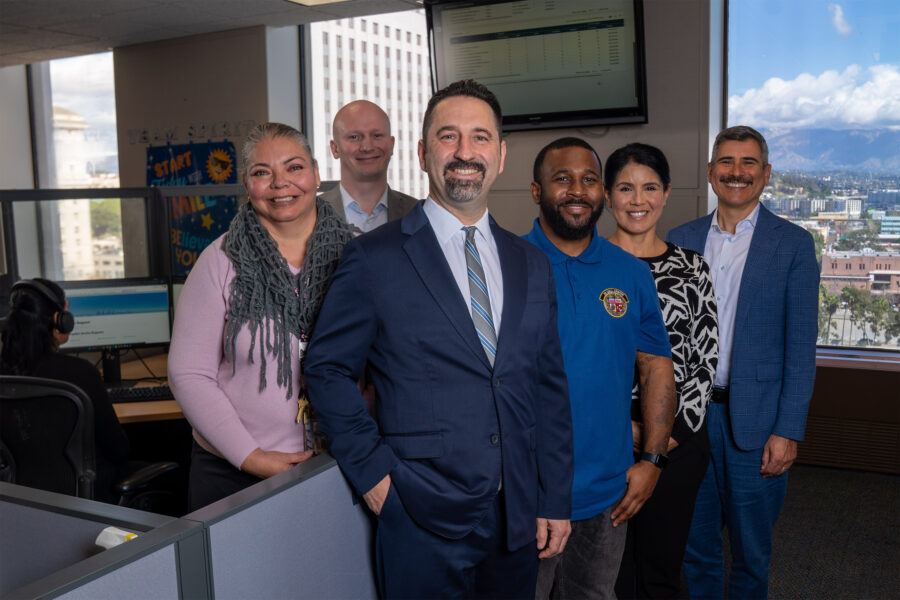
The app and website were designed and built by a dedicated team at ITA with assistance from 12 different City departments.
Background
The new MyLA311 mobile app and website is a crucial tool for Los Angeles residents and businesses, serving as the primary channel to access more than 68 City services across 12 City departments. An easy-to-access, comprehensive knowledge-base of more than 1,300 articles delivers relevant information to residents with questions about libraries, parks, animal adoptions, road rules, and much more. It empowers Angelenos to actively participate in the maintenance of their neighborhoods by reporting problems like graffiti, potholes, and illegal dumping, which in turn help keep the City of Los Angeles cleaner and safer. This modernized platform streamlines the process of communicating with their City, making it easier for the public to engage with their local government. The platform offers Angelenos self-service options via a website and mobile apps (Android/iOS), social media, chat, email and via phone service provided by 311 and other City contact centers.
The new Salesforce-based platform is being actively used by residents, and overall usage has increased 20 percent since the launch in March of last year. The new MyLA311 was on track to deliver more than three million service requests in its first year (an increase of 20 percent). Closure rates of service requests by City departments have also increased from the previous system.
The MyLA311 system was replaced and relaunched on a new cloud based, industry leading Salesforce platform. The prior system was running on end-of-life technology that was out-of-support and more than 10 years old, risking outages and issues for the public.
Team Effort
To build the new MyLA311 system, contributions and input were obtained from each of the 12 City fulfillment departments, the Board of Public Works, City Council staff, several groups within the Mayor’s Office, Neighborhood Councils, and most importantly feedback gathered over years from members of the public via the 3-1-1 Call Center and app stores.
With the increased usage of MyLA311, ITA continues to receive requests for enhancements from City departments, elected offices, and members of the public. ITA makes the requested improvements to MyLA311 continually to improve its features, capabilities and usability for both the public and the internal staff who rely on it.
Well done, ITA! The Club thanks Club Members Maryam Abbassi, Eduardo Magos, Marina Sanchez and Ted Ross for helping us tell this story.
What’s New in MyLA311
- Keyword search
- Auto-suggest
- Public FAQ with video and links
New choice of services requested with a consolidated menu
New mobile app for department field crews (backend for City employees to fulfill the requested service)
- Optimized routes
- Send notes and photos to residents instantly
- Real-time view of other requests in the area
Improved customer experience
- Easy mapping (drop a pin where you want)
- Resident gets estimated time for completion
- New customer satisfaction survey
ADA improvements
- Supports disability accommodations
- Can now report ADA violations across Los Angeles
- Developed with the assistance and approval of the Dept. on Disability
A platform for the future
- No more monthly downtime
- Improvements made without downtime
- New features implemented much more quickly
The Alive Interview: Customer Service Made New
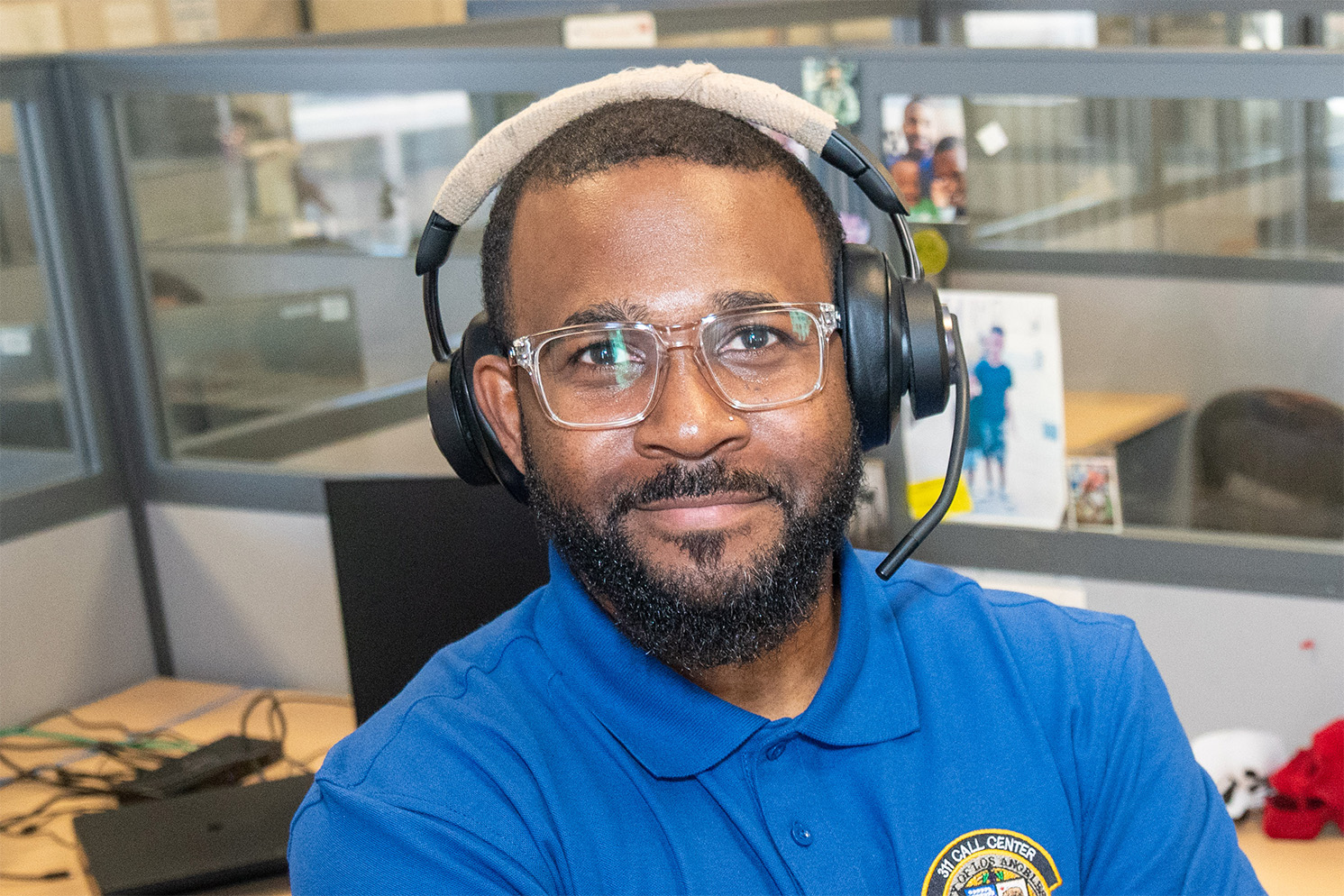
On Feb. 6, Alive! interviewed the team behind the project to modernize the City’s critical MyLA311 system. Team members include Ted Ross, General Manager, Information Technology Agency (ITA), 21 years of City service, Club Member; Jeremy Stout, Information Systems Manager, 10 years; Eduardo Magos, Assistant General Manager overseeing the Applications Bureau, 25 years, Club Member; Kilay Maranon, Chief Communications Operator for the 311 call center, 24 years, Club Member; and Ryan Long, Principal Communications Operator with the 311 call center, 10 years, Club Member. The interview took place via Zoom.


Thanks for joining us today to talk about modernizing the MyLA311 system. But first tell us: What’s the journey you took to the position that you are in now?
Ted Ross: I started my career in the private sector working in large IT systems and finance. I felt driven to work for government after 9/11 and I joined the City of Los Angeles. I started my City career at Los Angeles World Airports (LAWA), working in their financial IT systems. When the Controller’s Office took on the challenge of replacing its 25-year-old mainframe financial system, I answered the call and came downtown to manage the challenging, but successful Financial Management System (FMS) project. I then joined the Information Technology Agency as an Assistant General Manager in 2012. At that time, it was a department in crisis. Very talented people, but a department drastically impacted by the Great Recession. I was appointed General Manager by the Mayor and Council in 2015.
I’m very proud to be part of ITA. It’s an incredibly diverse team with a wide range of skill sets and customer responsibilities, which makes the work dynamic and meaningful. Their work is often behind the scenes, but very important and ever changing as the technology changes. There’s never a dull moment.
One of the many things ITA does is implement big IT systems. And, the MyLA311 software platform is the biggest in the City of Los Angeles, processing more than 2.5 million Los Angeles resident and business requests each year. To modernize and improve the MyLA311 system, we had to work very closely with the public who submit requests using the platform, the City departments that fulfill service requests using the software, and the myriad of other stakeholders, such as our elected officials who represent L.A.’s diverse communities.
Jeremy Stout: My whole career has been with the City, I’ve been with ITA the whole time. I started as an entry-level programmer. My first assignment was rewriting COBOL to SQL, going from mainframe to modern database. Then I became a Programmer Analyst, doing everything from creating chatbots to augmented reality training to re-platforming procurement applications as well as public safety applications. And now I oversee our Salesforce implementations, including MyLA311, as well as our RAMP procurement platform, and our Dynamics installs and our custom-coded applications for public safety and Citywide applications.
Eduardo Magos: I have been in software development for my City career. I’ve helped build systems and managed teams that develop systems. It’s always been software and applications for me. I’ve been an Angeleno my entire City career, and I’ve been gravitating towards systems like 311. In fact, I’ve been involved in some way with service request systems, be it MyLA311 or its predecessors, because I have a particular interest in building software that I can use as an Angeleno that makes life easier for our residents and also for City workers who deliver services.
My career has landed nicely in the world of software in what we call digital transformation – bringing service delivery end to end using digital tools. That’s been my specialty; I would even say passion. In the last few years, I’ve been over all of our enterprise systems in ITA, and I have found that, more and more, it’s all tied to process change as well. Like – how do we improve the way we do things? That’s been my career in a nutshell.
Kilay Maranon: I started my City career when 311 was implemented in 2002. I started as an Operator taking calls, and over time I grew within the 311 call center. After about four or five years, I was promoted to a Supervisor, then I worked my way up to managing the 311 call center.
Ryan Long: Right before I came to the City, I worked for LA County Medical Examiner-Coroner’s office in public service as part of the billing unit. It’s public service, but no one likes the guy sending you a bill. I knew I wanted to work in public service, but I wanted to find myself somewhere where they would say thank you at the end of the call.
I looked for a different place to work. The City was hiring for a Communications Information Representative. I interviewed with Kilay. She was great enough to hire me and bring me on. From day one, I knew this was my home because it allowed me to combine the things I love, which are technology and public service. From there, Kilay and Donna Arrechea, [the previous 311 director,] kept letting me spread my wings; I eventually became the Principal Communications Operator, and I’ve been happy ever since.

Renewal
So, let’s talk about the modernization program of the MyLA311 system, which in a way takes the pulse of the City. What did you bring into the new MyLA311 system?
Eduardo: Sure. Broadly, MyLA311 is a vehicle for the public to interact with the City on topics of graffiti removal, pothole fixes, trees down, and many, many other issues. The system’s history comes from a consolidation of many phone numbers across the City when the world was phone-centric. Its early incarnations involved replacing a host of independent digital systems that were early builds for each of our departments. Once the public moved past phones to websites, they needed to know a dozen-plus City websites to access to have a pothole filled or whatever. For many years, MyLA311 brought that into a unified platform.
Why did we modernize it? There have been many rapid changes in the world of technology since we created MyLA311. The version we recently replaced had been around since 2015 and needed to be replaced. Some of what you’ll hear in the rest of this interview is going to be features that the public can see and benefit from, but many of them are behind the scenes, the technology that underpins it all.
One of the big drivers for modernization is security. The world of cybersecurity has become more and more important. It’s front and center. The technology itself was out of date. The hardware was out of date. And two very big things have happened in the last five years. One is a global pandemic, almost six years ago now. What happened during that time really exposed the limitations of the prior system. With remote workers and customers not able to come to City facilities, we needed new service delivery very quickly. We had to rapidly produce online services. 311 was not able to be the single point for that because we had an older system that was very labor-intensive for updating, with many pieces that could not be changed because of its outdated versions. While the City provided a rapid wonderful response to the pandemic, a very modern digital response, we had to do that in services outside of MyLA311.
Another event that exposed our old system was the wildfires a year ago. Modernization was necessary to ensure our future ability to respond to the needs of the City. On top of that, the City has become increasingly digital. We needed a system that could scale in large emergencies, something that could handle half a million users all of the sudden trying to submit a request for service at the same time. We had experiences where our older system would go down under certain types of loads and inquiries. We needed robustness and needed to deliver it fast. This modernization positions us to do so in ways that we were not able to in recent years.
Ted: The old 311 system was intended to handle at most one million requests a year. At its time of replacement, it was handling 2.5 million requests. The original 311 system was expected to have a seven-year life. We were already in year 10 and counting. A lot needed to be changed, and it was the right time to do it.
At no time does the public rely on us more than during emergencies and natural disasters. Ten years ago, 311 was seen as an important service, but not one really used it in an emergency. Now, the City regularly promotes it during emergencies to ensure 911 is not being flooded with non-life-threatening requests. Having a readily accessible 311 call center, website, and mobile app for reporting issues like clogged sewer drains, downed trees, and street repairs ensures non-emergency concerns are addressed efficiently while keeping 911 lines clear for urgent fire and police emergencies. Increasingly, 311 has become a critical emergency response platform to ensure L.A. residents have an outlet for information and non-emergency requests during natural disasters and civic disturbances.
Eduardo: We are now on track to receive more than three million requests in a 12-month period, which would be the highest we’ve ever seen. We have higher utilization now than our prior system.
The older system was having performance issues. It was sluggish and harder to find the information quickly. We sought to alleviate those pain points with this new system.
Kilay: With the new system being cloud-based, there’s less downtime. We haven’t had any downtime as we did with the previous system. The intake process for the 311 representatives is expected to be faster and easier such as the caller’s information populating during intake. The layout is compatible with our current AWS Connect system; we’ll be able to move to a single workspace where staff can handle calls and complete the intake process in one workspace.
Eduardo: Our current system is now fully cloud-based. We used to have to bring the system down periodically for patching, for security updates, and/or for just regular updates. That is a thing of the past, thankfully. We’ve had 100 percent uptime since we launched.
As far as the workspace goes, even our phone technology has moved to a cloud-based service. With that, our call takers will receive the call in a digital workspace on a screen, which will immediately put them into the intake flow for our 311 system. They’re now in one world as opposed to a prior system, where you might be punching codes into a phone that sits on a desk or you might be holding multiple windows open. Computer requests and phone responses were in different systems, but not anymore. The modernization streamlines operations and creates ease of use for our call takers.
When did you officially launch the modernization? When did you retire 1.0 and go to 2.0?
Jeremy: March 28 [2025] was launch day.
Ted: The old system required multi-hour outages every month. For more than four hours every month, it was down for maintenance and unavailable to everybody! But the new system has been up and running for almost a year, with not even a second of downtime. That alone is a big improvement for our residents and City employees.
Eduardo: When the old system went down, our call center would not shut down. We had to manually note every request that came in during that time in a spreadsheet or on paper, and we would have to re-key it once the system came back up. It was very time-consuming, very laborious.
Ryan: We were definitely on the Excel spreadsheet when the old system went down, and then we had to find time between calls, because they didn’t stop, to add those into the system as the day goes on and hope that we didn’t miss any. Our calls come in fast-paced. The phone doesn’t stop ringing. Calls are continuous. Requests cover a broad number of topics. The old system could do some of those things, but the new system has so many more robust tools and intuitive features, and it provides more access and quicker results. It’s a really great upgrade that enhances a 311 agent experience. We don’t even need to ask for the customer’s name anymore if they’ve called before. We have their history, we have all their cases, and we can hit the ground rolling and tell them the answer they want before they even ask it to us. It’s a great tool to have for our call center.
It’s so much more efficient.
Ted: City money is resident money. We’ve got to spend it wisely and efficiently. Not only do we now have a better system, the City of Los Angeles has a modern platform to build on. It’s built on the industry-leading Salesforce platform. It’s a modern, robust system that the public can be proud of. No longer are we buying and installing something that in five or six years has to be replaced. It’s cloud-hosted, so as new features come in, they can get configured and turned on by people like Jeremy and tested by people like Ryan. We love the idea that we have selected a powerful, best-of-class platform that will continue to modernize as the public’s needs change over time.

Better Mapping and More for City Employees
We’ve talked a lot about customer service, meaning LA citizens calling or using the app. Of course that’s important. But City employees use the back end, right? What does the modernization look like for a City employee on the receiving end to, let’s say, get the address to fix a pothole?
Ted: Yes, absolutely, their experience is also updated for Street Services, Sanitation, Street Lighting, Rec and Parks and other City staff out in the field having to get the work done.
Eduardo: The MyLA311 system has a core group of 12 City departments that provide services on the platform. A lot has been done on behalf of our City users for service delivery. One update improves address validation improvements. We’re a large City, geographically shaped in some interesting ways, with whole cities embedded within where we do not provide services. We need really strong mapping tools to determine where we do we or do we not deliver services. And the complexity doesn’t end there around pure boundaries. There are private neighborhoods that are gated; there are mobile home communities, and there is service all within that. We need a very robust mapping tool to help send crews and the right equipment. Then add another layer of complexity on there: We have large parks, Griffith Park, for example. How do you report a broken water fountain in a park that is thousands of acres? We need mapping tools where you can pinpoint your exact location, where we can share that exact pinpoint on a mobile device for the delivery teams to go and make that repair. And then add an LA River that cuts through our City and has a whole bunch of jurisdictional issues around it. There’s a bike path there. Some things are taken care of by the state, some by the Corps of Engineers, some by the City. The new system shares and determines all of that through advanced GIS systems. That’s just one big improvement, for example, among many other improvements.
Ted: I want to give a huge shout-out to those 12 other departments. We may be the ITA and we’re known for facilitating the intake of service requests with the call center, website, and the mobile app. But really, 311 is a marriage between receiving service requests and fulfilling those requests. The fulfillment is done by 12 other departments who work very hard in the field, in warehouses, and with the public to help solve their issues. An effective 311 system is really a marriage, and a lot of other departments like Public Works Sanitation, Street Services, Street Lighting, the Bureau of Engineering, the Office of Community Beautification, Building and Safety, Transportation, Recreation and Parks, LADWP, the Department on Disability, and Animal Services deserve a lot of credit for the 311 modernization project.
In addition, with this app, for the first time ever, we had a software project that worked very closely with the Department on Disability. We were able to implement very specific Americans with Disabilities Act improvements implemented in the system from top to bottom. You can report ADA violations around you in your neighborhood, and it supports disability accommodations for those using the app.
Speaking of working together, a technical, under-the-hood question: ITA handles all of the requests? They don’t go from you to Street Services, and then Street Services sends them to the people in the field, for example?
Eduardo: That’s a good clarification. ITA manages the MyLA311 platform, which is the interface – the web, the mobile, and even the phone systems that the public engage with. It all comes in through a unified platform that we secure, administer, and develop. From there, based on the criteria that was submitted, it then gets assigned as a work order to a department. If we know that it’s in a park and we know it’s related to the water fountain, it will go to one of the maintenance crews at that particular park. They get assigned a work order and they can complete the request from a mobile app directly, or if they have a third-party system, we integrate with that. We handle it end to end. We orchestrate and design the delivery of service through these digital tools.
Got it.
Ted: When you ask what’s different for City employees who take care of the end user, this new system comes with an entirely new mobile app for department field crews. It has optimized routes so that they take a more organized, simplified route to get to where the work has to be done. It allows a field crew to be able to send notes and photos to residents instantly. So if I fill a pothole or if I paint over graffiti, I can take a photo, submit it, and it goes to the person who requested it. It also gives a real-time view of other resident requests for field crews. If I’m in an area of the City, I want to see all of the related tickets in that area. I don’t want to have to drive from San Pedro to Pacoima to service a ticket and then back down to San Pedro. I should spend my time resolving those issues in a local area. The new system does that automatically and adds a lot more efficiency for field crews who want to spend less time in traffic and more time doing the work and closing the tickets.
Jeremy: We have the ability to do advanced duplication check within the system, too. If the system detects that you’re submitting a request that’s already been submitted, it will notify the customer. It also gives the customer the ability to follow that request. That’s my favorite feature. Customers don’t have to reenter the information or burden the department with duplicate requests. The system automatically allows the customer to get the updates of that request. We do allow departments and the service worker to create their own reports within the system.
Right. So the idea is kind of like Amazon taking a photo of your package on your porch, and then the system sends that photo to you. If I would write in that there’s a pothole, and it gets filled, the City employee could take a photo of it, and I could see that in the report that the request has been accomplished.
Eduardo: Yes, that’s right. It’s an area of continuous improvement for us. We’re constantly getting feedback from our public, but one of our goals is to improve communication with the public and also align expectations. There are many things that the City offers, and it’s important that we explain what we can offer, and what we can’t. We will send information when you submit a request. If we have a service-level agreement about how quickly they can expect us to respond to the ticket, we will put that information there to help manage and guide expectations. If there are specific areas about what the service will do, we will include that in the email when you submit it. When it’s closed, we will show proof that we closed it. And if we can’t, our goal is to clearly explain why the service could not be completed. It’s really important that we update our language, update our information, and guide our customers along the way so they understand what we did and how we did it. That is an area of continuous process. We’re continuing to grow in that area.

AI and the Human Element
AI is at the top of everyone’s minds. How is artificial intelligence being implemented into MyLA311 version 2.0?
Eduardo: There are a number of areas that we are evaluating right now. An early one that we looked into that holds a lot of promise for us is AI for visual analysis. We’d love to move to a model where a 311 intake begins with a photo. We’ve experimented with this, and it’s not fully there yet, but this is the idea: a user submits a picture. AI can already tell us the location; we already know who the user is because the user is logged into the app, or could submit anonymously. But through visual analysis, the AI tool would be able to assess what service is being requested; fill out as much of the details as possible through the visualization; and then give the user a quick pop-up that says, “Here’s what we’re going to submit on your behalf. Is this correct?” The system would allow for edits, and then the user can submit. It would streamline the process. That’s one simple possibility.
Another area where we see AI really growing in use is working as an assistant to a user. That would allow someone to interact with, say, a chatbot, even through spoken word, to speak out loud to their phone device to this assistant that would then translate the request into a structured request that would get submitted to a department. Those are some that we’ve looked into.
On the other side, the backend for City employees, at many times we have high volumes of requests. How can we use AI to run algorithms to decide where we are most effective in deploying our limited resources? And how do we prioritize where to send a vehicle, a specialist to remediate different problems across the City? And also, can we use this data? Can AI look across millions of reports, even over many years, and start looking at where we would apply some preventive measures, maybe in partnership with different community groups or others? How can we address things like copper theft or illegal dumping? Some of those approaches can come from AI; it can perform analysis with volumes of data that’s much harder to do with an individual sifting through them.
Those are just a couple possibilities
Ted: As artificial intelligence often takes center stage in the news, it only highlights a fundamental truth: technology is nothing without people. Our employees are the heartbeat of everything we do. What human beings do well has become that much more important. None of us is looking for AI to replace human beings. Instead, we need a talented workforce of human beings with modern, innovative tools like AI to deliver maximum value to our residents. Fortunately, we’re on a modern, sophisticated Salesforce platform, which means that over the next five to 10 years as AI innovates, the City of Los Angeles has the ability of turning AI features on, or not. We didn’t have that on the old platform.
Eduardo: There is also language translation. We’re already using that across the many languages spoken in Los Angeles.
Ted: I look forward to any tool that makes life easier for a call center operator. I look for any tool that makes it easier for the public. AI shows a lot of promise. But we also want to be very mindful of the damage AI could potentially do if implemented unwisely. We want to make sure we’re using the right partners and applying the right tools, and we’re very mindful of what it is we’re trying to turn on. We want to make sure AI only benefits the public and our employees and doesn’t hurt them in any way.
Right. Ethical AI and human AI.
Ted: Yes. The invention of the hammer did not replace the carpenter, and the invention of the wrench did not replace the plumber. These are simply tools to make our employees better. These are tools that must be used to make the experience better for the public. These are certainly not replacements for the people that still must evaluate, select, configure, maintain, and use them.
Kilay: For the 311 call center, AI would allow the 311 representatives to handle more complex calls and take the time to share the warmth of the human voice. The representatives are more empathetic and bring an understanding to each call. AI can’t replace the empathy and the interaction with a human being.
Jeremy: We’re using it to transcribe the calls. Any calls that come in are being AI-transcribed onto our platform. AI really assists our search capability on the back end to help the agents find their content faster.
Eduardo: Here’s one other benefit that AI can help with. 311 information is useful for many different use cases, not just the delivery of services. It can act as a little bit of a pulse check on what’s going on across the City. Other governmental agencies and universities can also use 311 data to do some analyses and think about the welfare of Angelenos. They can do that through our open data portal. We have something called data.lacity.gov. Outside data analysts and students from some of our large universities reach out to us to look at our 311 data and help identify issues that are going on in the City. You could research where to plant trees or a whole host of things. 311 data is something that is useful to others beyond the basic service request.
Challenges
What were the challenges of modernizing it?
Eduardo: What MyLA311 does, and what is very complicated to do, is working with the work flows and systems of 40-plus City departments. While there are a dozen core departments that can fulfill service requests, many other departments are involved with 311. How do we coordinate across many different ways that they do business? We try to present a very cohesive and unified presentation of something that is not always aligned that way in reality. A perfect example of that is that we took a catalog of services from the old system that was almost 100 different things you could request. But it was confusing to the public. We had so many different things. because we had many different departments that each wanted to kind of own their own service.
So a challenge that we took on with this new project was to consolidate into a simplified menu. The system figures out who to assign it to. 311 does a noble job of trying to simplify for the public. They don’t need to know our org charts.
Ted: And that’s just the City of Los Angeles. Other cities surround our City, or other counties, or there might be state responsibility. Our 311 operators have the very difficult task of taking American federalism and making it easy to use for four million Angelenos.
Of course.
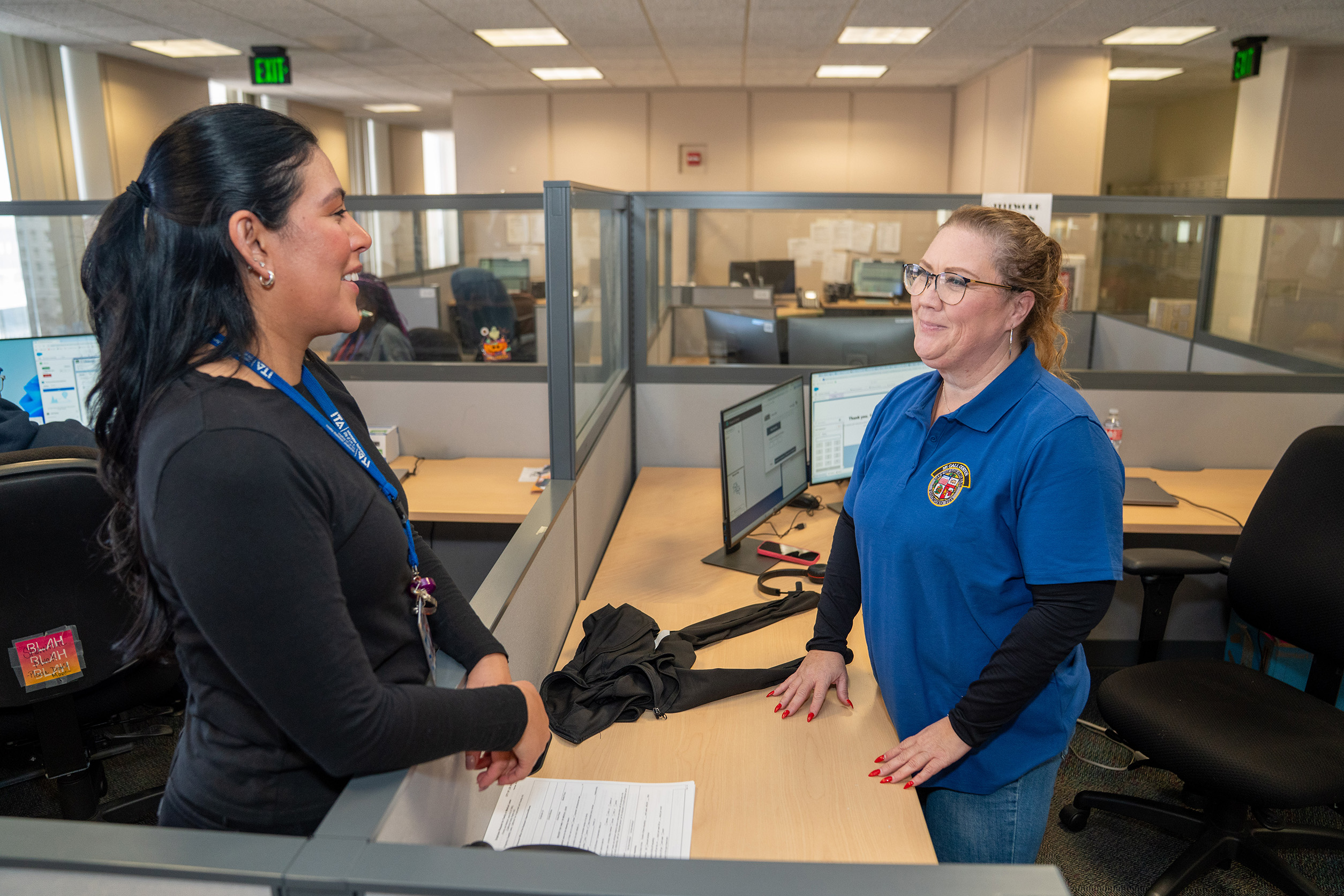
Ryan: One challenge for us was making sure 311 had a voice in the project. Our agents handled a lot of calls and needed something that would support their day-to-day operations. Our director at the time, Donna Arrechea [now Retired] was insistent that 311 agents have input on what we wanted the new system to do for us. She created a 311 working group to ensure we had a system that fit our needs. Through a vigorous period of testing, feedback and conversation, I think we were able to help build something that felt like it was for us.
Ted: And the City always has something going on. We’re trying to implement large, complicated projects while we’re dealing with many other challenges happening at the same time. The most obvious was that this system went live in March 2025 but was supposed to go live in January 2025. We had to delay it for several months while the City responded to the terrible Palisades and Altadena wildfires. As you can imagine, there is always something happening in Los Angeles that requires our attention.
A certain kind of person works at ITA. Whether they work in our call center, whether they’re a programmer or they work in a data center, or they work out in the field, what we do well, you never hear about. But if one thing goes wrong, you hear all about it. Technology is not easy, and the reality is any one thing could go wrong in any one area and it becomes a big issue. Our teams do a good job of coming out, identifying the cause, and working to resolve issues in a professional manner. They’re often constrained on resources and funding, and they have to do everything it takes to restore the service, whether it’s for the public, the LAPD or LAFD, for Sanitation or Rec and Parks or elected offices. A lot goes on to make ITA work, and it’s being done by a lot of really talented and hard-working people. They are often the unsung heroes. Thank you, Employees Club, for writing about the hard-working City of Los Angeles staff that makes things work even when nobody is watching.
You’re welcome. We love doing that.
Eduardo: Working within our own constraints is a challenge. We all have a list of ideas and wishes, and our wish list for 311 is much larger than what we can deliver in any one iteration. What I hope you hear is our commitment to continuous development. ITA takes that approach with all of our software.
And there’s only so much we can do with set funding and the staffing that we have at any given time. There’s always more we would like to do. We try to be smart about prioritizing and choosing to be very effective and efficient with what we do have, but there are limits. Those can be frustrating, especially as all of us care very much about what we do.
Ted: Everybody’s a critic. Some people love Toyota and hate Honda. Some people love Honda and hate Toyota. The reality is they’re both great car makers. When we’re building products like this, we’re working with experts and professionals, but invariably someone asks, “Why did you do it this way?” We always have to work through those challenges. We incorporate everyone’s feedback, but sometimes there’s no one right answer. We find ourselves, like any modern organization, talking to a lot of stakeholders, soliciting a lot of feedback, and gathering a lot of information, but invariably trying to thread a needle over and over again to deliver a service that is award-winning. There has been a lot of excellent response on 311, but there are also people who disagree. And you know what? That’s okay. We welcome any input to make the MyLA311 tools better for everyone who uses them.
What has been the reaction?
Ryan: Internally, the feedback for our call center has been really positive. When we demonstrated the new system and its capabilities, agents were excited for the new toy that we had to play with, to see what it could and couldn’t do. Now I have to add a separate filter in my email just for the emails about all the bright ideas the agents have. Just this morning, I was able to share an email with them about a new feature that was implemented into the system, regarding a tool that makes their searching for illegal dumping or dead animals much faster. That makes me feel good to know that their input is getting implemented at a much faster rate.
In the old system, I didn’t know how the public viewed or understood our knowledgebase or what they needed it to do for them. Now that they get to provide direct feedback on an article or knowledge base, we can get a better understanding on what exactly they need as we get to see if from their point of view. I’ve already changed some of the articles to help it make more sense for them and not just make sense for internal City users, and reached out to a few directly to provide tips on how to use the new system.
Eduardo: People love MyLA311 if we deliver the service they requested. If we fill the pothole, five stars, great app, great call center, great everything. And if we took weeks to deliver that service or closed it without an explanation, one star; what is the City doing? It’s very much tied to service delivery.
Jeremy, how many releases of the new system have we done since launch? I would say more than a hundred. We are committed to continuously updating the system by City employees, based off of the feedback that we’re getting both from our City users and from the public.
Jeremy: Yes, close to 100 releases, more than 300 work items, which is a specific update or fix to the system.
Ted: So 300-plus improvements in less than a year done by City staff. Within one year, we have had more than a 20 percent increase in submissions for residents. The public is really using the new system significantly more than the old system. And “significantly more” means more than 500,000 more submissions in a year than the previous system. We have a more than 95 percent ticket-closure rate. The public is using it more, and our employees are effectively using it to close tickets and get the work done. As long as the City Council and Mayor continue to fund Street Services and fund Sanitation and graffiti removal and the folks who actually do the work, they’ll be on a platform and a system that will enable them technologically to get the work done with something that’s highly usable by the public.
Excellent.
Kilay: Everyone’s getting used to the new system; overall it’s been a positive experience. The MyLA311 support team has made it an easy transition. I don’t want to forget to share that Donna Arrechea, the previous 311 director, was a big part of leading this project for 311. She has retired, but she provided a lot of input and knowledge regarding the system. Also, our 311 representatives played a key role in testing the new MyLA311 system and providing valuable feedback. They should also be recognized as the first point of contact for Angelenos and for their dedication to serving and assisting the public.
Eduardo: Donna told me, “Ed, I am going to postpone retirement until we get this system launched, and then I’m retiring.” She cared very much about seeing this through to its end, and I personally am grateful to what she offered. Donna was in the role for many years, and as we put together our proposal and our requirements for this effort, we, through Donna’s feedback, collected a lot of information from the public. We went through our Google Play Store and our Apple App Store reviews. We went through a variety of different places where the public had already submitted requests and feedback, and we were able to fold those in. Change is hard for many people. Different can be threatening at first. The challenge that we are up for is winning over people by delivering a better service.
Tips
What tips do you suggest for using MyLA311 more effectively?
Ted: If you’re driving in a car and you’re submitting a request … in the passenger seat, of course, not driver! … be sure to get to the map screen quickly so that your pin drops where you are. If you drive a block or two away before you get to the map screen, you will have to move the pin a block or two back to where you were.
Eduardo: You can hold your finger on that pin and move it anywhere you’d like.
I’ll add another. I’m stealing Jeremy’s favorite feature: The ability to be notified that the request has already been submitted by someone else is really cool because it means I don’t need to enter any more information. When they close that one ticket, maybe five people who were following it all got notified. I get the warm fuzzies knowing someone else did the work of submitting it to the City because it lets me know that my neighbors care or the people in the area care as much as I care. That’s a cool thing.
Jeremy: A photo is worth a thousand words. Submit more photos if you have a request. It can help the field department provide quicker service.
Ted: When I submit a graffiti removal, I not only give location, I like to put in the comment where it is. I might voice type “gang graffiti on the north side of Third Street, just west of Fairfax” or whatever it may be. Just to try to make it easier for the crew to get to it. I know they appreciate that.
Kilay: The mapping pin is a great feature, but constituents can also enter their locations by using an intersection; it doesn’t have to be an exact address. As Ted mentioned, they can add additional comments to describe the location. That’s a great feature. Also, through the 311 call center, we are able to text the constituents their confirmation number, the department’s phone number, the website for the department, or any resources they are requesting. It makes the process better and ensures the caller has the information available to them.
Ryan: It’s part of the mapping enhancements, which I think is a great tool. Now you can search for a landmark. In the old system, you needed an address or intersection. The new system, if you’ve got your favorite restaurant that you go to and you notice something there, you can put the name of that restaurant in since the system uses Google Maps, and it’ll pop up and you can click it and then finetune with the pin to select the exact location. We don’t need to have the constituent call back with more precise location information anymore. Being able to search by landmarks is a really great tool for the new system.
Eduardo: The other one I wanted to mention is to create an Angeleno account. An Angeleno account is a single sign-on to not just MyLA311 but the majority or a host of City applications and websites. We have a unified login. The benefit is that you don’t need to put in your email address. You don’t have to fill in the contact portion of your 311 ticket. It’s already pre-filled for you. It’s that much quicker to be done with your entry and move on. And it makes sure that you can get that text notification from 311 if they need to follow up on something. We do respect anonymity and allow you to be anonymous for most non-billing-related service requests. But there is value in having an Angeleno account. Once logged in, it’s secure and it gives you access to many other City systems without having to remember half a dozen passwords for City websites.
Where do you get an Angeleno account? This is the first I’ve heard of it.
Eduardo: You can get it from angeleno.lacity.org. It’s a single sign-on website that we have.
A Passion for Service
What do you love about what you do?
Kilay: I love managing a diverse group of individuals, whether it’s Operators, Supervisors, or working closely with the public. I love being able to provide them helpful resources, especially the elderly community; and support residents during emergency situations. As Ted shared earlier about the Palisades fire, we extended our hours to assist the City to provide residents in those areas with helpful information, resources and guidance on where to access support in person. That’s what I love doing – being able to assist the public while working with a diverse group of people.
Ryan: Like Ed, I grew up in LA. I went to Crenshaw High School, and I used to walk a mile every day to school. On my way, I’d come across illegal dumping, graffiti, palm fronds, what have you. A couple days would go by and I’d take that same walking path and I’d notice it’d be gone. I didn’t know who picked it up. Being a naive teenager, I just assumed that it had disappeared by magic.
When I interviewed for 311, I didn’t know what 311 did. I left the interview not really knowing what they fully did, but I called my dad on the phone. I said, “Hey, I interviewed for 311. Not really sure what they do, but it seems like a cool little place.” He said, “Oh, I used to call them when you were in high school to keep your walking path to school clean.” That was him keeping my little area clean and safe! Now that I’m at 311, I think that always stuck with me because now I get to talk to people on the phone that remind me of my dad, people who are making a difference in their community. I love being able to share the spirit of that selflessness the same way that my dad did. That’s what I love the most about my job.
Eduardo: That is the coolest, Ryan. What a cool dad.
Ryan Long: He’s super cool. You’d love him.
Eduardo: Warms my heart.
Jeremy: For me, it’d be problem-solving. I love to problem-solve. I love getting that “a-ha” moment once I solve the problem, whether it be coding, development, or just solving business process problems.
During this process, the Mayor’s Office came out with the ED5, which helped us guide customer experience on this new platform. We had a clear focus on how to improve the process for our constituents and the public.
Eduardo: I enjoy getting to realize these types of software systems that really do make a difference in helping people address issues that they see across the City. LA is an awesome city, and there are so many cool things about it, but there can be some tough things to it, too. You need help. You need to reach out to your City to help out. Making that quicker and easier is very positive, something I enjoy very much.
Ted: When I worked in the private sector, I helped wealthy companies make even more money. That’s not very inspiring to me. When I work for the City and I do my job, I help residents and businesses clean up and transform their neighborhoods, and I help City employees do their jobs much more easily. It’s much more inspiring every day.
With that, thanks so much, everybody, for telling us about the modernization program, and for all you do for the City.
Ted: Thank you, Club!
Ryan: Peace out. Thank you, guys.
Kilay: Thank you.