

In June, I traveled to the Northern Ireland and Ireland to attend the Thirteenth International Conference on the Inspiration of Astronomical Phenomena in Belfast, to present a paper there (“Celestial Impact,” a report on all of the major PST ART: Art & Science Collide exhibits that emphasized astronomy); to screen Pacific Standard Universe: Art Cosmology California (Griffith Observatory’s cinematic contribution to that monumental multi-institutional art event mobilized by Getty); and to examine more ancient and historic astronomical sites on the Emerald Isle (my fifth trip there).

“Maeve’s Cairn is an unexcavated prehistoric passage grave on the summit of Knocknarea in Ireland’s far west, near Sligo. About 5,000 years old, it was designed to incorporate a north/south line, and I am standing at one of the boulders that establishes that meridian.”
“Lord Rosse built the Leviathan of Parsonstown on the grounds of Birr Castle. With a speculum metal mirror six feet in diameter, it was the largest telescope in the world when completed in 1845. It retained that status until it was decommissioned in 1890. With it, Lord Rosse was the first to observe spiral structure in galaxies, but at the time these objects were not yet known to be large systems of stars, gas and dust outside the Milky Way Galaxy in which we reside.”

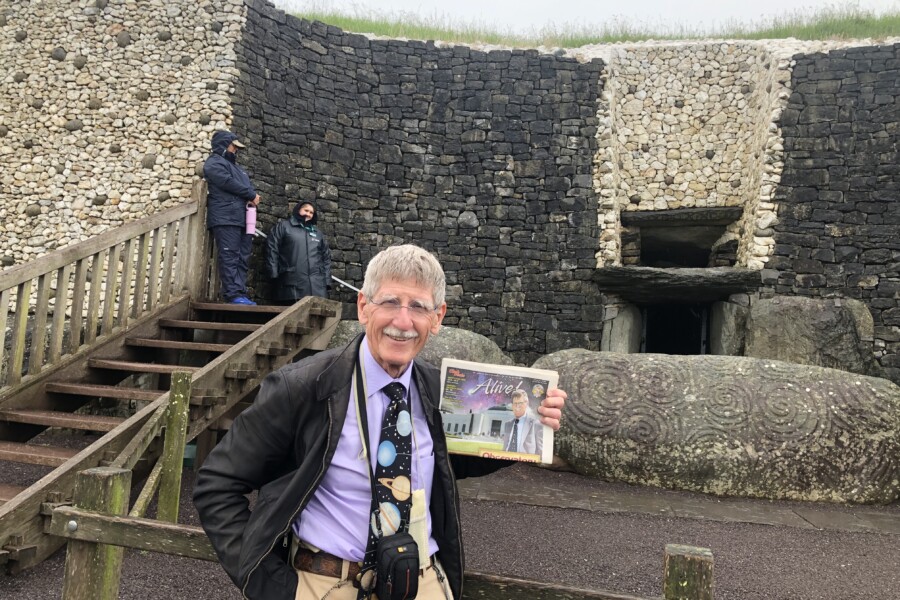
“Newgrange is an even larger prehistoric Irish passage grave, about 30 miles north of Dublin. It was deliberately designed to accommodate the first beam of the rising sun at winter solstice. The window above the door was specially designed to let that light enter and penetrate like a luminous blade to the innermost chamber. I’ve been to Newgrange six times—once at winter solstice—and have written about it several times.”

“Armagh Observatory, in Northern Ireland, U.K., about an hour’s drive west of Belfast, has been ‘exploring the cosmos since 1790.’ It is an historic observatory with a significant record of research and now includes the Armagh Planetarium on the same grounds.”