
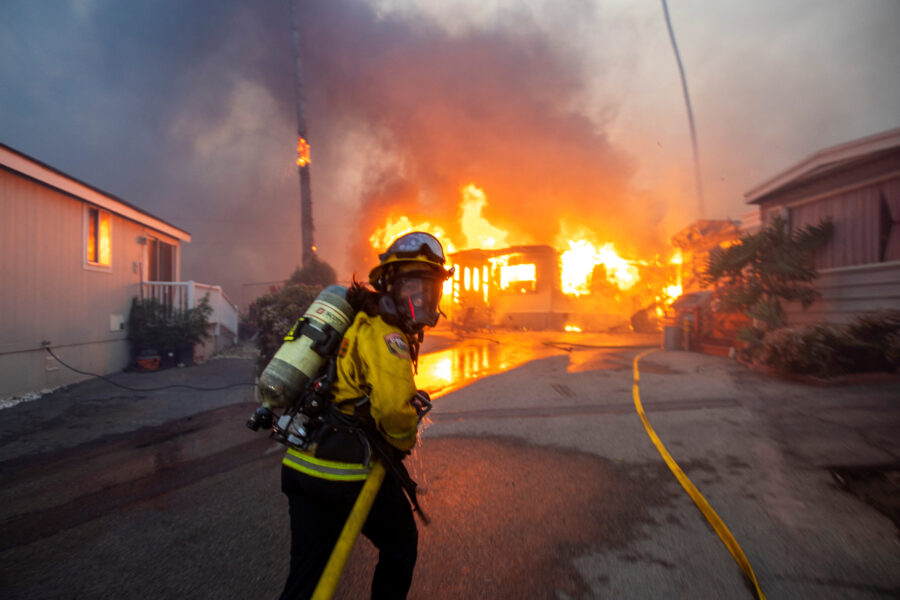
January 2026 marked the one-year anniversary of the most devastating fires to scorch Southern California in our history. The strength of the fires was unprecedented.
City employees stood up and got busy setting the stage for recovery and rebuilding, as they always do. The healing will continue for years, certainly. But those individuals and departments that met the moment starting 12 months ago deserve to be honored and highlighted.
In this month’s special remembrance, the Club joins others in remembering the tragedy and thanks those who stepped up and got LA on its feet. We celebrate and honor you.
Stepping Up to Serve
Almost every element of the City, including the Club, stepped up to help. Here’s an overview.

LIBRARY
The Los Angeles Public Library’s popular Pacific Palisades branch was a complete loss to the fire. Efforts began soon after to plan for its replacement.

REC AND PARKS
The department’s Palisades Recreation Center was heavily damaged in the fires. Sports programs were relocated to nearby recreation centers to keep youths engaged. Plans are under way to replace the Palisades Rec Center.

THE CLUB
The Club and its charity partner, Club Angels, responded to the fires by calling all Club Members in the affected areas to assist them. Club Angels partnered with the Los Angeles County Asian American Employees Association and the LA unit of the Filipino American Law Enforcement Officers Association to gather, sort and donate clothing, canned goods and Club merchandise to wildfire victims.

AIRPORT POLICE
LAX remained open and received traffic from Burbank Airport, which temporarily closed. LAX reversed its takeoff and landing approaches due to the strong winds. Airport Police patrolled the Palisades area against unnecessary traffic and looters.

LAPD
Police Dept. teams mobilized to actively assist with evacuations and traffic gridlock. LAPD was on a Citywide tactical alert with personnel assigned to assist in the Pacific Palisades, West Hills, Hollywood, Topanga and other communities. The department also managed major road closures throughout the City.

PUBLIC WORKS/STREETSLA
Street Services cleared streets of damaged trees and other blockages.

HARBOR/PORT POLICE
Port Police helped secure the Pacific Palisades community alongside its partner agencies since the Palisades fire began. “The destruction is hard to witness, as are the many faces of homeowners as we escort them through the neighborhoods. Our deepest condolences to those impacted. Thank you for letting us service you.”

LADOT
The Transportation Dept. repaired critically important traffic signals and directed traffic away from the burn zones to assist in the reconstruction.

LAFD
“The Los Angeles Fire Dept. was the City’s primary tool during and after the Palisades and Sunset fires. Much more detail of the LAFD’s many activities are listed in the February 2025 issue of Alive!

PUBLIC WORKS/ENGINEERING
Among other tasks, the Bureau of Engineering began the long process of replacing hundreds of road monuments – the brass medallions that legally determine road ownership and location so that rebuilding of the neighborhoods could continue. The medallions were destroyed or heavily damaged and dislocated by the fires and the extensive use of heavy construction vehicles during the rebuilding process.

EMERGENCY MANAGEMENT BUILDING AND SAFETY MAYOR’S OFFICE ECONOMIC AND WORKFORCE DEVELOPMENT DEPT. ON DISABILITY
The Emergency Management Dept. established an emergency disaster recovery center where residents impacted by the fires could access needed City services, including Building and Safety, the Economic and Workforce Development Dept., and the Dept. on Disability.

LADWP
Water and Power played a major role in the recovery after the wildfires destroyed major parts of Los Angeles. Hundreds of crews assessed damage and repaired power and water systems. The department had billions of gallons of water available in four open-air reservoirs, including the Hollywood and Encino reservoirs, for aerial firefighting support. Water and Power’s emergency crews cleared destroyed infrastructure and worked to restore power. The department also supplied water in firefighting efforts.

In Remembrance
City Councilmembers, state lawmakers, Mayor Karen Bass and other elected officials gathered the morning of Jan. 7, 2026, for a private ceremony that included Palisades residents and clergy. Family members of those who died also participated by receiving American flags and white roses. “As we collectively mourn, the pain remains palpable,” Mayor Bass wrote in a statement. “But so does something else now – hope and resolve … We come together to support one another, to forge the path forward.”
Valor Awards
Under the lights of Dodger Stadium, the LAFD Foundation hosted its annual VALOR Awards on Nov. 19, bringing together City leaders, corporate partners, and community members to recognize firefighters for their courage and service.
VALOR is the Foundation’s signature event, an annual tradition honoring men and women whose decisive actions, expert training, and selfless commitment have protected lives across and beyond Los Angeles. This year’s honorees were celebrated through a series of video presentations and personal stories, each underscoring the weight of the split-second decisions firefighters make on the city’s toughest days.
Heroes Related to the Fires of Jan. 7


Medal of Merit
Before dawn on Jan. 8, 2025, flames were encroaching on the home of LAFD Capt. Daniel Lievense and his family. Capt. Lievense was already assigned to a separate brush fire when his 20-year-old son James called. He reported that smoke in the air was thickening, a house on their block was engulfed in flames, and nearby resources were already overwhelmed.
Concerned about the safety of his son, he instructed the entire family to evacuate, and called his brother, Engineer Matthew Lievense, who was off-duty. Being close enough to help his brother, Engineer Lievense put on his personal protective equipment (PPE) and fought through traffic to get to his nephew. Once they connected, he picked up James, who had stayed behind after the rest of the family had evacuated, and went to secure any available tools and equipment that they could use.
They returned to their block to find near-zero visibility and a wall of heat. With no engine, radios, and only the hoses and other spare equipment they could find, Engineer Lievense and James stretched the lines they could to build a water curtain, protecting homes that were still intact from those that were already actively engulfed in flames. Save for brief support from a passing engine, Engineer Lievense and James engaged their limited firefighting resources and stood strong, remaining in place to try and save as many homes as possible by any means necessary.
As soon as he was relieved from his assignment, Capt. Lievense set his sights on getting to his brother and son as quickly as possible. He remembered arriving to his community to see houses burning on both sides of the street and live power lines lying across the street. The Lievense brothers both recalled falling naturally into their roles once they were together; Capt. Lievense taking the lead, expanding their strategy, and prioritizing at-risk structures, while Engineer Lievense supported James in carrying out the plan. Both faced unimaginable split-second decisions, like choosing whether to stay and continue fighting to save an engulfed structure or move on if success was more likely for saving more homes further along.
At one point, as a garage with an attic fire threatened to overtake other houses, the Lievenses climbed up with hand tools and snuffed the blaze from there. Through more than 12 hours of continuous firefighting and a neighborhood fire watch over the following days when power and water failed, the brothers held the line until they had done all they could.
When the last flames were out, 14 homes, two apartments, one condominium and one commercial building remained – a direct result of the tireless efforts of the Lievense brothers and James to protect their neighbors’ homes and the community they love.
Capt. Daniel Lievense and Engineer Matthew Lievense answered a call that came from within. The dangers and risks were no match for their courage and dedication to family and community, as evidenced by every difficult choice they made. Their leadership turned what could have been complete devastation into saved homes and an opportunity for hope.

Letter of Special Commendation
When the Eaton Fire began on Jan. 7, 2025, driven by 80- to 100-miles-per-hour Santa Ana winds, Altadena lost power completely. Being on the westside of the Altadena community, LAFD Firefighter/Paramedic Darren Lloyd was not initially concerned about the fire reaching his community – the Altadena community where his family has been for the past 80 years.
In the early morning hours the following day, and because the Altadena community had not received any official alerts, off-duty Firefighter/Paramedic Darren Lloyd awoke to phone calls that the fire was headed his way. From the front of his home, he could see the flames cresting the foothills above Loma Vista Park and knew that it was time to act.
He woke up his pregnant wife, collected important documents, prepared a quick bag, and sent her to her parents’ house in Glendale. His next order of business was tending to his community.
Knowing that his neighbors had not received notifications of the encroaching flames, Firefighter/Paramedic Lloyd went door to door, waking up residents and ushering them out of their homes. At one home, he nearly kicked down the door of a neighbor that had fallen into a deep sleep after taking their medication. At another, he found a man with dementia and coordinated packing important items and helping him into a neighbor’s car.
After checking as many homes as he could, Firefighter/Paramedic Lloyd loaded up his turnout gear and tools and went back to fight. He recalled coming across the 210/134 freeway transition and seeing a bright, orange glow across the entirety of Altadena.
When he returned to Altadena, he went right to work. Two homes were already fully engulfed in flames and a third was taking on embers and extreme heat. Loading up with his personal protective equipment (PPE), Firefighter/Paramedic Lloyd went to work. He opened lines, used available yard hoses and the water he could access, and went from home to home, by himself, off-duty, protecting as many properties as he could.
Into the following days, even as hydrants and garden hoses went dry as the water grid failed, Firefighter/Paramedic Lloyd was relentless. He pivoted without delay, using neighbors’ fire extinguishers, clearing brush and fuel, and even employing a shovel to throw dirt onto spot fires. Day and night he paced up and down the street, watching for rekindling and stamping out embers. Even in the days after the flames were out, he stayed in place to safeguard properties, confirm addresses for displaced families, and deter looters who sought to take advantage of the devastation.
Just months before, Firefighter/Paramedic Lloyd had moved back into his renovated childhood home in Altadena. That history added new meaning to every decision he made throughout the days of the Eaton Fire.
About a week later, a neighbor approached him with a photo on her phone. It was him in full turnout gear, attacking the fire as it reached to engulf her home, a home that was still standing as a direct result of Firefighter/Paramedic Lloyd’s unwavering commitment.
Off-duty, alone, and short on resources, Firefighter/Paramedic Darren Lloyd protected his community through evacuations, tireless structure defense, and the kind of courage that gives a community that will never be the same some semblance of hope.
Heroes Related to Other Actions


Around 7 a.m. Feb. 15, 2024, the engine from LAFD Fire Station 112 received a call for a medical emergency in Fire Station 38’s district. Assuming that the station was having a busy morning, the crew geared up and made their way to the incident.
While en route, a sudden explosion occurred nearby. While only some of the members actually felt the explosion from inside the engine, every member saw the thick, black column lifting over Alameda Street in Wilmington. Suddenly over the radio, Mayday calls started coming through. Firefighters were down.
From the front seat, Capt. Christopher Sebourn of Fire Station 112 requested coverage for the emergency medical services (EMS) call and made the executive and immediate decision to divert. He contacted dispatch and added his company to the incident that had just occurred. Engineer David Roberts, who also worked at Fire Station 112 with Capt. Sebourn, navigated traffic and got the crew to the scene in a mere 72 seconds. What they saw when they arrived, Firefighter Joseph Coleman described, was apocalyptic. Nine Firefighters, fellow members of the crew whom some would later discover were friends from the field, lay scattered across the street, surrounding a smoking semi-truck carrying two compressed natural gas (CNG) tanks, one of which had exploded. Some were face down and still, others on their knees, some staggering around in a dazed state.
Capt. Sebourn attempted to reach the company in charge of the scene, but after no response, under the pressure of the potential for a second explosion with the additional CNG tank, he established command of the incident. Prioritizing rapid triage and immediate transport, the crew went to work.
Firefighter Field, who was working an overtime shift at Fire Station 112 that morning, jumped into paramedic mode. She began stripping off burned gear, prioritizing the most critically injured, and worked with her fellow members to prepare the patients for transport. Between moves from patient to patient, Firefighter Field supported the development of an expanded perimeter to ensure the safety of the nearby communities, the public, and the firefighters working to save their injured comrades. Firefighter Joseph Coleman was also working an additional shift at Fire Station 112. As the crew triaging patients began moving the injured firefighters to the rescue ambulance, Firefighter Coleman got behind the wheel, prepared for swift transport to the hospital. He connected with the nearest hospital, Harbor-UCLA, and prepared them for a swift handover of patients requiring critical attention.
Engineer Roberts, who had delivered the crew to the scene in record time, switched gears without hesitation. He assisted Firefighters Field and Coleman with assessing and carrying the injured, one of whom he would later find was his friend Tom Rodriguez, initially unrecognizable due to the ash coating his face.
Once all the patients were taken safely from the scene, the focus turned to the pending danger. The responding crews continued to secure the scene until the threat of the second CNG tank exploding had been stabilized. Through it all, Capt. Sebourn remained calm and served a critical role overseeing the incident. His clarity and focus helped an incident that began with the worst possible scenario end with an organized rescue and successful patient transport.
Field and Coleman cited their training as LAFD Firefighters as the driving force behind their ability to quickly embed with a station that was not their own. Capt. Sebourn and Engineer Roberts said it was as though they had all four worked together before.
On a potentially fatal day in February 2024, nine LAFD Firefighters went into Harbor-UCLA, some unconscious and all severely injured. After varying degrees of medical attention, some days later and some weeks later, all nine firefighters walked out — a direct result of the expert decision-making and tireless efforts of the entire Engine 112 crew to support their fellow members. ambulance, Firefighter Coleman got behind the wheel, prepared for swift transport to the hospital. He connected with the nearest hospital, Harbor-UCLA, and prepared them for a swift handover of patients requiring critical attention.
Engineer Roberts, who had delivered the crew to the scene in record time, switched gears without hesitation. He assisted Firefighters Field and Coleman with assessing and carrying the injured, one of whom he would later find was his friend Tom Rodriguez, initially unrecognizable due to the ash coating his face.
Once all the patients were taken safely from the scene, the focus turned to the pending danger. The responding crews continued to secure the scene until the threat of the second CNG tank exploding had been stabilized. Through it all, Capt. Sebourn remained calm and served a critical role overseeing the incident. His clarity and focus helped an incident that began with the worst possible scenario end with an organized rescue and successful patient transport.
Field and Coleman cited their training as LAFD Firefighters as the driving force behind their ability to quickly embed with a station that was not their own. Capt. Sebourn and Engineer Roberts said it was as though they had all four worked together before.
On a potentially fatal day in February 2024, nine LAFD Firefighters went into Harbor-UCLA, some unconscious and all severely injured. After varying degrees of medical attention, some days later and some weeks later, all nine firefighters walked out — a direct result of the expert decision-making and tireless efforts of the entire Engine 112 crew to support their fellow members.


On Oct. 5, 2023, Firefighters Daniel Nakamura and recruit Firefighter Armen Chalian were leaving another call when they saw a dark plume of smoke rise into the sky. They turned toward 73rd Street and Broadway in South Los Angeles and found a large homeless encampment behind a wrought-iron fence, engulfed in flames. Bystanders pointed and shouted, and Firefighter Chalian heard it first: a woman was trapped inside the gate, the flames right against her back.
Moments before, the two had been discussing what to do if they ever arrived first on scene to an incident. That preparation, Firefighter Nakamura reflected, was divine in nature, as the very situation they arrived to was the exact scenario they had talked through.
With no hose line on scene and a life in imminent danger, the Firefighters knew that there was no time to waste. Firefighter Chalian’s training took over as he put on his turnout gear. In a quick, instinctive callback to his days in the drill tower as a recruit Firefighter, without even realizing it in the moment, he clapped his hands to himself to signify completion.
Firefighter Nakamura immediately went to the fence to try to hoist the woman over, but her injuries and positioning made that method too dangerous. Instantly redirecting, he went back to the rescue, grabbed his bolt cutters, and returned to Chalian already in position to assist with entry. The two worked together to get the gate open, and as the fire began to move across her body, they pulled her into the alley and out of danger. Crews from Fire Station 33 arrived and knocked the fire down, while the Firefighter/Paramedics on scene worked with the patient to prepare her for transport in critical condition to the nearest hospital.
Firefighter Chalian will not soon forget that rescue. He cites Firefighter Nakamura’s leadership and resolve during the incident as the catalyst for what he was able to do to ensure a life was saved. For Firefighter Nakamura, the timing of the “what if ” scenario they had discussed shortly before arriving on scene, underscored the value of preparation and decisive action with seconds to make crucial decisions.
What began as two Firefighters on a routine return from a call became a rescue that they were not required to respond to but believed they had a duty to address. Two Firefighters, one new and one seasoned, read the scene the same way, trusted their training, and employed the speed and courage necessary to give their patient her only chance of survival.

It was not the first time that Firefighter Andrew Talley had visited Lake Havasu in Arizona for vacation. The peaceful town was a quiet escape from his day-to-day as a Firefighter at one of the LAFD’s busiest stations, Fire Station 11. On Sept. 1, 2024, he was on vacation with friends, idling past Devil’s Elbow, a well-known area in the gorge portion of the lake, when he noticed someone standing at the edge of a cliff about 30 feet in the air.
The man turned around and prepared for a backflip, and then launched off of the cliff edge. Firefighter Talley watched the landing go awry. The man hit the water on his back, surfaced briefly, and then slipped under the water and did not reappear. Firefighter Talley wasted no time jumping into action. He grabbed a personal flotation pad, pointed his friends toward the area where the man went under, and dove into the water.
The current was strong that day, Firefighter Talley recalled. He and two of his friends repeatedly went underwater, searching the lake in the area surrounding where they had last seen the man surface. Firefighter Talley finally found him several feet down near the rock face, unresponsive. With the help of his friends, they hauled him to the nearest shoreline.
Firefighter Talley immediately saw that the individual had no pulse and was not breathing. There was no cell service in the gorge, so attempts to reach 9-1-1 were failing. Talley instructed a bystander to hold the man’s head steady and began chest compressions. Despite having no radio and no crew, unsure if help was even on the way, Firefighter Talley fought tirelessly for more than 10 minutes straight, desperate to keep the man alive until help arrived. As if out of thin air, a San Bernardino County Sheriff’s boat appeared. Talley assisted them with loading up the patient and preparing him for transportation, all while continuing chest compressions. The Sheriff’s boat met the Lake Havasu Fire Dept. upriver, and their medics took the patient – later identified as Shane Baker – in a helicopter to the nearest hospital.
Off-duty and without his usual medical equipment, Firefighter Talley had relied solely on his training in a desperate attempt to save Baker’s life. For the rest of the trip he was quiet, haunted by the fact that he did not know Baker’s outcome.
When a social media post from Shane’s friend reached Firefighter Talley’s mother, she immediately reached out to let him know that Shane was, in fact, alive.
Weeks after the rescue, Firefighter Talley and Baker met in Lake Havasu, an incredibly rare occurrence in Firefighter Talley’s line of work. The two shared an emotional embrace, and continue to stay in touch to this day.
Because Firefighter Talley acted quickly, without hesitation, and remained relentless in performing extensive chest compressions, what could have been a fatal accident ended with a powerful reunion. Firefighter Andrew Talley’s readiness and resolve under pressure directly resulted in a life saved and forever changed.