
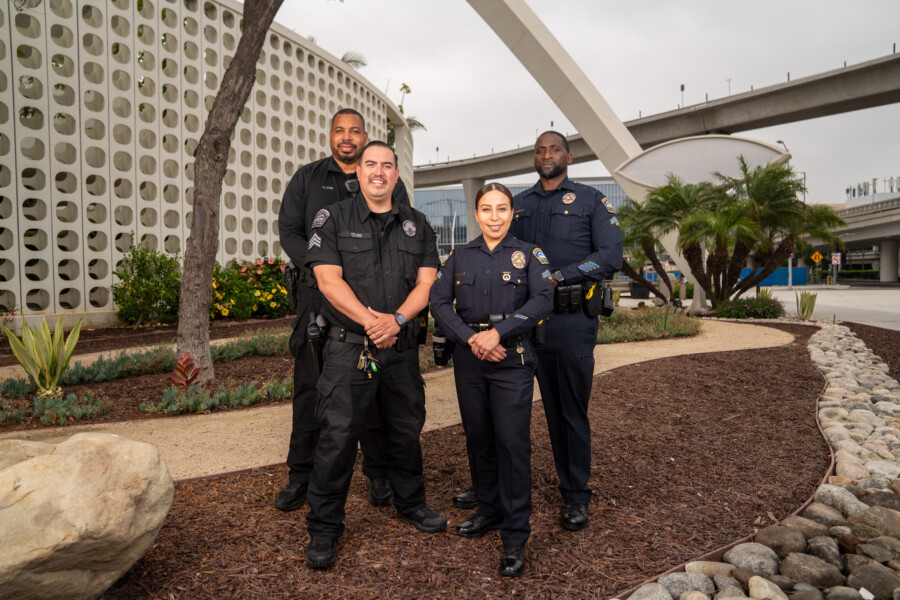
Airport Police is reaching out to provide service as never before. The department is growing into new, deeper and community based activities.
Two years ago, Airport Police – a part of Los Angeles World Airports – expanded its reach to the traveling community by creating two new units – the Community Relations Unit, to build relationships with neighboring communities, and the Crisis Intervention Team, to tend to the airport’s significant unhoused population.
In this month’s feature story, Alive! interviews and examines these two critical functions as LAX prepares for several world sized events in the next three years: the World Cup, the Super Bowl, and the 2028 Olympic and Paralympic Games.
Community Relations: Forging Positive Relationships
Airport Police’s program of Sr. Lead Officers focuses on building positive relationships between Officers and community members, aiming for respectful interactions and positive impressions. Building trust and positive relationships with the neighboring public is key to Airport Police’s community engagement.
Sr. Lead Officers are held to a higher standard of conduct and performance. Each Sr. Lead Officer is responsible for a geographical area with duties tailored for the area
specifically.
Sr. Lead Officers:
- Are assigned specific areas and communities to facilitate the mission of the SLO program
- Within assigned areas, make direct contact with the airport community withing assigned areas
- Form partnerships with the community and help them problem-solve through community meetings and work briefings
- Act as liaisons between Airport Police and the community for any security and policing issues
- Review and analyze crime reports for their area or assignment
- Assist watches in developing strategies to reduce area crime
- Attend necessary roll calls to ensure that pertinent information from community and tenant meetings is disseminated
- Develop training for Airport tenants
Solve airport community problems, reduce crime and improve the quality of life for the community - Regularly meet with the Community Relations Unit Sergeant to update, review and analyze how the Sr. Lead Officer is addressing crime and community outreach.
Crisis Intervention Team: Helping the Unhoused and the Stressed
Up to 130 homeless individuals set up residence at LAX on any given night, as recently as 2020, the majority of them suffering from mental illness and/or substance abuse issues.
Separately, flying in general can be stressful, and the Crisis Intervention Team Officers occasionally must address issues of passengers who might be in need of assistance.
Officers in the Crisis Intervention Team work very closely with nonprofits, hospitals, social workers, mental health clinicians and other County and City departments within the Los Angeles area. Officers are expected to perform outreach and enforcement in and around the Airport Area in relation to transient, homeless and mentally ill population.
Officers on this team are specially trained to engage in crisis negotiations.
Crisis Intervention Team Officers are responsible for:
- Responding to 5150 W.I.C. radio calls
- Address encampment radio calls related to the unhoused
- Engage with unhoused individuals and offer necessary resources
- Provide training to other divisions to ensure compliance with current laws and regulations
- Participate in crisis negotiations as needed
- Perform outreach and enforcement of the unhoused and mentally ill population
- Working with other agencies and entities.
Inside, read all about these two relatively new and critically important units.
The Club thanks Sgt. Shawn Young and Sgt. Curtis Smith, Club Members, and intern Jacqueline Alvarado Canesses for their invaluable assistance in producing this article. We honor you for your service.
Policing Means Helping
On July 30, Club CEO Robert Larios and Alive! editor John Burnes interviewed members of the Airport Police’s Crisis Intervention Team and Community Relations unit: Sgt. Shane T. Young, 20 years of City service; Sr. Lead Officer Karina Alvarado, 10 years; Officer Naim Al-Amin, 18 years; Sr. Lead Officer Larry Henderson, 22 years; and Officer Percival Valdenor, 23 years. All are Club Members. The interview took place via Zoom.


Alive!: Welcome! Everyone knows the Airport Police from our many visits to LAX. Today we’re talking about two specialized units, the Crisis Intervention Team and the Community Relations Unit, and the special assignments they have.
Sgt. Shane Young: That’s correct.
Are those two units together operationally?
Sgt. Young: We’re both under the Patrol Service section under Commander Adonis Cutchlow and Lt. Pedro Preciado. Because the Crisis Intervention Team deals with
nonprofit organizations plus LA County, it falls under the Community Resources Unit.
Got it. Before we get too far along, tell us how you got to be in your current position.
Sgt. Young: I started as a Patrol Officer like everybody else through the Academy. Eventually I became a Field Training Officer. During that phase, we decided to implement a Sr. Lead Officer program; I became one of the first Sr. Lead Officers in the group.
Over time, Airport Police management decided that we needed to create a Crisis Intervention Team to serve individuals experiencing homelessness in the Manchester Square area, which was developed in 2014. Another Officer and I were first deployed to the Manchester Square area to combat homelessness and occupancy issues that were expected to come forward; we asked people to leave houses and streets so we could build a beautiful facility, the ConRAC, the Consolidated Rent-a-Car facility, as part of the major redevelopment project at LAX.
Basically we had to create a team so that Airports wouldn’t face lawsuits that we weren’t unfairly kicking people out when that wasn’t the case. I had done my time in Patrol of the Manchester Square and was reassigned to Patrol again. Later, I was asked to come back on the Crisis Intervention Team as a Sr. Lead Officer since I had the experience of having created the Crisis Intervention Team, and then also as one of the first Sr. Lead Officers.
Got it.
Officer Percival Valdenor: Before this, I was in Patrol, where everyone starts. For five years, I was a member of the Urban Police Rifle Cadre. A few years after that I joined the Bicycle Team here. In 2018, I joined the Crisis Intervention Team, which deals with homeless individuals who are residing here at the Airport. I’m still a proud member of the CIT. Very happy to be a member of it.
Officer Naim Al-Amin: I entered the Academy in 2006, graduated in 2007, and served in Patrol from 2007 to 2017. I transitioned to the Crisis Intervention Team (CIT) in 2017, where we built a service-first strategy to connect unhoused individuals with safe placements and care, supporting site readiness around the LAX Consolidated Rent-a-Car facility – ConRAC. After that phase, we shifted our focus to the Airport itself, particularly the Central Terminal Area, engaging individuals experiencing homelessness. On Airport property, we reduced the unsheltered population from roughly 100 people to fewer than 10, and today we focus on sustaining those gains through ongoing outreach and coordination.
Sr. Lead Officer Karina Alvarado: I began my career in Patrol, where I served for approximately eight years before being promoted to Sr. Lead Officer. During my
time in Patrol, I completed several courses and training programs to prepare for the
role I hold today.
In my current position, I focus on Community Relations not only within the Airport but also with the surrounding Westchester community. My goal is to build strong relationships with local stakeholders and ensure they know that Police Officers are here to support them whenever needed.
Sr. Lead Officer Larry Henderson: Like everyone, I started out in Patrol. I was there for maybe 21 years. Toward the end of my time there, we developed our Labor Relations Team, which handles labor actions that occur here at the Airport. After the Sr. Lead Officer announcement came out, I applied and was hired. That’s where I work now, and I still deal with the labor issues as well.
Tell me a little bit about what you mean by labor actions.
Officer Henderson: Sure. The Airport is made up of a vast number of employees, some of whom work under contract, and some of whom work for the City. We deal more with the contracted employees. When it’s time for labor negotiations, all parties don’t always come to an agreement on all things.
When that happens and negotiations break down, that leads to labor actions, whether it be information pickets or a full-blown strike. If those things do occur, they have a tendency to impact the Airport. We try to first facilitate a negotiation to minimize the impact on the Airport. We have a duty to keep the peace once the labor action takes place. We help facilitate a peaceful demonstration if one occurs within Airport grounds.

Destination: Airport Police
Have you always wanted to be in law enforcement? What drove you to be an Officer at LAX?
Officer Henderson: I can’t say that I always wanted to be in law enforcement. My first career path directly out of high school was to become a registered nurse. Sometimes people giggle at that because I’m like 6-foot 2, 260 pounds; they haven’t ever seen a nurse that big before. But one night I was watching Cops while I was in the middle of going through the nursing thing, and somehow nursing just wasn’t adding up with my personality. Watching Cops, I thought I could totally do that. At the time, I was working with a coworker at another job, and her fiancé worked for Airport Police. I didn’t know what that was. I thought it was maybe a department within LAPD. She started to school me on who they were and what they were about. It appealed to my interest, so I came out and applied.
Sr. Lead Officer Alvarado: I didn’t initially plan on becoming a Police Officer; it wasn’t until college that I discovered my interest in law enforcement. At the time, I wasn’t sure which direction I wanted to take, so I enrolled in a variety of courses, including psychology, nursing and law enforcement. Ultimately, I found myself drawn to law enforcement and decided to pursue it further.
I earned my bachelor’s degree in criminal justice from Cal State Dominguez Hills. After graduation, I began applying to police departments. During the LAPD application process, I discovered the existence of the Airport Police, I hadn’t known about the department before. On the application, there’s a section where you can check off departments of interest, including Airport Police. I selected both LAPD and Airport Police.
I soon learned that Airport Police hosted weekly workout sessions every Wednesday to help prepare candidates for the Academy. I started attending those sessions and was immediately impressed by how welcoming and supportive everyone was. They pushed me physically and mentally, and through that experience, I developed a strong passion for this department. Eventually, I applied to Airport Police and I was hired.
Officer Valdenor: Since I was a child, I always wanted to become a Police Officer. Right after high school, since I hated studying, I joined the Army, and I was infantry all the way. When I left the Army, it took me a while to get a City job. That’s why I’m forever grateful to the City of LA, especially Los Angeles Airport Police. I got my first City job as a Security Officer for five years. Airport Police is a department full of opportunities. I was able to take advantage of it and become a Police Officer. To my surprise, I became part of the Crisis Negotiation team. Because I was never really good at talking, but the Airport Police trained me and supported me. I’ll always be grateful for this job.
Officer Al-Amin: I’ve always wanted to be a Police Officer, as Officer Valdenor just mentioned. I attended UC Riverside and realized my academic track didn’t align with my calling to serve. When I turned 22, I applied to the Los Angeles Police Dept. However, working with the Transportation Security Administration (TSA) introduced me to Airport Police. I applied, entered the Academy as one of the youngest in my class, and I’ve been here ever since.
I love this work. Joining the Crisis Intervention Team (CIT) made it my dream job. It lets me help people and give them options. My approach is simple: service first, enforcement second. We meet people where they are and connect them with what they need.
Sgt. Young: It goes back to when I was 16 years old. I had a kid when I was 16. I wanted to see what I wanted to do with my life while raising a kid. I actually became an Explorer for the Orange Police Dept. Over time I really enjoyed it. And then I had a decision to make – do I want to go into the military or do I want to become a Police Officer? I tried the Orange County agencies, but Orange County agencies are not too
friendly for 21-year-olds trying to patrol their streets. Luckily I was able to get a friend of my dad’s to say, hey, you know what? You should try LAPD or Airport Police. I tried both processes because you can click both boxes. I went to the Airport Police workout program, where I got to meet a lot of the Background Investigators and the people who are actually doing the hiring. Over a period of time, I got the job offer with Airport Police. And I’m forever grateful for that. It was one of those things where I wanted to stay in the States instead of being deployed to somewhere overseas. I’m very grateful to be here.
Two Specialized Units
Describe these two units and their functions. What are they? What are they not?
Sgt. Young: The Sr. Lead Officer program – the Community Relations Unit – is the interaction between Airport Police and the tenants and community surrounding LAX. The LAPD implemented basically the same program within their own communities. Airport Police never really had anyone to communicate with the tenants and let them know the services we provide them. We had Sergeants who would go to some of these meetings and talk to the tenants, but the word was never passed along. The importance of the Sr. Lead Officer program is to build that relationship.
For instance, Sr. Lead Officer Alvarado is in charge of our northside terminals – Terminals 1, 2 and 3 – but she also serves the Westchester community. And then we have Sr. Lead Sr. Lead Officer Henderson, who’s in charge of the Tom Bradley International Terminal. That includes more than 100 airlines. But he also deals with the airfield enforcement, which obviously is very key when it comes to people driving onto the airfield, whether they’re speeding or not abiding by the rules of the airport.
Community Relations is all about relaying that message. Training the Sr. Lead Officers to hear the concerns of our neighbors is huge. These are quality of life issues. We want to make sure that everyone – passengers, employees, neighbors – who comes to the airport is getting the services that they need. The Sr. Lead Officers are the faces of the department. The Crisis Intervention team is under the same unit as Community Relations. The Crisis Intervention Team serves individuals who are experiencing homelessness on airport property. The key component of it is making sure we relay the message that we have services for them. The Crisis Intervention Team works with a nonprofit organization called PATH who comes out and helps us.
What is PATH?
Sgt. Young: It stands for People Assisting the Homeless. It’s a nonprofit. We have a contract with them to come and help us with our referrals to try to get the homeless placed into shelters, housing or anything else like that. Not a lot of homeless people want to talk to law enforcement because they think they’re going to be under arrest or they’re going to be transported to a hospital or they’re just generally in trouble. That team wears softer uniforms for that reason.
Crisis Intervention is different than Patrol. It’s a specialized unit that can also assist in helping people get where they need to go to, whether it’s being reunified with family members in a different state because their family doesn’t have funds, or they got stranded here and they’ve been living homeless here for a while. We also partner with the LA County Dept. of Mental Health. We do have a full-time clinician who works 40 hours a week with us who goes out with the Police Officers to perform mental evaluations.
Does the Crisis Intervention Team get calls from other airports about
passengers who might be under duress and need special attention?
Sgt. Young: Yes, we get that information right away.
Officer Henderson: The one thing I might add about Community Relations – we do community projects as well. For instance, we have a school coming out in September that wants to visit the station, and we’ve formulated an entire program that has exceeded the expectation of what they were originally going to get. Now it’s been
expanded to an airfield visit. We’re responsible for setting up that kind of service. We’ve also implemented an annual Christmas event. And then we also do little things for the stakeholders throughout the airport, such as our Coffee With a Cop event, a national program that we coordinate locally at the airport. And National Night Out – we specialize it for our tenants and passengers coming into the airport.
When it comes to reaching out to the community, does that mean mostly with nonprofts in the area – or businesses, too?
Officer Alvarado: Yes, we engage with businesses as well, although not as frequently as with other community groups. We connect with local businesses through outreach efforts, such as building relationships, inviting them to events, and maintaining open lines of communication.
What is your specific jurisdiction?
Officer Alvarado: Typically, we patrol a 10-square-mile area surrounding the airport.
Big Events, Bigger Airport
The growth of these two units – does that indicate the growth and the maturity of the Airport Police Dept. – where you’re going, what you’re becoming, and expanding your services in a number of different ways?
Officer Henderson: I would say so. Sgt. Young was one of the first ones to take the lead for the CIT program because it didn’t exist. We handled it as part of regular Patrol fashion – if you committed a crime, we’d put you in cuffs and take you to jail. Now with the CIT, they do a great job at getting services for these people. Everyone
who falls under that criteria isn’t necessarily a criminal. They may have some issues that they might be dealing with. The CIT Officers have taken an extensive amount of classes to help them diagnose those things. They also are in contact with a lot of different services that your normal Patrol Officer may not be aware of. That’s one way our department has expanded.
Regarding the Sr. Lead Officers and the Community Relations program, we’re striving
to get a better community outlook with the way they view Police Officers. In the past few years, I would say law enforcement has taken a black eye. We have been in the news a lot lately, and so it was vital that we try and change the mind sets of the people who we see every day. One of the ways that we do that is keeping in constant community contact and showing the public that we care. It’s not just about handcuffing and put ting people in jail. We’re humans too. We have families just as well. We want to be sure that if the community comes across a Police Officer, that they’re getting the type of help that they need.
Officer Al-Amin: The growth of these specialized units reflects a more mature, service forward Airport Police Dept., pairing traditional enforcement with clinician-informed, problem solving responses tailored to a global airport.
Within the Crisis Intervention Team, our service first, de-escalation model has kept use-of-force incidents extremely low. Rather than defaulting to arrest, we focus on connecting people to shelter, treatment and long-term supports. Our crisis-negotiation capability is grounded in formal training. We have completed Los Angeles Police Dept.’s SWAT crisis-negotiation coursework, and are POST-certified, with additional instruction through LAPD’s Mental Evaluation Unit, D-Prep, and the Public Agency Training Council (PATC). That PATC course was taught by Jack Cambria, the longtime commander of the NYPD Hostage Negotiation Team and a nationally recognized crisis-negotiation instructor. We also host visiting agencies that observe our approach and take lessons back to their comunities.
Sgt. Young: The CEO of the Airport acknowledges both units and their success. That’s why we are continuing to grow. With 20 Officers being part of the team, we need to make sure that we’re fully ready for anything that comes, especially the Olympics and Paralympics, the World Cup and the Super Bowl. We want to make sure that all our team is prepared. We take very good pride in what we do, and we’re expanding. The goal is to continue our progress.
You’re looking ahead to these major events. Are you also preparing for the ongoing major expansion of LAX in size and scope, with the People Mover, the Metro Transit Center, the renovation of all the terminals, and the expansion of Tom Bradley westward? Has that expanded your functions?
Sgt. Young: It has over the time, yes, especially with the ConRAC, the Consolidated Rent-a-Car facility, and now we have the Automated People Mover that’s going live sometime next year. It has expanded our roles and responsibility because technically all of that is our property. Our agreement with LAPD is we will handle anything that’s Airport property. Before, we didn’t have all that infrastructure. But now we’re talking about an actual people mover that goes from Century and La Cienega all the way down into the Airport, which goes through the hotels and through parking lots and other things. Definitely our roles and responsibilities will change over time.
What challenges do you face every day? What are the unique challenges to being on these two units?
Officer Henderson: One of the challenges is trying to keep everybody happy. Sometimes one tenant will ask for one thing, but it may conflict with what my management may want and vice versa. Labor relations is one of those subjects where it hits close to the heart, because in some shape, form or fashion, we all are in the labor force. You want to see everybody try to get the most that they can, but sometimes it comes at the cost of the business that you work with every day. It’s not a sides thing, it’s a job that I have to do. There’s a neutrality that comes along with this position. Sometimes people just don’t see it that way because they want that they want in that time. It all comes down to the way that you are able to negotiate with people and have them understand both points of view. I think I have a pretty high success rate when it comes to that.
Officer Alvarado: For me, it’s about getting the message out to every employee, especially since LAX employs a large number of people. I make an effort to be present and engage directly with employees to help educate and inform them.
Officer Valdenor: One of the biggest challenges that I see on the Crisis Intervention Team, not just for me, is that we have a lot of homeless individuals who want to live at the Airport. It’s hard to remove them because they put up a fight. That makes it hard to go through the process of booking because of City law. Second to that is we don’t want to just kick people out. We want to find shelter for them, but there aren’t always enough shelters. Still we want to give them a decent place to live. After we find them shelter, often they end up back at the Airport again. It can be like a revolving door. That part of the job is very challenging, not just for my team, but for the department and the City.
Officer Al-Amin: At a global hub like LAX, scale and diversity shape every CIT contact. Our daily challenges are human – language access, cultural differences and the full range of emotions that come with crisis, layered on top of time pressure inside active terminals. Our job isn’t just to show up; it’s to understand, stabilize and resolve without disrupting operations. No two encounters look the same, and with roughly 210,000 passengers moving through LAX on an average day, that tempo never lets up.
Growing Successes
Tell us a story or two of your experiences that reaffirm you’re doing what you should be doing with your life.
Officer Henderson: I’ll go back to my time here as a Sr. Lead. We just started the service at the middle point of last year. One of the first things we did was host a local Catholic school when they came to visit. It was the first time they came through. They walked from their school to our station. The Airport Police leadership asked us to host them, and to take over these kinds of visits from now on. The students were young, and we didn’t have to do a lot to impress them, and they were very happy. The next group that we hosted was older, maybe middle school. I thought it was going to be hard to impress them. Turns out, I think they enjoyed themselves way more than the younger kids because they could try out more things. Our goal now that we’ve taken over that program is to expand this opportunity for them that they haven’t had before. That’s one of the things, that really lends a sense of happiness to me and also for the rest of my team as well.
Sgt. Young: Over a period of time, the Crisis Intervention success rate is high when it comes to reunifications with family members or even just helping people out with jobs. That reassures me that what we’re doing is working. We had an individual who basically was living here at the Airport, a young gentleman down on his luck. Family didn’t want him. His own family members had kicked him out. He was stranded in the streets of LA and had made it here to the Airport.
Over a period of time, as the Officers continued to learn how to get resources and use encouragement, compassion and empathy, this individual eventually was able to join the US Air Force, and he became very successful. He still reaches out to us and thanks us for the compassion that we showed over a period of time. We train our Officers to show compassion and empathy, to encourage these individuals to do something besides being arrested or cited or even taken to a hospital for mental health evaluations. The fact that this individual was able to turn his life around when he had nobody to believe in but law enforcement, it shows the impact and how our team works.
And in another situation, we had a female who was contacted 150 times, whether being arrested, cited or even placed in a 5150 hold. She was able to turn her life around and get housing. She was able to get a job and live in a house with others and continue the progress of her life. In terms of the Community Relations Unit, there’s a lot of support from our command staff, especially like our Commander and our Lieutenant who encourage us to be successful. Our Officers do community events that are huge successes every day.
Officer Al-Amin: One moment that really affirmed this calling followed a multi-county pursuit that ended on an overpass at the entrance to LAX. After CHP brought the vehicle to a stop, the driver exited holding a knife and threatening to jump. Under the direction of Sgt. Larry Hatfield, our CIT team—Officer Marvin Wimbish, Officer Valdenor, and I—partnered with a Los Angeles County Dept. of Mental Health Clinician, Barbara King. Using that clinical context and our crisis-negotiation training, we slowed the tempo, built rapport, and offered real options. In time, he stepped to safety. We transported him for care with no force used because patience, empathy and a service-first approach worked exactly as they should.
Officer Valdenor: When we started CIT, we were dealing with people with mental illness and taking them to hospitals. Two weeks after our training, we had a call at a rental car center. A guy refused to leave, and threatened to shoot anyone who came near him. When we arrived on scene, we had an Officer in formation already with a shield getting ready to move in. Things could have gotten deadly at that point. Since we had just finished our crisis negotiations training, we applied what we had just learned two weeks before. The guy started listening. We were able to bring it to a conclusion without anyone getting harmed. I will never forget that.
A Passion for Policing
What do you wish people knew about what you do?
Sgt. Young: I wish that people would understand that Airport Police is here to help. We take it as more of a customer service objective, with safety in mind. We’re here to help anyone who’s traveling. From the community aspect, the Sr. Lead Officers are there to listen to what the traveling public or the tenants have to say. We take great pride in what we do. We try to take it to another level.
Officer Henderson: I wish people knew how vast of a department that we are. Even new Officers coming in learn who we are. I think we need constant reminders that say, hey, this is who we are. We face inherent dangers that sometimes the public doesn’t realize that can be present. Having 22 years on now, I get it.
Officer Alvarado: I want people to know that we’re not LAPD, TSA, or security. We are Airport Police, and we do exist as our own department. I’d like others to learn more about who we are, the successes we’ve achieved, and how we’ve grown and developed over the years.
Officer Valdenor: We’re not just law enforcement. We have Christmas functions, Halloweens, those kinds of things. Come over, meet with us! We’re more than happy to have a coffee and some food with you. We’re here for you guys.
Officer Alvarado: Amen.
Officer Al-Amin: I wish people knew that, in Crisis Intervention, empathy is a strength. It’s how we keep people safe and solve problems. In this work, the most effective approach is service first, enforcement when necessary: listen, de-escalate, and connect people to care while protecting the traveling public. We treat every person with dignity and respect because, before anything else, we’re human beings serving other human beings.
What do you love about what you do?
Sgt. Young: I’ll be honest with you – people might say this is cheesy, and that’s fine, but I love the people I work with every single day. I might not be able to show them the compassion that I really want to because I’m always busy. But when it comes to this team that we have built over a period of time, I take great pride in knowing that they’re able to succeed and making sure that they’re motivated on a daily basis.
At the end of the day, we’re human; we all have families. We all have children and wives or girlfriends or boyfriends or whatever the case may be. Knowing that that Officer can go home and enjoy their family instead of being miserable or taking their anger or frustration home, well, I’m proud to have a role in that.
Officer Henderson: I developed a lot of friends here. When sometimes you are on a
rough call with someone, and their safety is dependent upon me, or vice versa, that’s going to build a certain level of friendship and trust. I wouldn’t trade that for the world.
Officer Alvarado: I genuinely love helping others. Going home knowing I made a difference, even by simply offering guidance, is something I’m passionate about. I consider kindness one of my strengths. While some might see it as a weakness, I believe it goes a long way in this line of work.
Officer Valdenor: I wanted to be a cop so badly when I was a kid because I love the hook and book. I was able to do that. I love the adrenaline rush of a foot pursuit. I was able to do that. But now it’s more – I also love to help people. I want to be the answer to their questions. And with this job, I’m living the dream. I love every
second of it.
Officer Al-Amin: What I love most are the people, both the team I serve with and the individuals and families we help. In CIT, many victories are silent and they’re exactly why I do this. A person chooses treatment; a tense moment de-escalates; a family sleeps a little easier. These are the successful interventions that rarely make
headlines and that’s fine. I take real pride in helping people regain stability and dignity, even if we never see them again. If we keep someone safe and move them toward help, that’s a good day.
To the two teams we’ve talked to today, thank you for taking the time to share your thoughts and tell us about what you do.
Sgt. Young: Thank you. And we love the Club’s discounts!
Officer Alvarado: Thank you!