
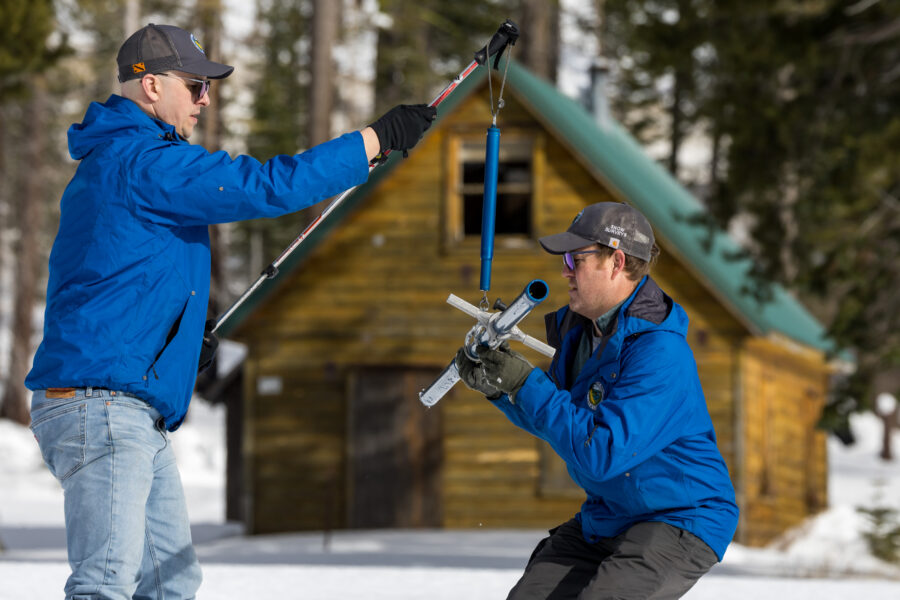

The Dept. of Water Resources (DWR) conducted the first snow survey of the season Dec. 30 at Phillips Station. The manual survey recorded 24 inches of snow depth and a snow water equivalent of 5 inches, which is 50 percent of average for this location. The snow water equivalent measures the amount of water contained in the snowpack and is a key component of DWR’s water supply forecast. Statewide, the snowpack is 71 percent of average for this date.
The results were welcome news for water managers who rely on the statewide snow surveys to make water supply decisions for the year ahead. California’s statewide snowpack had been lacking in early December with above-average temperatures and very little storm activity. Recent storms have turned that around and provided a significant boost to the snowpack and the state’s water supply.
DWR’s electronic readings from 130 stations placed throughout the Sierra Nevada indicate that the statewide snowpack’s snow water equivalent is 6.5 inches, or 71 percent of average for this date, compared to 115 percent on this date last year.

On average, the largest snow-producing months in the Sierra Nevada are January, February and March. Drought and flood always marked the California climate, but extreme whiplash between wet and dry is becoming more pronounced, not just year to year but often within the same season or month.
As of the end of the year, major reservoirs statewide were 123 percent of average thanks to recent precipitation on top of three consecutive years of above-average snowpack conditions.
On average, the Sierra snowpack supplies about 30 percent of California’s water needs. Its natural ability to store water is why the Sierra snowpack is often referred to as California’s “frozen reservoir.” Data from these snow surveys and forecasts produced by DWR’s Snow Surveys and Water Supply Forecasting Unit are key factors in determining how DWR manages the state’s water resources.