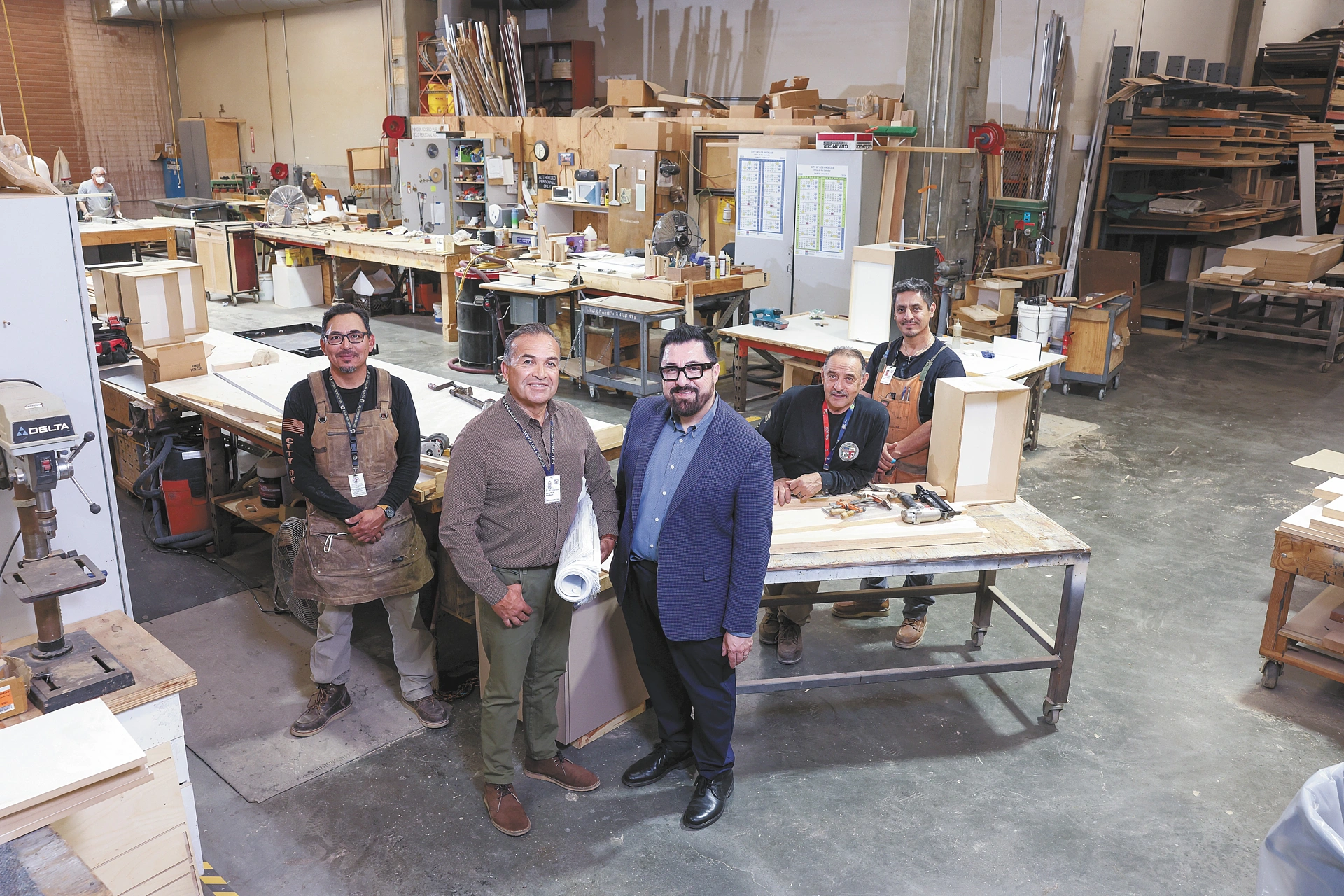
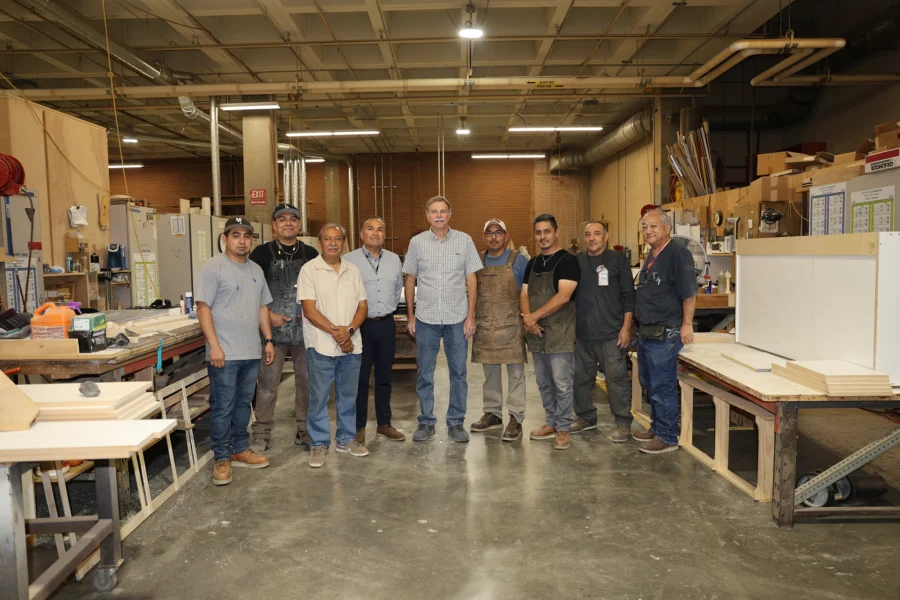
Look around, and you’ll notice that Los Angeles government infrastructure is built heavily on wood. A City requires a dedicated construction team to maintain the past while building its future. That team is Construction Forces’ cabinet shop.
The cabinet shop produces millwork and cabinetry, and custom restoration and replication of LA City’s historic fabric.
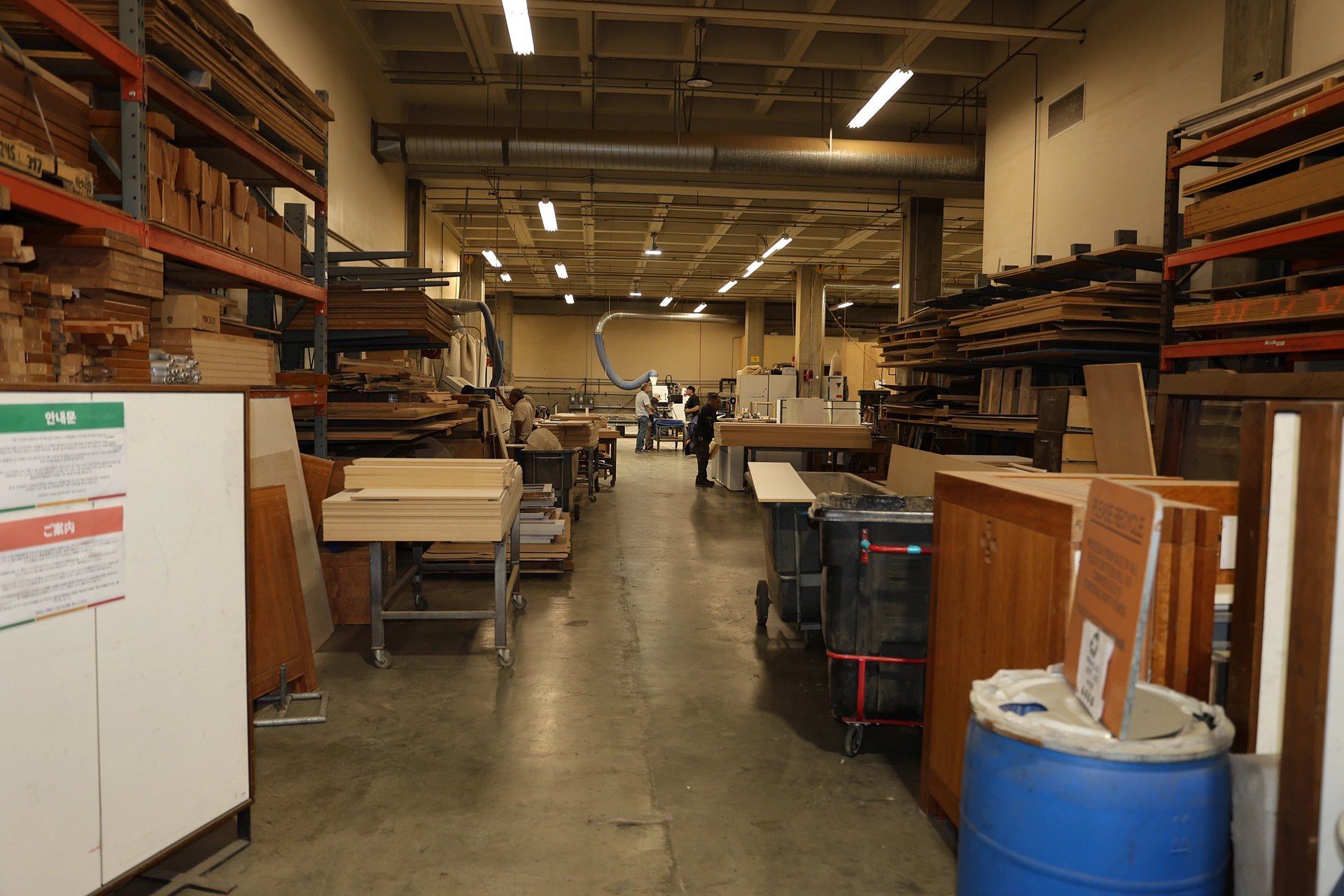
The shop, based in C. Edward Piper Technical Center, includes a variety of old-school tools complemented with large-scale computer-controlled routers, an edge banding machine, a spacious spray booth, a new wide-belt sander, planers, a table saw, and a joiner, among other machines. The equipment helped the Division build cabinets for the new City Council Offices in City Hall during the seismic retrofit in 2000, and countless other projects including the remodeling of fire station kitchens and the recent buildout at Piper Tech. The carpenter shop built the replacement Council desks in the City Council Chambers in City Hall that replicated the original design of the desks; restored the cupola of the historic Point Fermin Light House; rebuilt the front entrance doors to the historic Old Eagle Rock City Hall; replicated millwork, staircases, doors and other details for the historic restoration projects at Old Fire Stations No. 30, No. 44 and No. 60; and many other projects.
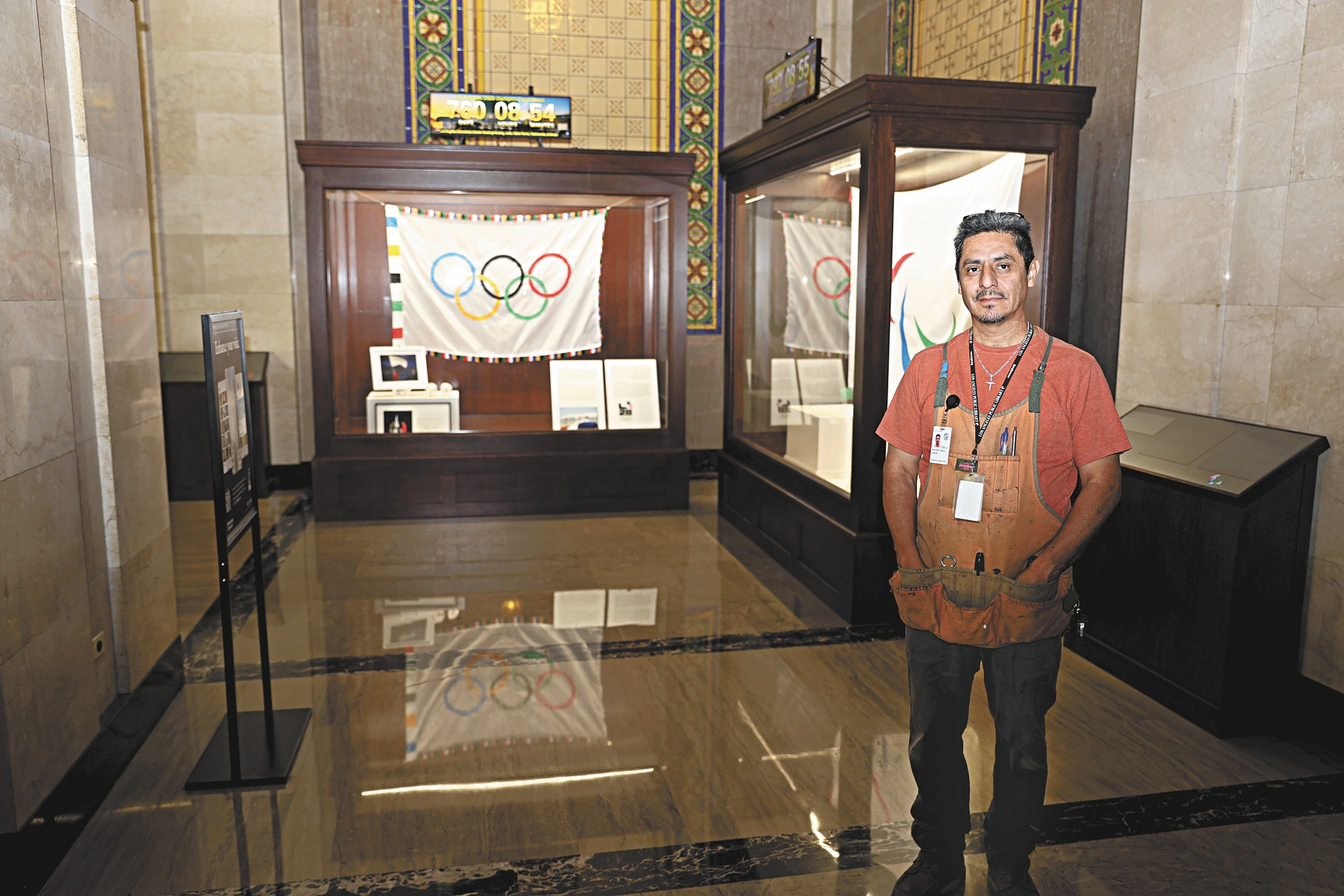
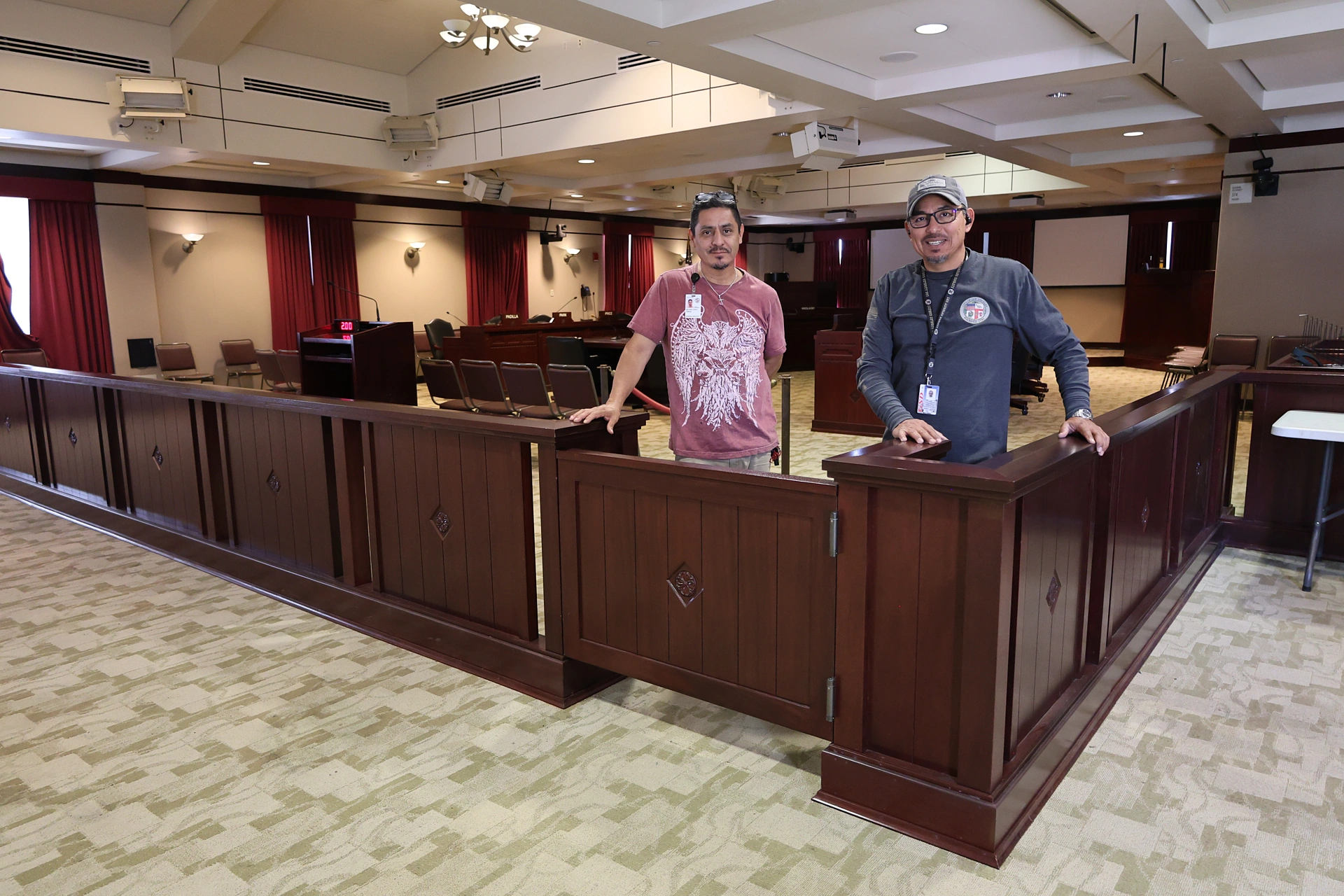
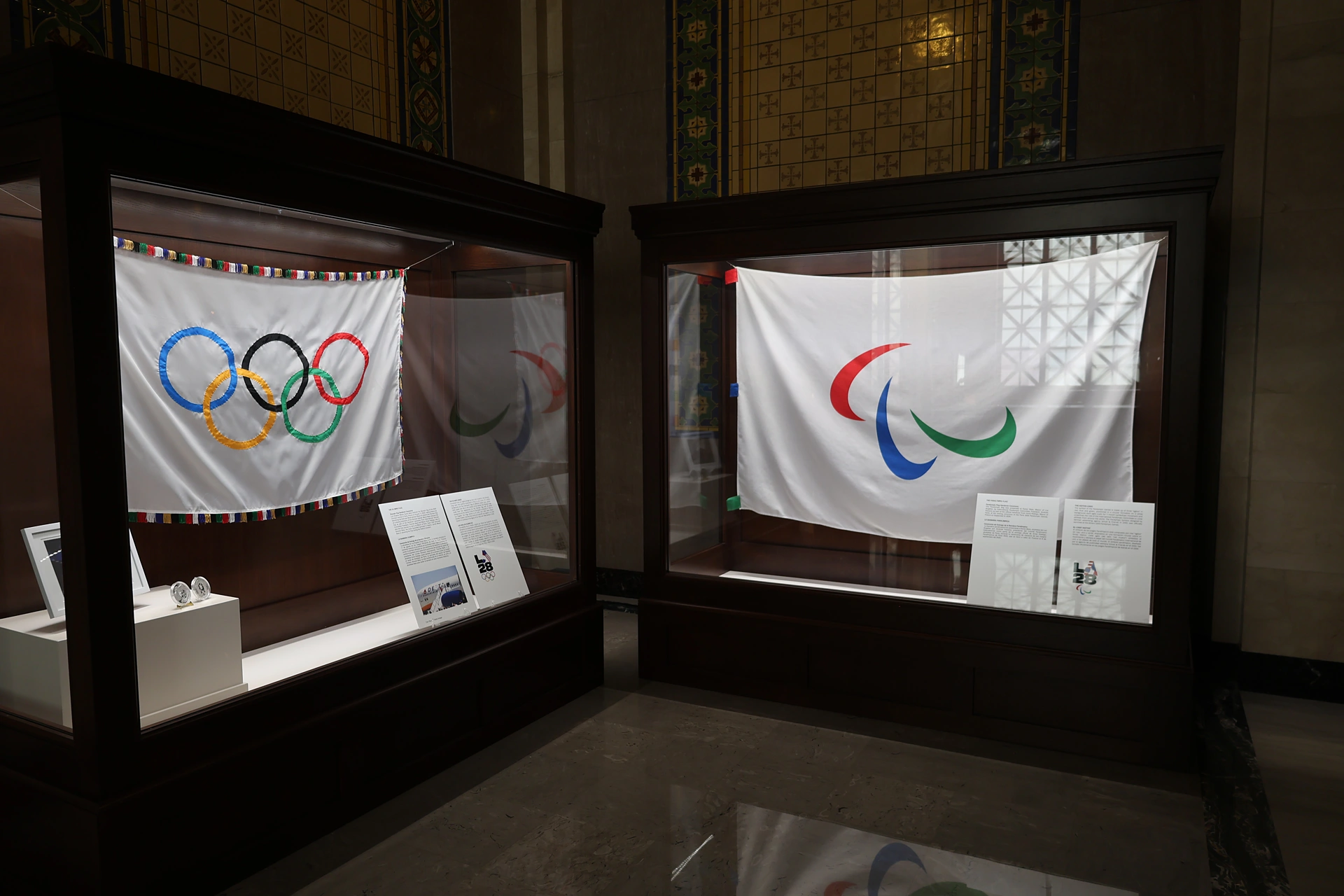
Current and recent projects include reclaiming wood from Central Library renovations; building cabinets for several LAPD stations; restoring Old Fire Station 23; building benches for the new Piazza Miramare in San Pedro’s Little Italy; restoring and rebuilding Frank Lloyd Wright’s Hollyhock House and its Residence A; a separation railing in the Van Nuys City Hall Council Room; details within the Vision and Warner Grand Theatres; and most recently building cases to display the Olympic and Paralympic flags outside the Mayor’s Office.
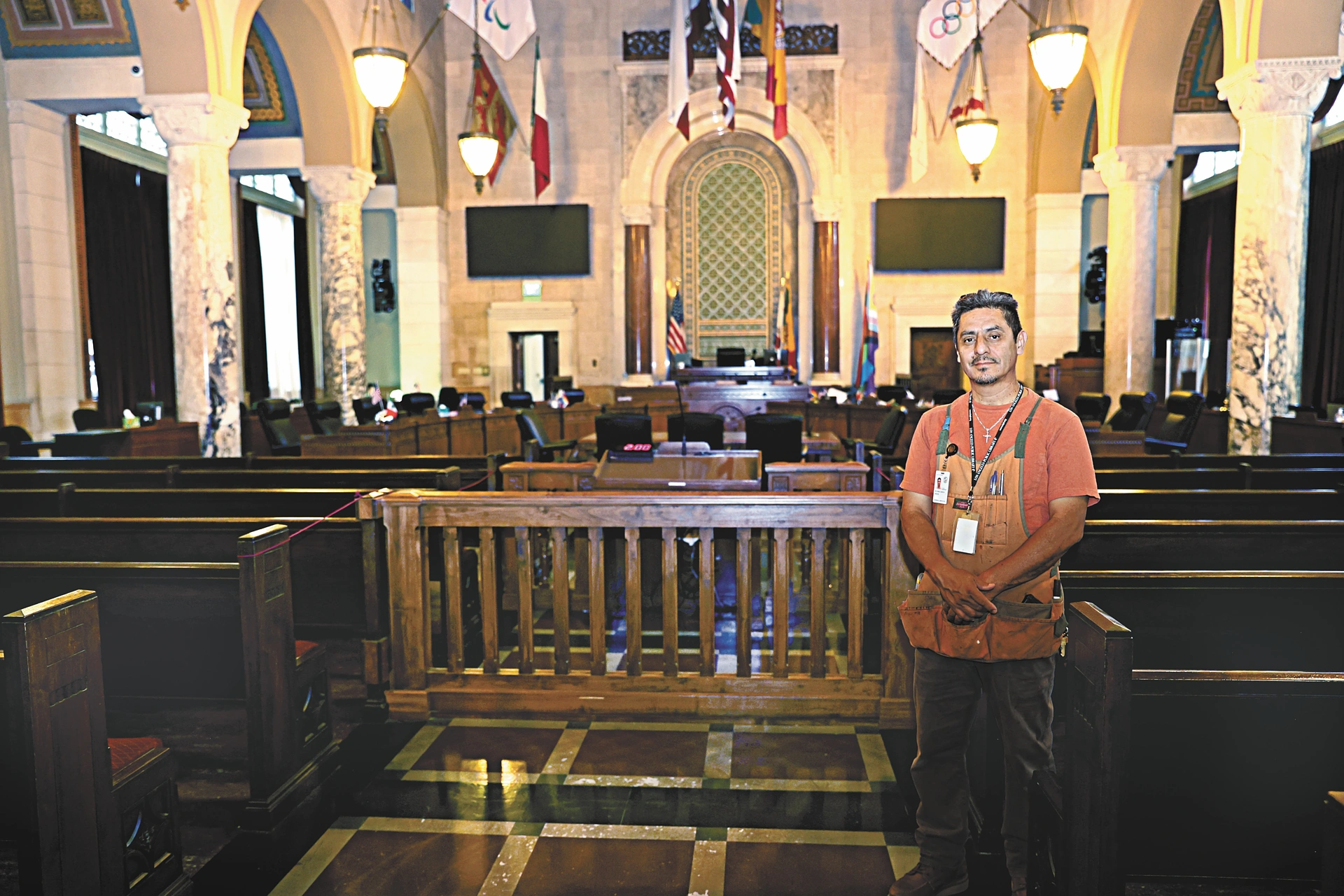
One of the biggest responsibilities of the team is maintaining the extensive and iconic wood in City Hall’s Council and Board Rooms.
Woods used include walnut, Douglas fir, cherry, sugar pine, and others. The Hollyhock House’s extensive use of vintage red gum requires the cabinet shop to search for months to locate appropriate stock of the rare, historic material.
Wood reclamation and sustainability are priorities, following proclamations from the Mayor’s Office.
Construction Forces: The Internal Contractor
General Services’ Construction Forces teams are unique in City government: they operate as internal contractors. The unit is sustained by bidding on and fulfilling competitive contracts from other City departments needing construction work done. They depend upon these internal projects for their income.
For most projects, the cabinet shop uses plans supplied by Public Works’ Bureau of Engineering.
With the Grain
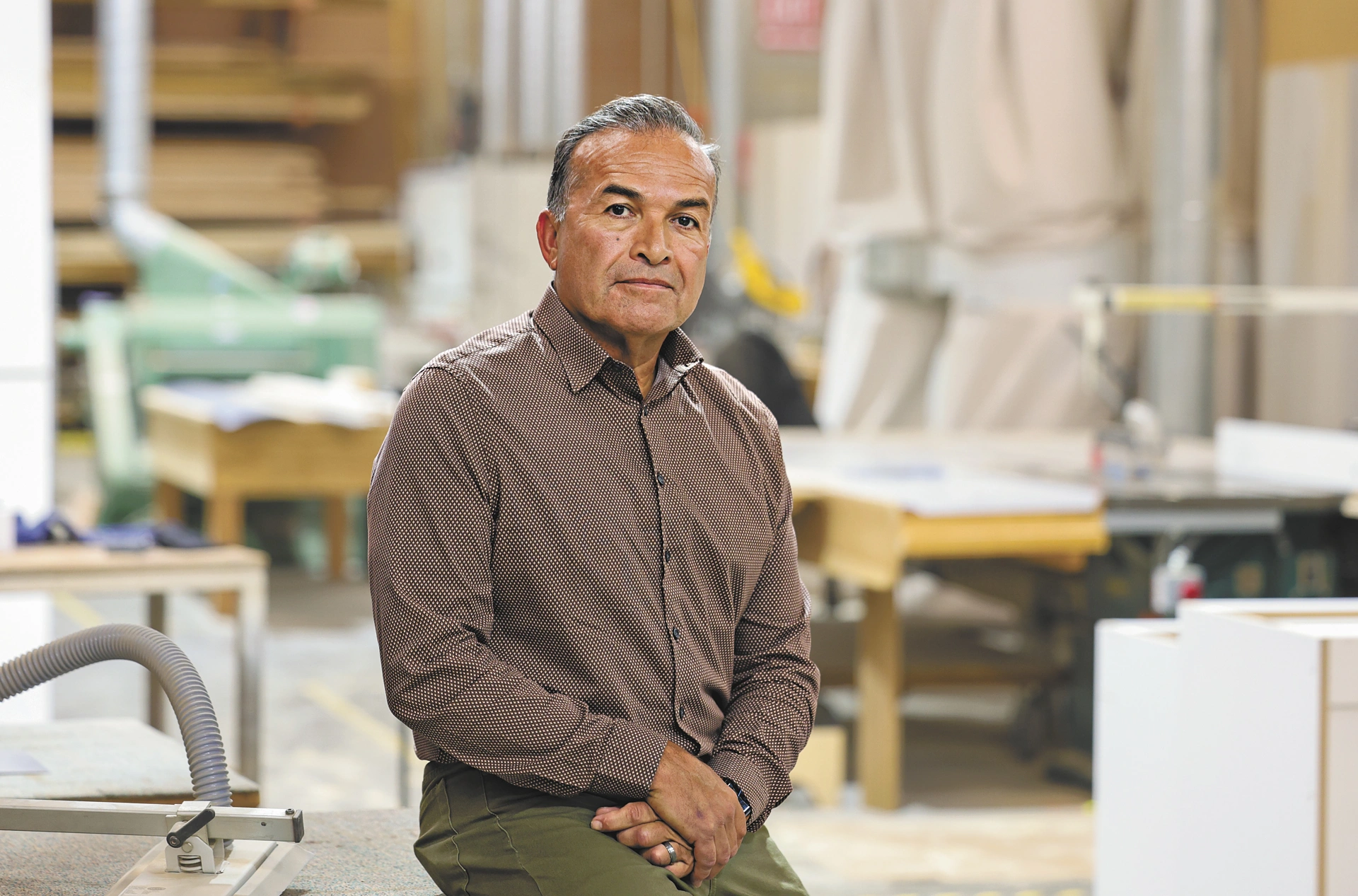
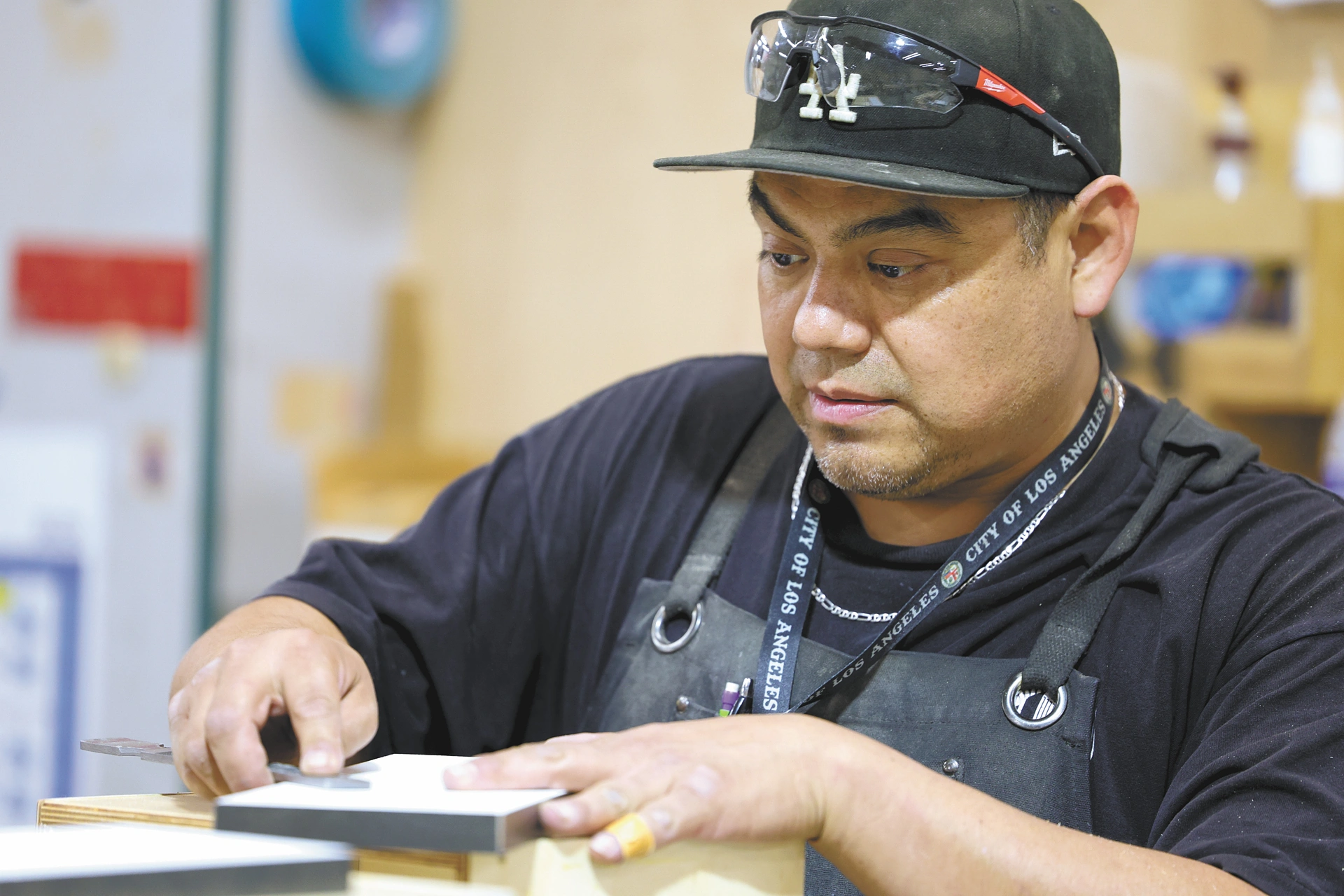
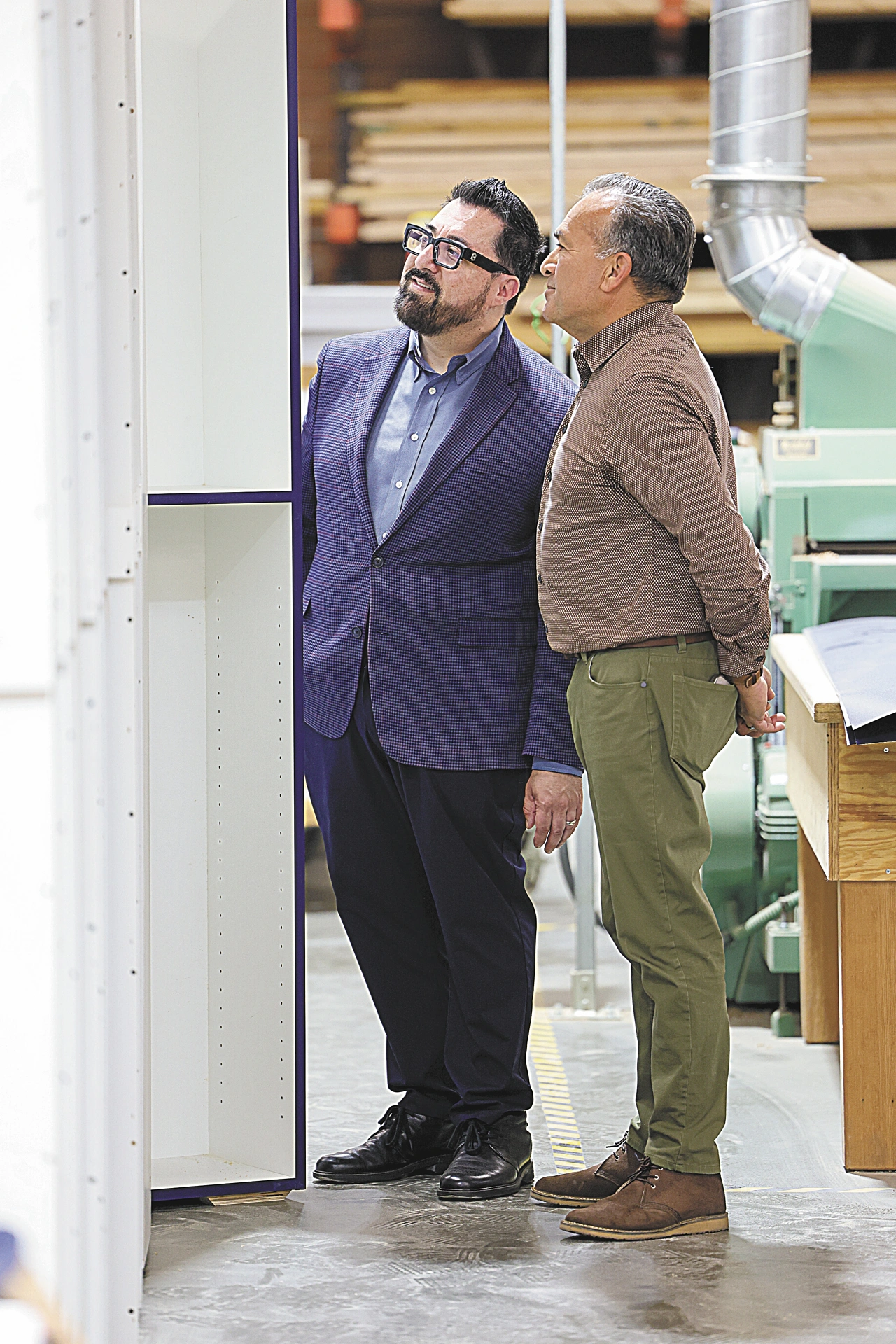
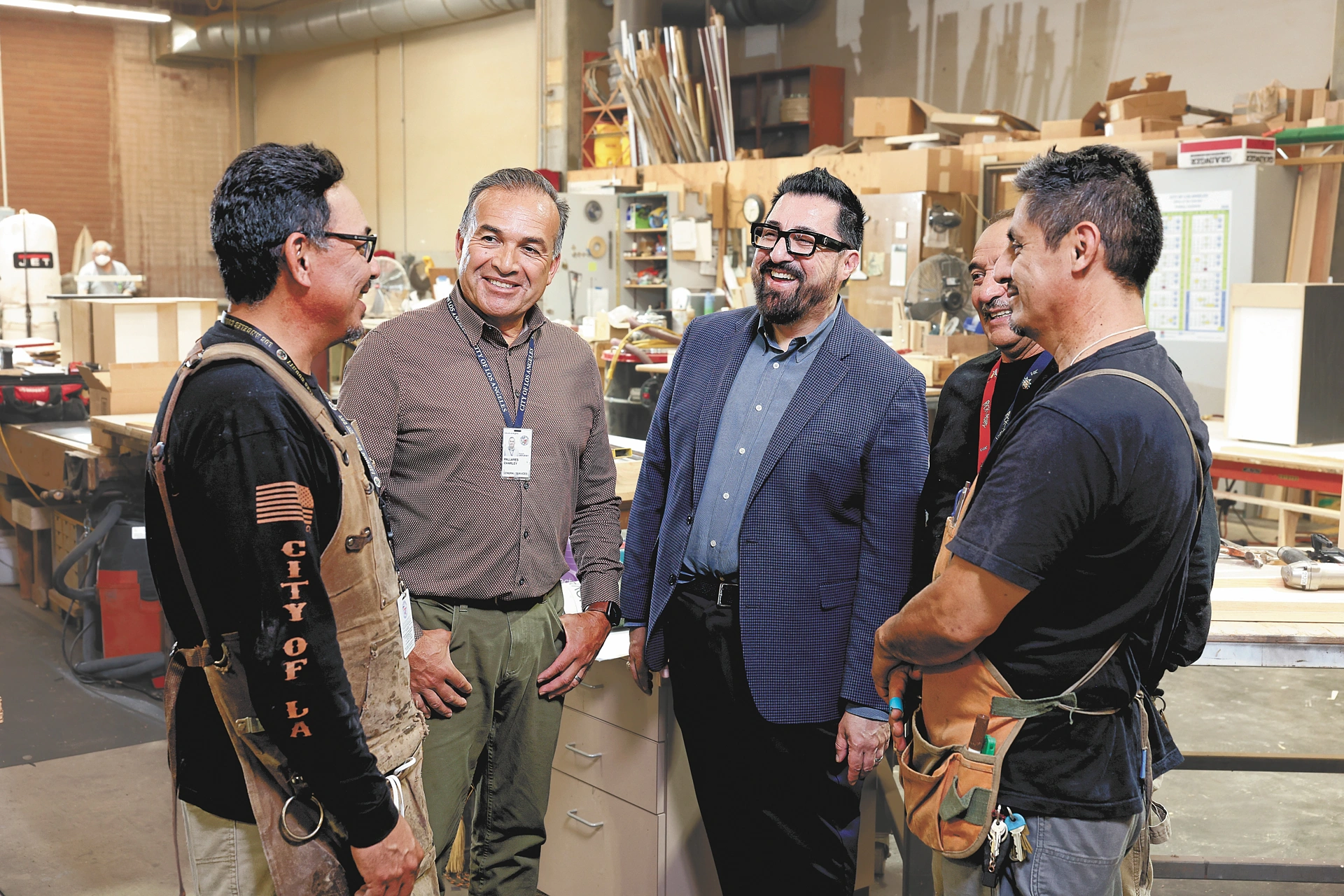
On May 7, Club CEO Robert Larios and Alive! editor John Burnes interviewed four members of General Services Construction Forces’ Carpentry crew. They are: Charley Pallares, General Building Superintendent, Construction Forces Division, 26 years of City service, Club Member; Alvaro Mendoza, Shop Lead, 6 years, Club Member; Blas Alvarez, Cabinetmaker, 3 years; and Jesus Becerril, Shop Lead, 8 years.
Gentlemen, thanks for putting down your saws, buffers and tape measures to tell us a little about what you do for the City. But first – how did you get to your current position?
Charley Pallares: I started with the City of Los Angeles back in 2000. My first appointment was at the LA Zoo as a Carpenter. Then I transferred to the LAFD as a Carpenter, and then I was promoted to Airports as a Sr. Carpenter, then back to the LAFD as a Sr. Carpenter. I made Building Inspector for a short time, then back to the LA Zoo as a Sr. Carpenter, then over here to General Services as a Construction Maintenance Supervisor, then to Superintendent. About four years ago, I was promoted to General Superintendent here. I’m in charge of the daily construction operations for the Construction Forces Division.
So you’re over the whole Construction Forces Division?
Charley: Daily operations. [Dan Rodriguez is the Director of Construction Forces.]
Very good. Were you a carpenter before your City career?
Charley: Oh, yes. I started my carpentry career when I was 17 years old out of high school. I started my apprenticeship with the union. I first served as a cabinet maker’s apprenticeship and then did a carpenter’s apprenticeship with Local 630. That’s a four-year apprenticeship. It took me five years. I continued working as a journeyman carpenter through the union, and I earned my general contractor’s license. I worked as a general contractor to support my family before coming to the City in 2000.
Alvaro, same question.
Alvaro Mendoza: I came in as a Carpenter, and the cabinet shop really liked the way I worked. They saw that I paid attention to how they built things, and how careful I was taking things apart. I worked my way up to this position.
Have you always been a carpenter?
Alvaro: Yes, I’ve been in the carpentry industry for over 30 years.
Blas Alvarez: I applied for the City and they told me to come take a test for Cabinet Maker. And they say, “How long have you been making cabinets?” I say, “40 years.”
Charley: And it shows.
Jesus: I’ve been with the City for eight years. Prior to that, I was doing a lot of remodeling for homes. Prior to that, I started my apprenticeship in ’92, and then from there, that’s how it came to be.
Cabinet Shop Projects
Give us a broad overview of the cabinet shop – what do you do? What kind of projects are you working on?
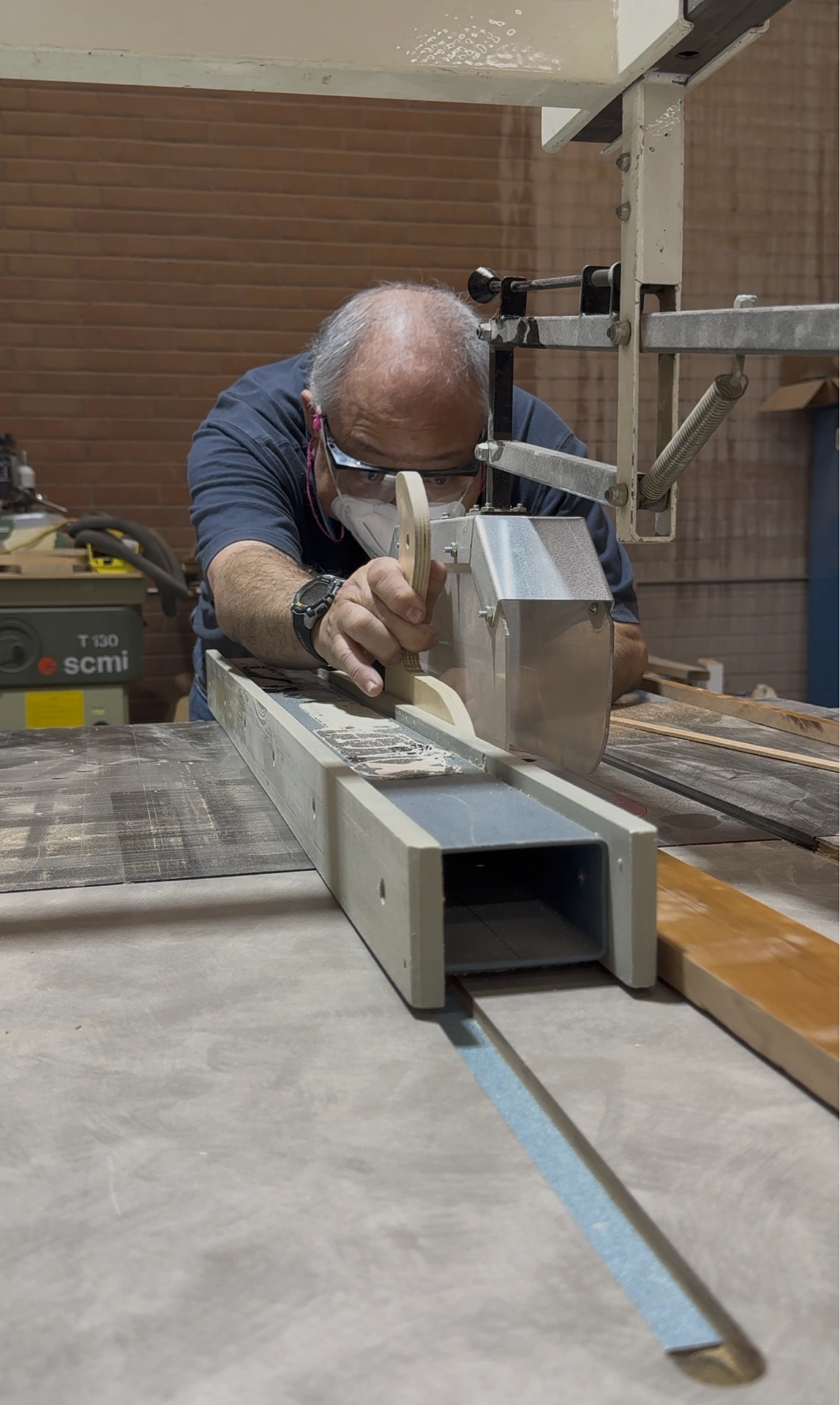
Jesus Becerril: The shop in Piper Tech is a little over 10,000 square feet, and it consists of three table saws, two planers, a joiner, an edge bander and some belt sanders. We also have a CNC [automated Computer Numerical Control] machine, some drill presses, shapers, a panel saw, and a spray booth.
We do a lot of finishes and different materials on different projects like building personal desks for Councilmembers, building interiors for Fire Stations and some historical work, too.
Alvaro: We can do everything from small to extremely large projects, and all of us in the cabinet shop work together and try to get everything done as efficiently as possible.
Charley: Some of the small projects include the pedestal for the mayor when she did her press conference in front of the Coliseum. The boys were called to go out there and repair that podium before the cameras were on it. That would be a small job that they do.
Some of the bigger jobs, like the cabinets at Residence A at the Hollyhock House, have huge historic value. The carpenters do a lot of historic work at City Hall, including the Council chambers. The public isn’t going to notice a lot of the work because the carpenters blend it in very well to match the existing, so it looks like it’s part of the existing chambers to meet the historical portion of it.
Into the Woods
What kind of wood is it at City Hall?
Alvaro: Inside the Council chambers is mahogany. The Van Nuys Council chambers, too.
Jesus: We used some walnut too because they had walnut furniture already.
Charley: The original wood in Van Nuys is walnut. The carpenters have to handpick that at the lumber yards. That’s not something where they place the order and it gets delivered. Blas will go down himself and select it so it matches the existing. They do such a good job that you don’t even know it’s new. Especially Van Nuys. I was very impressed with that. After COVID when the City was bringing the regular Council meetings back, we were tasked with building a partition in front of the Council room to separate the public from the Council members to keep everyone safe. The LAPD requested a type of barrier. But nobody wanted it to look like it had just been built and placed there. So the carpenters designed it, fabricated it in the shop here, and installed it. If you go to Van Nuys, you’ll see that it blends in perfectly. It’s great. That allows the LAPD time to respond if anybody gets out of line. It’s a safety feature.
There’s nothing ordinary about Frank Lloyd Wright’s Hollyhock House. It’s a UNESCO World Heritage site and a City treasure. What do you do for Hollyhock House?
Charley: Jim Byer [now Retired] was our long-time Cabinet Maker here in the shop. He had started that project years ago through Cultural Affairs with three Carpenters. When Jim retired, another supervisor took over, Ken Radosevich.
Hollyhock House is a Frank Lloyd Wright building, built in the 1920s, that the City owns in Barnsdall Art Park. A lot of the wood used was Douglas fir and red gum. A lot of that wood is old growth. The Carpenters have to go down to the lumber yard and pick it out, especially the Douglas fir and that red gum.
Blas: It’s not easy to find it. It takes months to get.
Charley: We’re doing that project through Cultural Affairs and Project Restore. Construction Forces also did a similar project – the Hollywood stairs in Beachwood Canyon.
At the moment we’re restoring the doors from Residence A in the shop. [Residence A is a related building next door to Hollyhock House – Ed.]
Alvaro: Yes.
Jesus: We’re repairing some of the doors and adding some of the stops that are missing. It’s a Douglas fir door. We’re also building the exterior, which consists of sugar pine. We’re blending in the color, the stain, to look in a consistent way to match what is already there. We are dealing with some old wood which has minerals from the rain that have gotten into the building. We do our best to do what we can to match the stain and make it a consistent flow with what Cultural Affairs wants to have to make it look original.
Charley: That’s a challenge.
Jesus: We have taken it to an extent where we have bleached some wood to try to take some of the new richness to make it look old. We have done that with some of that in the Residence A.
Charley: New-growth has more pitch in it as opposed to the heartwood, which is what the old-growth was made out of. So when the Carpenters get the new stock, it’ll be a lighter color of wood. Let’s say if you have one board, a portion of it will be dark and another portion will be light. They’ll have to stain that and match the grain to blend it all together.
It’s a great partnership between Cultural Affairs, Project Restore and us.
Alvaro: Sometimes we find old wood that has been aged and we try to save it as much as we can so we can use it into the buildings that we’re working on. And that’s a challenge as well.
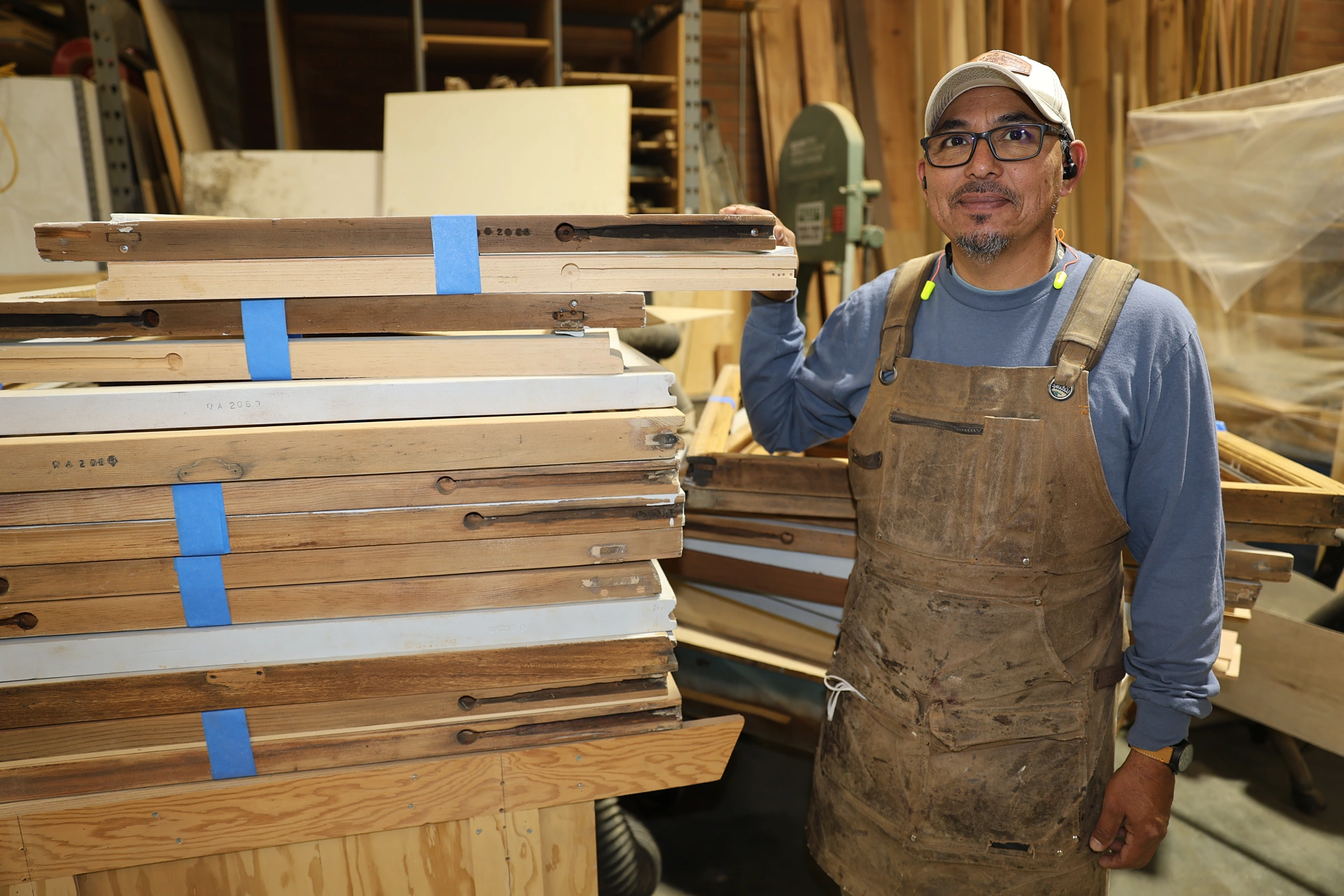
Charley: In some of the demo projects we get, the Carpenters will salvage a lot of that wood, and we’ll use it on other projects that we know are coming up. We have a couple pallets out here. Where did that come from, one of the old libraries?
Alvaro: Van Nuys Library.
Charley: We know we can use that wood on another project, even though the project hasn’t come to us yet. We have some space in the shop where we can store it, knowing that it’s going to be needed.
What’s the completion date on Res A?
Alvaro: They’re shooting for August.
History
What’s the history of the cabinet shop and the Carpentry division? Has it been around since the beginning of the City?
Alvaro: My understanding by one of the Cabinetmakers is that it’s been around for around 30 years.
Charley: That’s our Division, Construction Forces. The cabinet shop has evolved over time to what it is now. As you know, we’re not funded off the general fund. Our funding comes from our individual projects. We’re like contractors within the City. We’re performance-based. Each project will be estimated through our estimators; we have to get the project done within that funding and time frame. That’s the tough part of it, but we’ve been around for about 30 years now.
As you stated, the cabinet shop’s been a part of Construction Forces since the beginning. And now, I’m seeing a big transition Citywide to rely on us because a lot of carpenter and trade positions aren’t being filled in other departments. A lot of the departments are turning to us now to do a lot of work.
It’s just not the cabinet shop. Construction Forces is doing work out in the streets. We’re doing tenant improvements. So we do a lot.
Our guys are union hires as well as City employees. We can go in and get the work done. Our teams are very specialized. We’ve all had the training.
It gives you a lot of flexibility, I would imagine.
Charley: It does. Right now, we have a lot of work. But not always. It is a challenge at times.
The Olympics of Cabinets
Tell us about your most prominent of recent projects. Talk about the Olympic flag cabinets outside the Mayor’s Office.
Alvaro: Blas built a lot of the cases.
Blas: I fabricated the cases with Juan Carvajal. He has Retired already. Alvaro and Jesus were involved, too.
Jesus: I did the finish work on the cabinets. So we all had our hands in that cabinet project, along with what took us about eight guys to move that thing there.
Charley: Yes.
Jesus: It’s extremely heavy.
The good thing was the glass was installed afterwards on site. If not, I don’t think we would have ever gotten it moved. It is divided into three parts – the bottom portion, the center case, and then the upper lid, which contains the lighting. The glass got installed afterwards.
It was built in the cabinet shop and then assembled in City Hall?
Jesus: Yes, that’s correct.
Who designed it?
Alvaro: That was Jim Byer.
Charley: He was our Cabinetmaker who recently retired.
Did LA28 or the International Olympic Committee have a say in how it looked?
Alvaro: Yes, they did.
Charley: They had a crew out there that functioned like a quality control crew. They placed all the materials inside the cabinets, like the flags. All the displays.
Blas: We added the pedestals for the Braille interpretations afterward. They’re on each side of the cabinets.
How long did that take you to do that?
Charley: From when it started, from talking with the Olympic staff, and then doing the designs, about six weeks.
Blas: Six or seven weeks.
Charley: Our Construction Forces electricians had a hand in that as well, wiring it up and getting the lighting in there.
Blas: The hard part was finding the wood.
Charley: What wood was that?
Alvaro: White oak. It was quartersawn as well.
Blas: Finding it was the hard part.
Charley: To match.
It’s beautiful work.
Charley: Thank you.
A Multitude of Materials
Tell us something we don’t know about the City and its wood.
Alvaro: Well, different buildings use different materials and different kinds of woods. Van Nuys Council chambers use mahogany. The mayor’s desk, that was a walnut, correct?
Blas: Walnut.
Alvaro: Black walnut.
Blas: The Central Library is cherry.
Alvaro: For Residence A, we use red gum, sugar pine, and Douglas fir.
Charley: And how about Vision Theatre?
Alvaro: That was a mahogany.
Charley: We have the Madrid Theatre coming up. That’s in process. And for the Warner Grand, we’re doing just the laminates down in the dressing room areas.
Alvaro: For the old Fire Station 23 restoration, we have to use mahogany and Douglas fir as well.
Charley: As far as the City’s wood, what would you guys say? It’s pretty much what’s existing, and a lot of it is historic. It’s old.
Blas: The hardest one we had trouble finding was the red gum for Residence A over at the Hollyhock Park. That was a specialized wood, which is not that common. It’s limited to certain shops, certain wood providers.
Charley: Is it tropical?
Blas: It’s tropical. I believe they said it’s from Florida.
Alvaro: The last time, I waited three months to get 200 board feet.
Charley: That’s right. They had to ship that.
Blas: They consider it a softwood.
Alvaro: We use it because that’s what was called out by Frank Lloyd Wright. He wanted red gum on his plans.
Charley: When I was the shop guy over at the Fire Dept. on the ground ladders, we used clear Douglas fir for the main beams. It’s non-conductive for the fire guys.
Right.
Charley: Non-conductive for electrical means that electricity doesn’t transfer through it. You can’t use metal. We used oak for the stops and maple/hickory for the rungs on Fire Dept. ladders.
I figured they would just buy ladders off the market, but you made them for them?
Charley: I did a lot of the repairs. Alaco Ladder Company is in Chino. They used to be here in LA, formerly LA Ladder Company, and they made all the ladders. They moved to Chino years ago. So the department buys them now from Alaco; at the time Alaco had only three guys working there in the ladder shop, and they supply ladders for fire departments along the West Coast. In the LAFD shop, we did a lot of repairs on the ladders. I would make beams and break the ladders down; the guys would saw cut them. So instead of buying a whole new ladder, there were a lot of repairs done.
Makes sense.
Charley: In some cases, I was pretty much making new ladders. The woods in that were Douglas fir for the non-conductivity; maple/hickory for the rungs on that; and then oak for all the wood stops on the extension ladders.
At the LA Zoo, we’re redoing a restroom. We’re doing more and more work over there. The cabinet shop fabricated the door jambs out of redwood.
If you want to know what’s going on in the City, talk to Construction Forces. They know everything.
Charley: I hear that so much. A lot of people say, “We don’t know what you guys do over there.” Well, look around the City. We’ve done it all. We have a team outside of the carpenter shop that’s closing off the pedestrian tunnels by the schools. That is through the Bureau of Engineering. We built the majority of the ABH homeless shelters.
Were you involved in the tiny villages?
Charley: Not at the beginning. We’ve done quite a few repairs on them, so yes, we’re involved in it now.
Training
Where did you learn to become master cabinet makers?
Blas: Forty years of experience. But I have been working with wood for 45 or 46 years.
Charley: A master carpenter or master cabinet maker really comes into the mastery of the trade at the end of their career. When you start off as an apprentice, you’re working your way through; you’re learning. Like Blas was saying, he’s watched a lot of things over the years, taking bits from people and applying it in his own style. I often refer to Blas as the maestro primarily because he’s been around and he’s got a lot of experience.
We’ve all done our apprenticeships through the union and learned the basics, and you take it from there. A lot of it comes down to, you learn everything because you’ve got to support your family. All tradesmen, electricians, plumbers, and carpenters, we’re always working ourselves out of a job. You finish one job, you’ve got to move on to the next one. You’ve got to be versatile. As a carpenter it all depends on where your skill level ends up and how you become a finish carpenter or a shop carpenter – a cabinet maker.
The spectrum is huge. If you can master that skill, you’re going to create that demand for yourself. There are books, videos and now the internet for additional information.
Alvaro: I started as a carpenter with my dad and my uncle. We were rough carpenters. And then over the years, when I went to junior high, the teachers showed us little things. In high school, I went to wood shop, and I really liked it. Then I found out my grandpa was a cabinet maker. So over the years I’ve learned little tricks of the trade and I started loving it more and more. To me, it’s fun. I enjoy working with my hands.
Jesus: Back in high school, a wood teacher brought in a construction foreman. She brought him in to tell us, “Some of you guys could actually make a living off of this.” At that time I was getting into it and I saw that that was something I liked doing.
My father was a carpenter for the City. So throughout the years I learned cabinet making and framing. It takes a long time to develop skills that you learn and take up from different guys who have mastered this. From there you get your experience as you do it. It’s hands-on.
Charley: When you enjoy something, as you gentlemen know, you’re going to absorb everything you can. That’s how I feel about woodworking and carpentry.
You can make a decent living. It’s not a great living, but decent, and that’s how we ended up here. You want to do better, you want to learn more, and that’s how you end up as a finish carpenter. You do the fine work.
Is it a dying art? How do people see you?
Jesus: It’s a developing environment. We’re getting new tools that actually help us with time frames. Back in the day, we hammered a nail with a hammer. Now we have nail guns with the compressor. And we’re also now getting nail guns with a battery so you don’t have to bring a compressor anymore. So I believe it’s advancing and it’s helping us to not waste time or materials.
With all that new technology, you still need someone to put it in the store, because it’s not going to walk on its own. The cabinet’s not going to hang itself on the wall. You still need carpenters to make sure that, first of all, the floor’s level, the walls are plumb, all that.
Alvaro: We don’t think it’s a dying art. It’s still there.
Charley: There’s a need. Technology is not going to take our job away from us. It’s going to help us.
Are people jealous of you?
Charley: I don’t think it’s jealousy.
Alvaro: A lot of the people are impressed. They just want to learn. They want to see how things are made. But I don’t think it’s jealousy. Sometimes they come and ask, “How do you build things like that? What made you do that?” I think it’s passion.
Jesus: No one ever praises the guy who framed it. They always praise the guy who finished painting it and the guy who finished installing the cabinet. “Oh, wow, how beautiful.” They never praise the electrician who ran the conduit, because he was there before us. We’re like the last guy, so we get the praises. We all should thank each other. Without the wall being there, I wouldn’t be able to hang my cabinets. Without the flooring that finished the nice tile work or the carpet laying, we wouldn’t see that nice product shine.
Charley: Years ago in the LAFD shop, one of the mechanics came in early in the morning. He was getting ready to go out in the field. I had a pile of wood on my workbench, getting ready to build a cabinet for one of the stations. At the end of the day, the same mechanic, who’s still a good friend, came back and saw this cabinet. He’s looking at it and says, “Where’d that come from?” And I said, “I built it.” He says, “Wait a minute. Was that the pile of wood on your work bench this morning when I left?” And I said, “Yes, that was.” “I don’t believe that,” he says. “That was just a pile of wood this morning. Now it’s a beautiful thing that somebody’s going to use for years.”
I remember decades ago when This Old House exploded on PBS.
Charley: Yes.
There is a deep admiration for people – men and women – who can still do things like what you do. With your artistry.
Charley: Thank you for that.
Favorite Projects
What have been your favorite projects?
Blas: I matched a cabinet in City Hall for a Councilmember. That was walnut. She really liked it.
Alvaro: That was very challenging. That detail guided us for the rest of the wall unit and her desk. That was one of my favorites also.
A favorite of mine is restoring old Fire Station 23. It’s not completed. Other carpenters were trying to remove stuff with a crowbar. And I was just like, “No, you have to take your time. We have to save as much as possible because we have to reuse it; we have to revive it so we can showcase it later on.” It’s a historical place.
The other one is Residence A. Watching Jesus work matching the old stain and helping him out working that building has just been impressive. It’s one of my favorites as well.
Jesus: I liked the one we did in Van Nuys – a mahogany pony wall, which had a lot of nice rich red color. We matched the existing stain to the existing wall. We matched all the details, really.
Charley: You guys built that from scratch.
Alvaro: They’re all different. They’re all great works that we all did together.
Blas: Working together.
Charley: We’re lucky to be able to do that.
Alvaro: I would add another one – a beautiful conference table in the mayor’s office. We restored a 12-foot table. It turned out very nice.
Charley: It’s going to be there for generations to see, like everything in City Hall. It continues the history of the City of Los Angeles.
Blas: I matched eight doors at the Vision Theatre.
Charley: With the inlays with the triangles.
A Passion for Wood
What do you love about what you do?
Alvaro: The end product. And seeing the people who we work for, that we build the stuff for, just being happy about how everything came out. That’s satisfaction. I love what I do.
Jesus: Making something out of lumber just sitting on the floor – all of the sudden someone comes and sees the end product, which could be a nice cabinet, bookcase, or table. Making something useful for your livelihood.
Charley: It’s being used by everybody and it’s benefiting the City. Everything we do benefits the taxpayers. That’s huge.
Blas: I like making customers happy.
Charley: When I was doing woodworking every day for different departments, it was just great – working at the airport, at the LA Zoo, at the Fire Dept. At the LA Zoo, I built transport cages for the animals. The keepers at the Zoo would come up with an idea for something that they needed – for example a door shoot, benches, tables, things that they could use to help them with their daily job. At the Fire Dept., it was working for the Firefighters with the ladders, the apparatus floor, cabinets, anything that I could build to help these guys, to help them do their job. Same thing at Airports with the tenant improvements over there. There’s some great satisfaction there.
We’ve been doing it this long because we love it. It keeps us mentally strong and physically healthy. Our bodies do wear out. With the City of Los Angeles, generations are going to see what these guys do from our shop. We’re probably one of the last shops around. We are definitely one of the biggest right now. I don’t know what Water and Power or the Harbor Dept. has. We’re probably one of the last big shops left in the City. It’s kind of tough to accept.
Be happy to still do what you love, productively.
Charley: There it is, right there.
Gentlemen, this article is our way of recognizing and celebrating you. From all of us at the Employees Club, we thank you.
Blas: Thank you.
Charley: We appreciate Alive! and what you’re doing. This is great stuff.
Alvaro: Goodbye.
Jesus: Take care.