
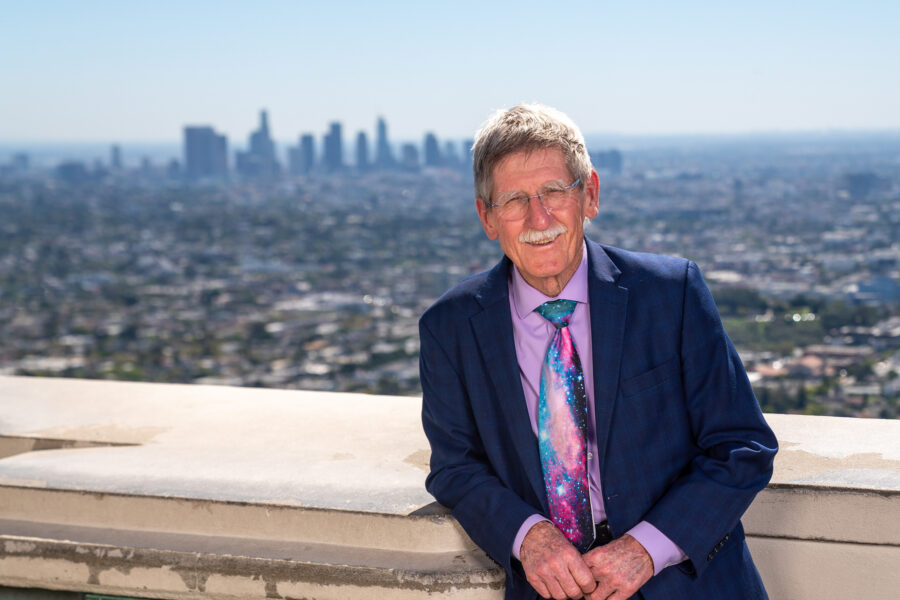
Fifty-six years is barely a blip in the life of the visible universe.
But in the life of a City employee, it’s legend.
This month, as his formal directorship of Griffith Observatory enters its fifth decade and his overall employment with the City surpasses an astounding 56 years, Alive! honors and reminisces with Dr. Ed Krupp, Observatory director and Club Member. (He’s been a Club Member for 45 of those 56 years.)
Known throughout the scientific and general world as one of the most visible astronomers and archeoastronomers (studying ancient peoples and how they viewed and interpreted the stars), Dr. Krupp brings familiarity, fondness and fun – not to mention serious respect and deep admiration – to the Observatory. He also brings a strong affection to the Club and its purposes.
In this month’s feature story – part one of two – Alive! explores his past and his early days of stabilizing the Observatory administration, which then set the stage for a spectacular renovation and relaunch in 2006; he generously shared that with Alive! readers. The Observatory’s continued popularity alongside its role as scientific educator grow every year due to his stewardship, and the City applauds in gratitude.
In these pages and in next month’s, we look to the sky and see a true star. Thanks, Dr. Krupp, for your service to Los Angeles and the world.
Alive! thanks Jennifer Wong for her assistance in producing these articles.
No Place Like Griffith Observatory
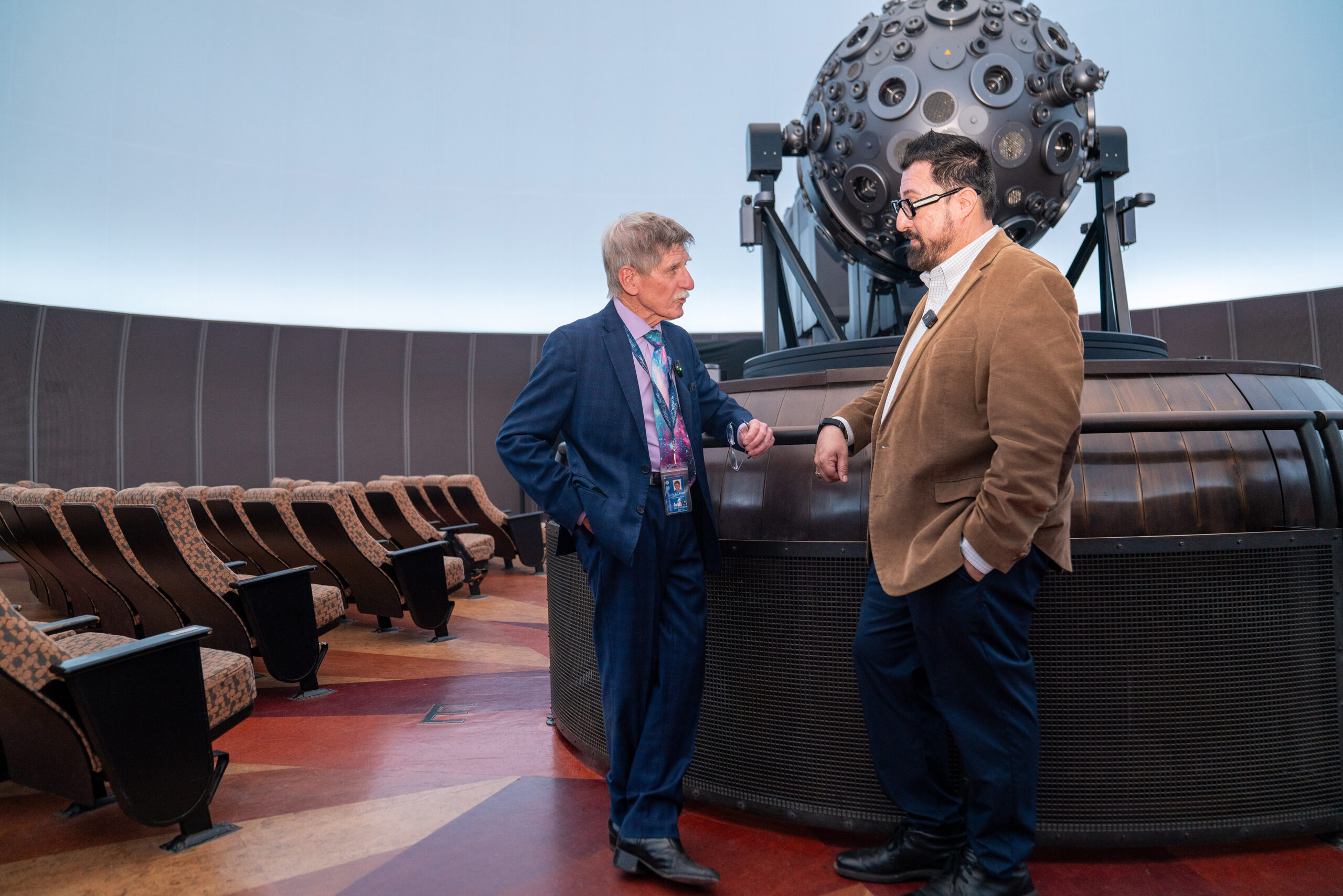
On Thursday, Feb. 12, Club CEO Robert Larios and Alive! editor John Burnes interviewed Dr. Ed Krupp, who’s now in his fifth decade as Director of the Griffith Observatory. The interview took place via Zoom.
Dr. Krupp is a longtime Club Member and from time to time contributes educational stories and photos on the subject of archeoastronomy.
Alive!: Dr. Krupp, thank you so much for joining us today in your busy schedule. And congratulations on your five decades as Director of the Griffith Observatory, one of LA’s true icons. Well, both you and the Observatory are true icons!
Dr. Ed Krupp: Thank you.
Let me just say at the outset, I’m really honored that you would do this. I maintain a relationship with Alive! every month, and I always enjoy opening it up. I am impressed by what you do with that paper. It enriches the City.
Alive!: That’s very kind of you. It is a pleasure for us to produce it and to honor City employees for all that they do – work that is often overlooked, and yet City employees are doing great things every day. We’re honored to be able to tell these stories.
Dr. Ed Krupp: Very good.
Primordial Formation
Alive!: Let’s start with your journey to the position you’re in. It’s well documented at this point, but go ahead.
Dr. Ed Krupp: Sure. I’ll try to keep it concise. My direct connection to the City of Los Angeles, and the Dept. of Recreation and Parks and Griffith Observatory, became official in 1970 when I was hired as a part-time Planetarium Lecturer to give morning school programs. When you’re hired for that job, they need somebody in the mornings, and for some reason they’d lost a few lecturers. But as you learn the shows, you wind up doing the programs in the afternoons and the evenings, too. I was still in grad school.
Alive!: At UCLA.
Dr. Ed Krupp: At UCLA. At that time I was also soon teaching elementary astronomy and astronomy lab at El Camino College in Torrance. Not a full schedule, of course; I was a part-time teacher there, too. But I was driving this gigantic triangle around Los Angeles from Griffith Observatory to UCLA to Torrance for El Camino. It kind of drove me nuts. But nonetheless, it was fate that had conspired to bring me to the Observatory. Can I indulge this a second?
Alive!: Sure.
About Dr. Ed Krupp
Born:
Chicago
Education:
Summer Science Program, Ojai, California
Pomona College (undergraduate)
UCLA (Master’s and doctoral degrees)
Teacher:
El Camino College
USC
UCLA
Griffith Observatory:
Planetarium Lecturer (part time), 1970
Curator, 1972
Acting Director, 1974
Director, 1976-present
Co-Founder:
Friends of the Observatory, to raise funds for the continued development of Griffith Observatory
Archeoastronomy:
Has studied more than 2,200 ancient, prehistoric and traditional sites around the world regarding the impact of astronomy on ancient belief systems
Eclipses:
Been to 17 total solar eclipses; headed to his 18th this summer
Author:
More than 12 books for adults and children; dozens of research papers, books. journal/magazine articles and columns; live presentations for planetarium shows; and has appeared in and/or written more than a dozen documentary films
Affiliations:
Membership in the American Astronomical Society; the International Astronomical Union; and the Committee for Skeptical Inquiry
Honors:
Received awards and honorary degrees from universities, institutes and conferences; and most recently was honored with the Education Prize by the American Astronomical Society
Club Member:
Since 1981 (45 years of Club Membership)
Dr. Ed Krupp: The reason I wound up taking a job as a part-time Planetarium Lecturer was because of my graduate school adviser, Dr. George Abell. He provided for me one extraordinary opportunity after another for my whole career as a grad student. I’d known him from an accelerated summer high school program called the Summer Science Program. He was a professor at that and I attended the six-week program in Ojai. That would have been back in 1961. Later, I was one of his graduate students. He called me into his office one day and said, “Ed, they have a job for a planetarium lecturer at Griffith Observatory. I think you ought to take it.” His recommendation was call the person in charge at the Observatory at the time, Leon Hall, Associate Director but acting as Director. I had been doing planetarium lectures in the small planetarium at UCLA, which is partly why George Abell thought this would be a good thing for me to do.
I had absolutely no interest in doing this job.
Alive!: Really?
Dr. Ed Krupp: Yes, true. So I ignored my adviser, which is a perilous thing to do. I ignored him quietly and didn’t do anything about it. He called me back into his office about two weeks later and said, “Ed, they have a job for a planetarium lecturer at Griffith Observatory. I think you ought to take it.” That time I got the message and called and made an appointment, and gradually I became a Planetarium Lecturer. You had to learn by attending shows that were being given by someone who was already experienced and trained in doing it. The fellow at the time doing the job was Ronald Oriti. He was a full-time employee and he had many years of experience doing the shows.
The auditorium had 663 seats. The job of the lecturer began out in front of the Observatory greeting all these school buses, teachers and students, and getting them seated in the planetarium and then running an hour show and hoping catastrophe didn’t occur. After that, you’d let them all loose and they ran loose in the building for another half hour before they all had to go back to school on their buses.
It was definitely an ordeal by fire at the beginning. But you quickly learned either how to handle an audience as big as that, with ages ranging from first through third graders all the way up through high schoolers. The fourth through sixth graders were clearly the best.
Alive!: How so?
Dr. Ed Krupp: They were always interested and well-behaved. Junior high school kids were a terror. The high schoolers were okay, but not that interested.
I was doing that job as a planetarium lecturer for a couple of years, and of course my perspective changed as it went along. My wife at the time would ask me how things were going. I was pretty dreary about it because it was not exactly what I had in mind. I explained, “It’s show business.”
Alive!: How did you see yourself?
Dr. Ed Krupp: As a very serious astronomer, of course, but that job was show business. As the weeks went by, not much more than a month, I began to know how to do it. I would come home and say, “It’s show business!” I had been converted.
Alive!: After your “conversion,” what was next?
Dr. Ed Krupp: I kept doing that lecturing position until I finished up at UCLA, that was 1972. I was looking for a full-time job somewhere, and I was convinced I was going to leave Los Angeles; I was applying to places all over the country. Nobody wanted me. One school actually did recruit me for an interview, which was sweet and nice, but I was really too young, just out of grad school, and too inexperienced for the kinds of positions I was trying to get at colleges and universities. As my prospects for work were growing dimmer, my adviser, George Abell again, called me into his office and he said, “Ed, they’ve got an opening for the Curator at Griffith Observatory. I think you ought to take it.” I learned my lesson in following George and wound up having an interview.
It was an emergency appointment for the Curator position – the last thing in the world I imagined doing. I did not imagine staying in LA. I did not imagine working full-time at Griffith Observatory. I certainly didn’t imagine being a curator. What does that mean exactly – dusting off the cases in which they keep the star or whatever. I understood Griffith Observatory, but I really didn’t have much of an insight into how the place really worked and what needed to be done. But I needed a job and it was a job in astronomy, so I took it.
Path to the Sky Starts at the Bottom
Alive!: What was it like being the Curator?
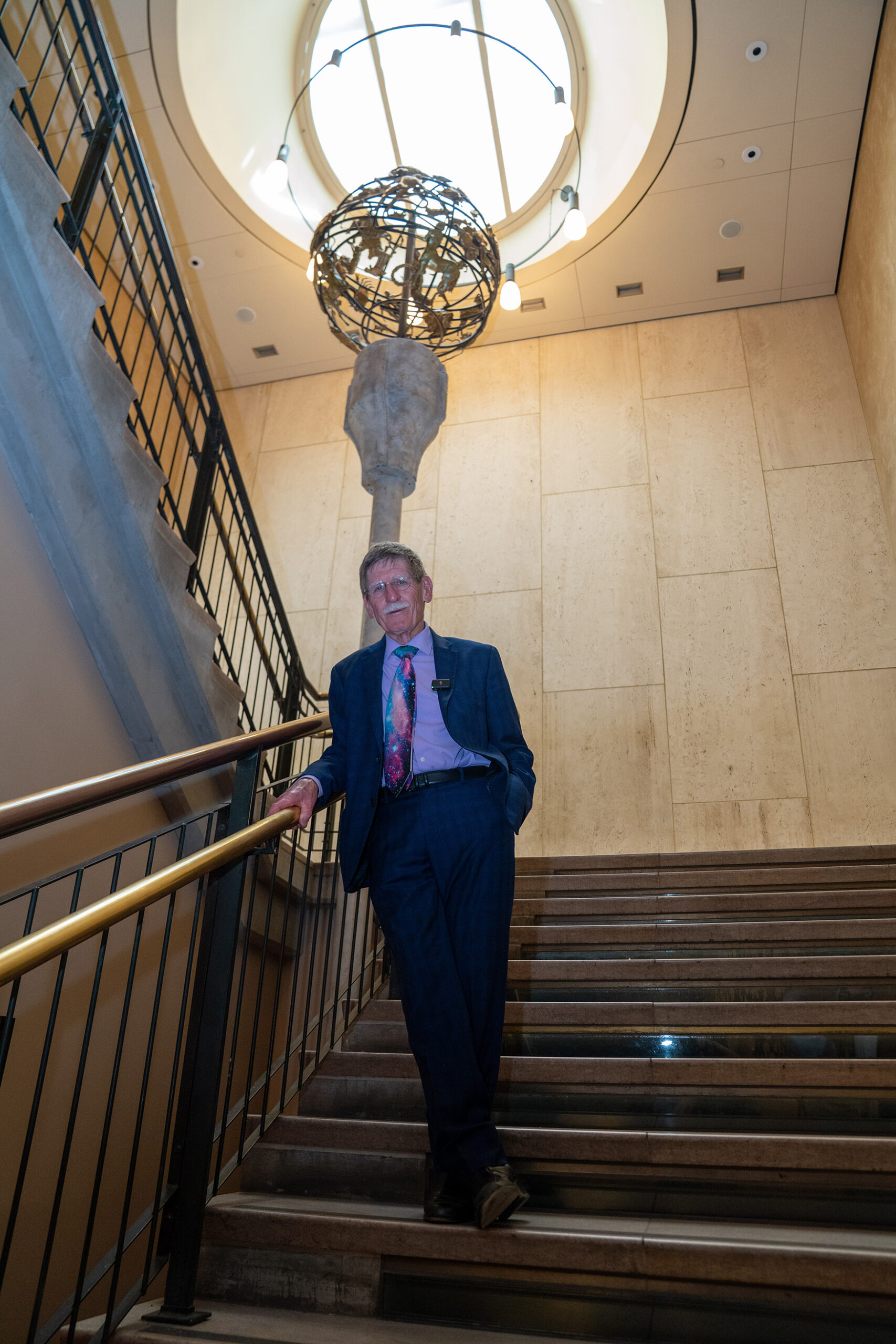
Dr. Ed Krupp: I was still the very scruffy graduate student. I wore corduroy pants and a beat-up jacket; my briefcase was a flip-top box; and I had Frye boots. I’d come to work like that. But it was fine because I was out-of-sight and working with the technical staff, primarily developing both concepts and executing new exhibits. The program had been started, but it stalled because the previous Curator had left. My office then was downstairs – not the downstairs that we have today, but the [craftsmen] shops were down there. When the shop guys were operating machinery, it was like bang, bang, bang … all this stuff was going on. I started getting depressed again and was thinking I really didn’t have much of an interest or care for this.
But it didn’t take long once again for conversion. I realized fairly soon, probably within a month, that I got to drive through a park every day. And that every day was different. There was an adventurous quality of working at Griffith Observatory, particularly down in the shop areas.
I was working with and for significant people. Leon Hall, the unsung hero of Griffith Observatory and Associate Director at that time, went back to 1935 and was the key person responsible for the original exhibit program. He knew the place upside down and backwards.
And another gentleman, again, not well known today, Marion Emmons, was in charge of the technical crew here. Both of these gentlemen took me under their wings and taught me how the City works. It was an extraordinary tutelage. At first, you don’t realize how valuable it is, but honestly, I wouldn’t have been able to understand what would be coming later and how to deal with it if it hadn’t been for the two of them.
So I worked as the Curator for a couple of years, from the fall of 1972 to the fall of 1974, and in the fall of ’74, things got a little strange around Griffith Observatory.
Taking Off
Alive!: What happened in 1974?
Dr. Ed Krupp: The Director who actually hired me as Curator, wound up leaving the Observatory and eventually leaving the city. I was appointed Acting Director in the middle of a personnel and programming crisis. There was uncertainty in the operation for a good two full years. I didn’t know where anything was going to go, but the place had to be stabilized. That was really the route by which I came to become the Director of Griffith Observatory. Really it was a very strange chain of accidents.
Alive!: That led to your being named the full Director in 1976, 50 years ago this year.
Dr. Ed Krupp: Yes, officially appointed permanent Director in January or February 1976. As far as Personnel was concerned, that was the date. But as far as I’m concerned, it was September, 1974, when the ceiling was falling down and suddenly I was trying to keep the place together with baling wire and chewing gum. We really don’t have to dwell on details, but there was an extraordinary disruption of the staff and its ability to operate together and to operate the Observatory. It was a chaotic period that somehow had to be pulled together. From my perspective, I was called downtown and I was told, “Okay, we’re going to have you go back and you’ll be the Director, but we’re not going to tell anybody.” So that was fun for a few months, but then it got a little bit more formalized, and gradually we came out of a tough time.
Alive!: You were doing a lot of “Acting.”
Dr. Ed Krupp: It was so funny. I’d already started doing expeditions related to ancient astronomy on my vacation time, including another trip back to Britain. My business card said Acting Observatory Director. I was on a train going from Gatwick Airport to London. A woman saw my business card on my luggage tags, saw the word “acting” and said, “Oh, I’m interested in the theater too.”
Alive!: Hilarious. And since that time, full Director.”
Dr. Ed Krupp: Yes.
Radio and Sports, But Always the Sky
Alive!: Growing up, you participated in radio and sports. Were those serious considerations for your future?
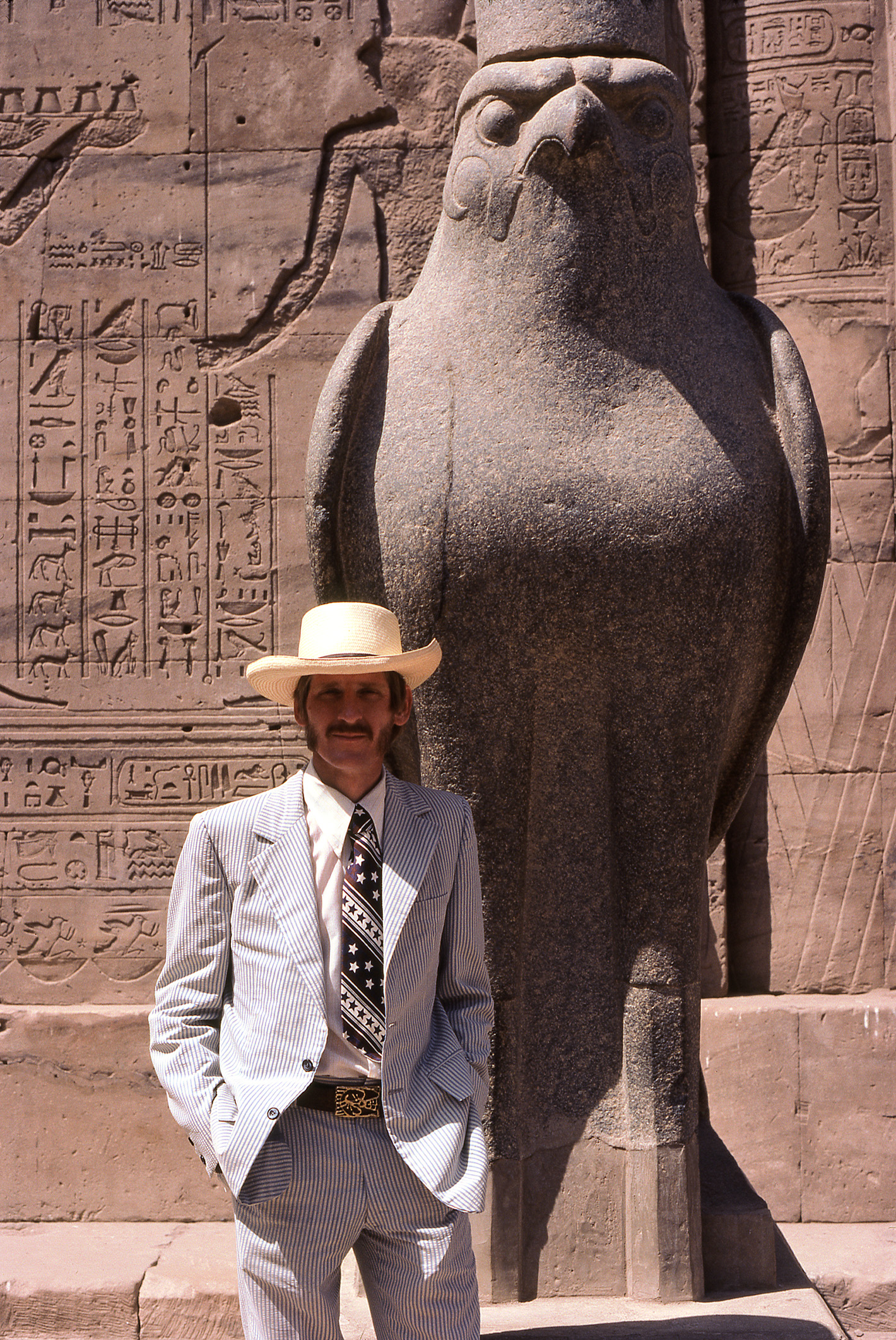
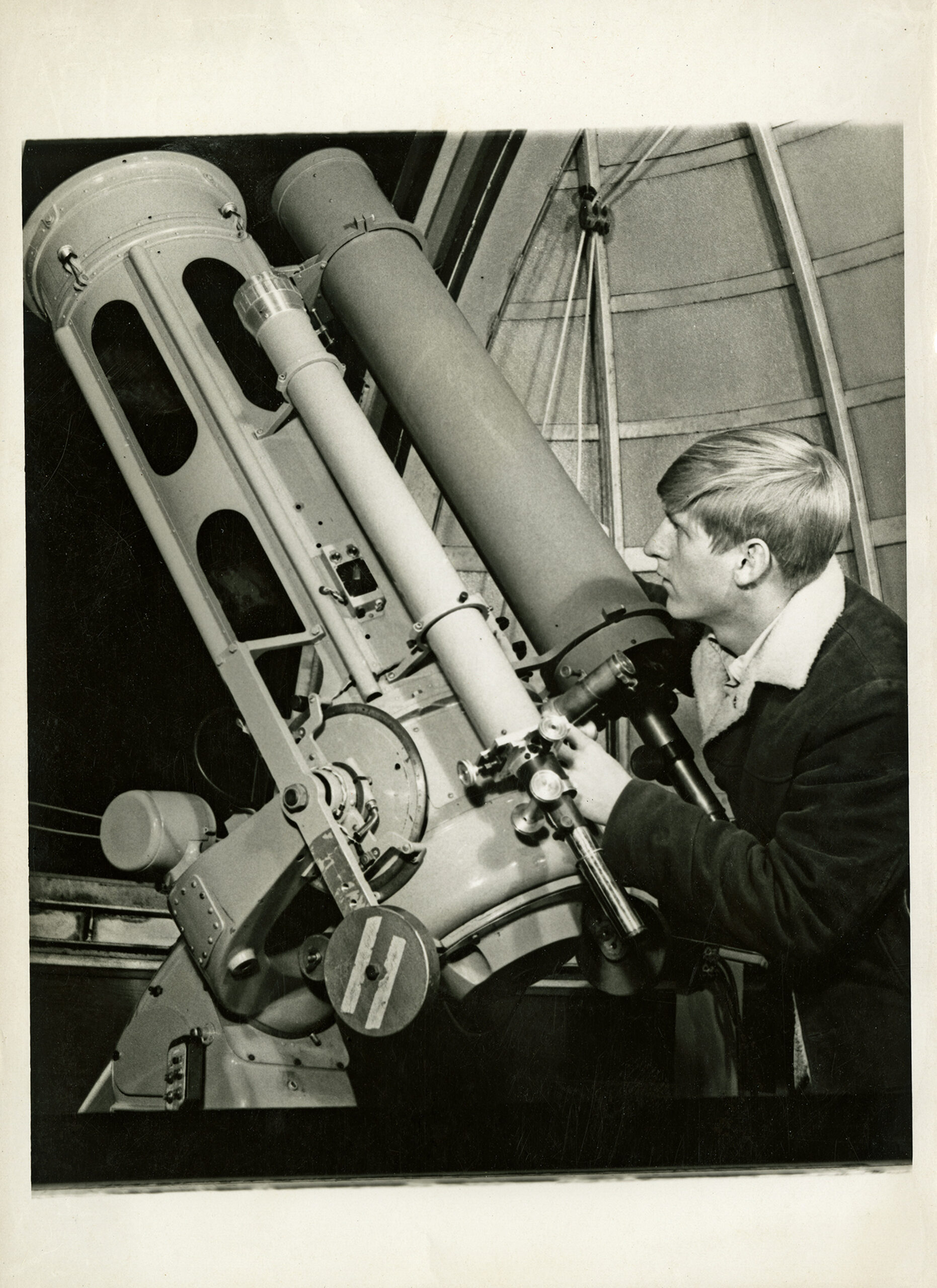
Dr. Ed Krupp: Not in any way professionally. I always intended to become an astronomer from the time I was eight years old. I had the good fortune as an undergraduate at Pomona College to try everything. I lived at its observatory for two years, quite a wonderful thing. All I’ve done since then is live at observatories! Anyway, Pomona also had a radio station, and my roommate was very astute with music. He was a physics major, but he really knew everything in music, and he had a good showmanship sense about it. He had the sense that we ought to do a radio show, so we did one. You learn about audiences and about making selections. You learn you can make bad choices that don’t make sense to anybody.
As for sports, I was not anything like a sterling athlete, but I had run in high school, and it was a natural thing to continue running in college – distance running, mostly. I was not good at any sports, but I really liked doing them. I had a college friend from Iran who said, “We have a soccer team, and you need to be on it.” I can’t say no to friends. I knew nothing about soccer and still don’t, but I got on the team and then ended up playing, for God’s sakes. But nothing serious ever developed from it.
Alive!: Your dad worked in aerospace. Was that an influence?
Dr. Ed Krupp: Of course, my father and mother were of considerable importance. But my father’s career in space exploration really began after I was eight years old. When I was 12 or 13, he moved the family from Chicago’s south side suburbs to Los Angeles. He was recruited by Lockheed and worked on missiles and a number of projects for them for a while and then moved on to North American Rockwell, to the Apollo project and then the subsequent ones. That really was his dream. Families were close back then, so it was really quite a thing to leave Chicago and come to LA. But he had an engineering background, and he always was very interested in science fiction and that kind of thing. “I don’t really want to go the moon,” he said. “But I want to push the button.” Essentially, he got to do that. He was right in the middle of it.
I had decided to become an astronomer a few years before that. When I was in grad school, I went to a meeting of the American Astronomical Society. One of the main speakers was talking to this assembled crowd of astronomers, about 3,000 people — just about all of the professional astronomers in the country. That speaker asked the crowd, “How many of you decided to become an astronomer at a very young age?” Honestly the whole room raised their hands. And then he said, “How many of you decided to become an astronomer because of a book or a visit to a planetarium or looking through a telescope?” And again all the hands went up. That is how you make astronomers. In my case, it was a book, and my parents. They saw the book coming from some door-to-door salesperson and bought it for me, figuring it would be meaningful to me. And it was. In fact that book was what made me decide at that age to become an astronomer.
Orbiting Around Teaching, Sharing
Alive!: You’ve always been a teacher, it seems. You generously contribute those skills to Alive! by submitting lessons from your travels. Why is teaching important to you?
Dr. Ed Krupp: I don’t know if teaching per se is important to me. Clearly, I wound up doing it, and I don’t think I think about it like that, but I think it comes down to some very personal and maybe self-indulgent sensibilities. I get taken by things that I think are interesting, extraordinary, and deserving of attention, and they command my interest. Somehow instinctively I have the sense that other people might like to get to know about this stuff. Maybe underneath, I want other people to be having as good a time as I am having with astronomy. I think that probably propels.
The other side of that that might be, again, just a different facet, but I was fortunate and I mean through elementary school and certainly junior high and high school, I encountered some extremely effective, entertaining and life-changing teachers. And then at that summer science program I mentioned, the two professors there, George Abell and Paul Routly at Pomona College, were also extraordinary individuals in communicating not only the facts, and I mean in some cases the intricate kill-you-off facts and techniques that you had to learn, but they did it with such enthusiasm and a playful sense that you just figure, oh, that’s how this is. This is just getting to do stuff with that sense of enjoyment, indulgence, play, whatever it is. And you sense they like to share that. And I think that just rubs off.
Alive!: Yeah, I think maybe showbiz, because you mentioned it earlier too in the interview, but I think it can go two ways. How does that showbiz manifest itself? Is it really just a projection of people wanting to be looked at or the attention to come back to the person doing the entertaining? Or is it just a natural function of sharing a passion? Some people share passions and there’s so much passion that comes out that it can sometimes be thought of as showbiz, but it’s not really about the person. It’s about the sharing of what you know and what you’re passionate about.
Dr. Ed Krupp: I don’t mean to be falsely modest in this regard, but I’m not particularly interested in attracting the personal attention of people, and I’m certainly not interested in cults of personality. Part of that may have to do with the development of experience with audiences. I needed to have a good time myself when I was actually teaching, like at El Camino or at USC. And I also needed to be sure that the class, in that case the audience, was mobilized, that they were not gonna fall asleep, that they were gonna like it, that they were gonna in fact be engaged. And so that prompts some of that sensibility. The other dimension of it, and this is a little odd I suppose, but an awful lot of the public speaking experience occurred in the planetarium. And the planetarium is a very singular place for presentation, narrative exposition. The room is dark and the attention is focused on the dome. And the dome, if done right, is extraordinary in terms of its visual impact and what it conveys. The information that you get is not just verbal, but it’s visual and then compounded by all of the theatrical effects that you combine with that, whether it’s music or the nature of the script or whatever.
Dr. Ed Krupp: But what that means is that the person who’s performing, and I strongly believe in live performance, as you know, we preserve that at the observatory because I think that forges an immediacy and an authenticity of the connection to the audience. But the audience’s attention is really focused then on the sound of that person, not on the person, but what’s being said. And it’s focused on what’s being seen, which isn’t the person, but is this environment that the audience is in. And I like that a lot. And it extended as well to the way in which I would continue to present just formal lectures. When I could in the old days of carousel projectors, I could actually manage to go out to wherever I was headed and work it out so I would have two carousel projectors set up with two screens, and I could run almost cinematically just an extraordinary number of images accompanying the material that I was presenting to people. And that meant again that their attention is focused on the images. And that’s what I wanted. I wanted them to be seeing these places or these things or these events that are happening that are extraordinary visually and very informative. And so it’s a very different thing from having an audience just looking at you while you’re doing something. Now, of course, you have to do that from time to time, but I really like the idea of audience attention on a different place.
Alive!: Is the connection to an audience, a direct connection to an audience, part and parcel of being a director? Was that always part of the job description, or is it more making sure that the funding and the finances and the people are the more management kinds of sides to it? Or was it considered both, or was it something that you couldn’t imagine not doing as a director?
Dr. Ed Krupp: Yeah. First, I had no idea until having to do it what it was about or what was required. And when you’re close to it then and you start seeing it, and I first started seeing it with Bill Kaufman, who was the director when I was the curator. And so that’s when I began seeing how somebody in that position actually operated, even though I knew at least one of the former directors personally and so had an inkling. In that sense, early exposure that’s meaningful tells you right away that you get the whole suitcase that you’ve got to carry. It is everything. It is public appearance, it is content, it is editing, and of course interaction with all of the governance on which the facility is able to operate, as well as the internal governance. It’s all part of one thing. I would have never imagined, certainly didn’t imagine as a graduate student, one, that such a kind of a job exists, and number two, I would ever be doing it. It was beyond my ken.
Cosmic Rebuild
Alive!: The Observatory closed in 2002 for major renovations and expansion, and reopened in 2006. You gave Alive! an exclusive tour, and that cemented Alive! in a lot of ways. Did you always know that you were going to rebuild Observatory in such a dramatic way?
Dr. Ed Krupp: Coming to that conclusion was definitely an evolving process, but it’s very easy to anchor. In the first years, both as Acting Director and then as Director, you’re just feeling your way through and trying to integrate yourself into what the place is doing as well to solve some of the wounds in place prior to that. I can’t begin to tell you in any way that I was being visionary. But by 1978, I had a sufficient understanding of how the City and Recreation and Parks works. And I also knew that the planetarium, as a primary feature of Griffith Observatory, like anything else, has a lifetime, and that we were very far into it. In particular, I knew that the Zeiss projector that put all the stars up on the dome, which had come in 1964, was the second projector. The projector was working fine, but I also knew it wouldn’t last forever. That prompted me to develop an outline of how in the world were we going to deal with it.
But that realization was leveraged by the knowledge that acquiring and then spending a large amount of money for something very expensive was very difficult. As Director, I was neither asked to worry about its future, nor have very many resources to marshal on behalf of that future. But I knew that we would need to make a very expensive purchase down the line, and I thought that it would be well to start planning for that. To me, it meant at the very least acquainting Recreation and Parks leadership that we were thinking about this. So in 1978 I developed a very modest proposal that imagined about 15 years in the future from then. I thought, “That’s great. I’ve got 15 years to solve this problem.”
Alive!: Not right away!
Dr. Ed Krupp: Yes. At that point it was just a renewal of the planetarium. And of course, what did happen was nothing. In 15 years. But I kept taking little steps — one step here, another there, and some of them were absolutely fortuitous on how that occurred.
It’s a very long and complex story. By that time I knew the grand old man of the worldwide planetarium community — Dr. Joe Chamberlain at Adler in Chicago. He was a friend. At one point, when I had the opportunity, I asked him, “Okay, you guys have done this. You fixed up Adler. How in the world do you do it?” He started telling me, and that turned into forming an independent private organization for development and advocacy beyond us. I had to invent that. The very notion of doing that came from Joe. But each of these things came about piecemeal –a little element comes here, a little one comes there. There was never an ability to press a button and make everything come together.
Alive!: But driving it all, piecemeal or otherwise, was wanting to leave it better than you found it.
Dr. Ed Krupp: No question. That’s our responsibility in everything we do, actually. You’re quite right that it would be dishonorable to leave the place less than it was. I wanted it to be the best in the world. That wasn’t in my mind at the beginning, but that emerged as a driving force. I can’t tell you that we succeeded there. I can only tell you that we damn well have tried. In some respects, we’ve got a case. We’ll let people complain and argue, but there really is no place on the planet like Griffith Observatory.
Alive!: It’s the best one I’ve ever been to.
Dr. Ed Krupp: Thank you. And increasing the profile of the Observatory to the world was an important part of that task. That has happened and largely because of the renovation.
I remember very clearly Alive!’s role in that. We still have a giant poster in the library here of the front page that you guys did. It’s framed. It meant a lot to us. Somehow raising the public visibility was actually the only tool that we had. The Observatory is highly visible. That visibility was leveraged on behalf of its ultimate development.
Of course, it doesn’t happen magically. You don’t turn a switch and suddenly you’re visible. It takes years, decades, in a way. I will just add here, though, that there’s another dimension to that high visibility that should not be forgotten — the three things that make Griffith Observatory what it is. One of them is very obvious: location, location, location. There’s three of them right there. There is no better real estate for this kind of enterprise than what we’ve got. It’s astonishing real estate. Number two, and this might seem a little strange given all of the things that we experience in City of Los Angeles, but the municipal ownership and governance of the place is extraordinarily important. It doesn’t always work in your favor.
In fact, at times it can be problematic. But the Observatory belongs to everybody. That sensibility goes into the attitude of the people who work here – that’s how they understand who they are and what they’re doing. They understand it as a public service, and they approach their job that way. This place wouldn’t survive without that mentality.
And then the third thing that makes this place what it is is Hollywood. It is no mistake that Griffith Observatory has both the profile and the character that it does — it is above and overlooking Hollywood. We have been entangled with Hollywood from the very beginning. The first film that was shot at Griffith Observatory was done before the place even opened in 1935. And then, of course, the record of films just continued through the years. It’s not just the filming. Rebel Without a Cause and La La Land were incredible in terms of changing the wide perception of the place. You can find documentation where we have affected Hollywood, and Hollywood very definitely has affected us. We are in the business here of narration, of telling a story that is meaningful to people — it prompts them to embrace the experience. We are at the point now, thanks to the development of technology, where we can tell amazing stories at the Observatory. You can’t say we can rival Avatar and all the CGI in cinema, but we get to a decent standard of professional production now. That’s essential for audiences to be able to take the place seriously.
Alive!: Telling true narratives about the physical reality of the stars, as you and the Observatory do every day, has got to be as old as looking at the stars themselves. The storytelling aspect of stargazing comes authentically.
Dr. Ed Krupp: I wouldn’t argue with you.
Deep Space And Deep Self
Alive!: I have a cosmically broad question for you now, Doctor.
Dr. Ed Krupp: I love that.
Alive!: Why is it important to study the stars? What do the stars tell us about ourselves?
Dr. Ed Krupp: First, that is an extremely reasonable question. And going back to some of the things that we’ve talked about already, it prompts me to remember teaching actual courses that I did or otherwise interacting with the public at the Observatory, or leading expeditions … it’s important to tell them why I care. It’s vital. If you haven’t instilled a sense of wanting to care about it, you’re not going to keep your audience and give them what Colonel Griffith wanted them to have, which was a transformation of perspective. The idea of “Why do you care?” is really important; you have to be able to tell somebody why it matters. In the case of astronomy, that’s an extraordinarily fair question.
Most of us are removed from the actual enterprise of astronomy in actual practice, although a portion of the population does have the ability and the sense of purpose and satisfaction actually to observe the sky. Most people don’t have that opportunity in the light-saturated cities, and we forget about it after all that. So what in the heck difference does astronomy make? I think there are two ways to go at this. One of them is straightforward: Astronomy prompts the very big questions. There’s no argument about that — you can’t take on the sky like this without asking these very big questions.
And when you ask those big questions, it promotes a quest for understanding. It invests value in accurate descriptions of nature. And when you get to an accurate portrayal of nature, that knowledge clearly enhances survival. That better understanding of nature winds up affecting your prospects for getting along. We’re in such a complex era now that we don’t necessarily even have an immediate sense of how these kinds of things work, but I assure you that the science and the technology which depend on accurate portrayals of nature in physics and astronomy are making everybody’s cell phones work today. We keep finding out more and taking advantage of it.
This is so silly now in retrospect, but I remember when we did the first planetarium show at the Observatory on the death of the dinosaurs – it finally became apparent what had happened to them. That asteroid impact at Chicxulub and Yucatán gradually emerged. Not only did we get hit, but we’re going to get hit again and again. The worst of it happened a few billion years ago, but there’s stuff out there with our name on it now, and it’s going to come. That knowledge has evolved slowly, but it’s evolved into our remarkable ability to survey whatever else is out there.
We don’t know it all, but we know a lot. And we’re just at the verge of being able to do something about it. It’s incredible that an organism on a planet like this has developed the skill and the knowledge through the embrace of the cosmos over generations and generations, to defend the planet when this comes along. This isn’t just pie in the sky stuff, it’s actually very real. And that’s not to speak of the practical things like calendars, navigation and time that came out of the sky in antiquity.
But the other thing that I think is always there is that astronomy develops perspective, and perspective is pretty important to us. I don’t always know how that perspective is going to alter a particular person, but it usually tempers their ways and perhaps the quickness of judgment and decision-making.
Here’s an example of how astronomy is affecting people. It has to do with the orbiting Hubble Space Telescope. When they finally got it working, it sent us pictures that looked wild and crazy in newspapers and online. You can go to websites that carry news, and the number of astronomy stories that appear is way out of proportion to the immediate significance of astronomy to people. It’s feeding a compulsion to stop for a moment and think about the grandeur and complexity of the universe. It prompts them to be mindful of where they really are in the cosmos, and that makes a difference in how they approach their everyday life.
In Part 2 in the May Alive!, Dr. Krupp talks about his passion, archeoastronomy; Griffith Observatory as LA’s Observatory, and the Alive! question: what he loves about what he does.
Read it all in next month’s issue!