
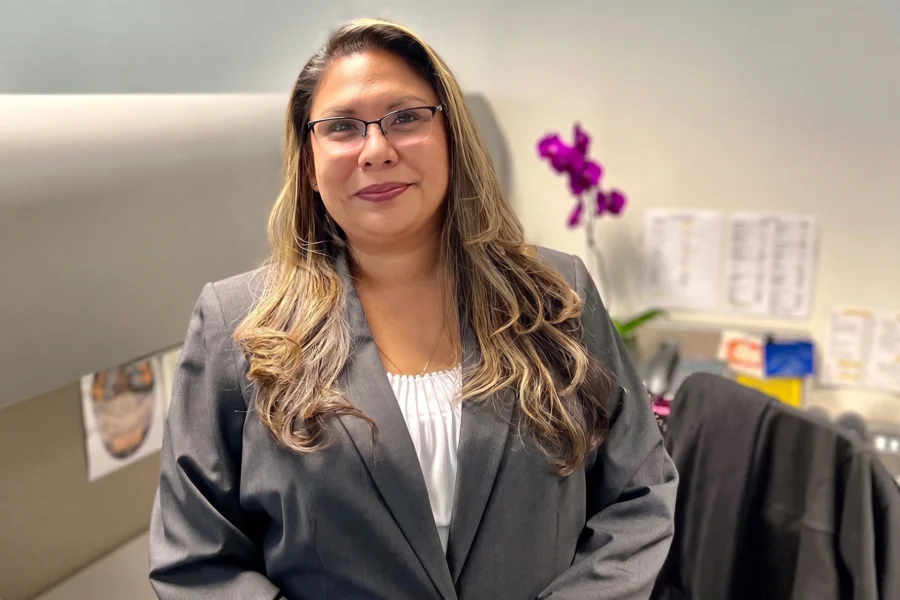
Pitch Perfect
Emily Zavala, Club Rep, wins research pitch contest while studying for a doctorate.
For Emily Zavala, longtime civilian employee of the LAPD and now an Administrative Analyst with the CAO’s Office, practice makes perfect.
She recently won the Big Pitch Competition, where graduate students present their current research findings in as compelling a manner as possible, at Claremont Graduate University in Claremont. The time she was given to deliver that pitch: three minutes.
“The idea is that we take whatever research project we’re working on and put that into a pitch,” Emily explained. “What I pitched contained, in a sense, the foundation of what my thesis will be built on. It was a description of a major thesis – delivered in three minutes.”
She had tried before. One year ago, in 2025, she participated in the contest for the first time, and came in sixth. Impressive, sure, but that wasn’t good enough for finalist, so she worked on her pitch and reentered. This time, bingo. The pitch win came with a $1,500 stipend.
“I was a finalist in 2025, but I didn’t place,” she continued.
Did she quit there? No way.
“I decided that I was going to come back. Because the focus of my education is the 911 Operators system, I decided to base it on another paper I was working on — more on understanding the mechanisms behind the system. That was the theme of this year’s pitch.
“I looked at the videos from the winners from previous years, and tweaked my presentation based on what I was observing. The big thing about this competition is that anti so that anybody, no matter whether you’re an academic or not, that you’re able to digest it and understand it. They want you to bridge the gap between academia and practitioner.
“I also noticed that emotions were a big part of being able to connect with the audience,” she continued. “That’s what I changed. I brought in more of my personal experience as a 911 Operator and tie in my academic research with how people could relate to it. So that it would resonate with everyone. This is something that I love and am passionate about. Even though I’m not a 911 Operator anymore, it’s still something that I’m constantly trying to add to the field.”
From 911 Operator to Researcher
Emily started her City career in 2006 as an LAPD Police Service Representative – a PSR. After 16 years in that role, she then transferred to her current position in the CAO’s Office.
She uses her PSR experience in her doctoral research, which studies how 911 Operators make the decisions they make, sometimes in split seconds.
“I hope that people will understand that the decision a 911 Operator makes an impact in a sense. We’re constantly looking at how [LAPD] Officers engage with the public, but we don’t understand that it all starts with that 911 call and how the Operator then makes the decisions that they will send the Officer,” she continued. “I’m researching that now, and eventually I hope to use that as a foundation to build into my dissertation. I’m hoping in the end, that I could present it to dispatch centers, and it will turn into a [process] intervention and be included in future training programs.”
Lay it on us: What have you learned so far?
“In general, law enforcement is constantly training. And that includes experience learned on the job — the longer you do the job, the more experience you have with calls and decision-making. But there’s another factor where sometimes the agencies overlook the traumatic stress — the trauma of the job. When Operators are constantly exposed to these very heightened emotional situations, it can weigh down on a person. That also impacts the decision-making.”
Learning From the Experience
What did the pitch experience teach you?
“The biggest thing is how to transform academic information into a practitioner’s language,” she said. “With most of my academic papers, I give them to my mom, my dad, my brother, my sister… and to them it’s mumbo jumbo. It doesn’t make sense. It doesn’t resonate with them. The pitch process taught me to transform that information into something that anybody can understand and apply to their lives. My first couple of presentations, I could see the people’s eyes glossing over. I’ve refined that translation skill now. It takes time to learn.”
Thanking the Operators
“I want to thank the people who do the job, the PSRs,” she said. “Without that experience at the LAPD, and without the Operators, I wouldn’t have this passion for this research that I’m doing. My work really pays homage to the people who sit and take these calls, the people who are often heard but never seen. That’s usually the motto that comes with 911. They serve a critical function that is often overlooked. I want to thank LAPD Communications Division for a lot of the individual support there. I had a couple of PSRs help me in the early stages of my master’s thesis. I’m sure I’ll be calling on them for the dissertation.”
Going Back to School
Do you recommend City employees going back to school?
“If it’s something that they always felt that they missed out on, if it’s something that’s desirable, I definitely recommend it,” she says. “I did it at a slow pace. I took one to two classes a semester because that’s all I could handle. It will be eight or nine years since I started when I hope to complete my bachelor’s, master’s and the PhD. degrees. I chipped away at it.”
And not quitting. That took her from sixth place one year ago, to winner this year.
“It’s something that I love and am passionate about,” she concluded. “I had to keep going.”